















Why AI strategies fail when leaders delegate them, according to Pathfindr CEO
In this ADAPT Insider episode, Dawid Naude argues AI value emerges through direct use, experimentation, and leadership engagement.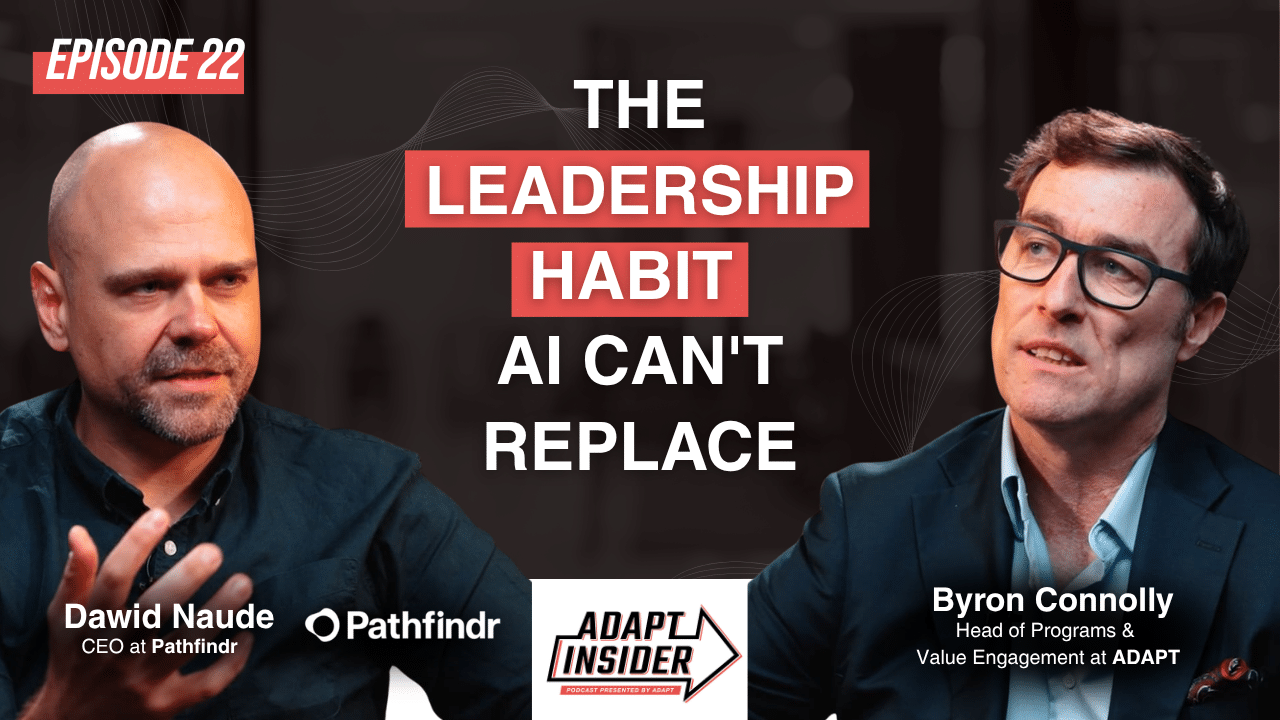


 Published Sep 1, 2026 in
Podcast
Data & AI Strategy
Contributors
Dawid Naude
Byron Connolly
Published Sep 1, 2026 in
Podcast
Data & AI Strategy
Contributors
Dawid Naude
Byron Connolly
AI strategies often stall because the people expected to lead them are too far from the technology itself.
When AI gets handed off to a project team or parked inside the technology function, business leaders stay disconnected from where it actually creates value.
In this ADAPT Insider conversation, Dawid Naude, CEO at Pathfindr, talks about how AI behaves less like a fixed enterprise system and more like a capability leaders have to use, test, and learn from directly.
Listen to the full episode on Apple Podcasts, Spotify, and YouTube.
Key takeaways:
- Leaders need direct experience with AI if they expect it to create value across the business.
- The most useful AI applications often emerge through hands-on experimentation rather than narrow upfront use cases.
- Cost, data, and oversight still matter, but they need to be managed in ways that support adoption rather than delay it.
Leaders have to make AI their own
Dawid’s point is that AI cannot be treated like another transformation program that gets delegated and reviewed at a distance.
Even a well-written strategy can fail if the leaders expected to act on it do not feel that it belongs to them.
That is what changed in Pathfindr’s own work.
Earlier strategy engagements often produced strong recommendations but weak follow-through.
The shift came when AI stopped being the strategy itself and became an input into each leader’s own strategy.
Once leaders started using the tools directly, they could see where AI helped them think, test ideas, and solve problems in ways that felt practical rather than abstract.
AI value shows up through use
Dawid also pushes back on the way many organisations still frame AI through narrow use cases.
His view is that AI behaves more like a general capability, where the highest value often only becomes clear once people start using it seriously.
That is why he compares it to tools like Excel or the internet.
The value did not come from defining every use in advance but from putting the capability in people’s hands and seeing where it unlocked better ways of working.
In AI, that means leaders using it to prototype ideas, pressure test assumptions, and work through more complex problems than a standard business case would surface.
Cost, data, and oversight need better judgement
He is equally clear that none of this removes the need for judgement. Token costs can rise quickly, so organisations have to link usage back to value.
Data still matters, but it should improve alongside adoption rather than hold it up.
And human oversight does not disappear, it changes shape as people and AI work back and forth across a task rather than through one static checkpoint.
The challenge is to sequence all of this properly.
Organisations need enough freedom to learn where AI is useful, enough discipline to stop waste, and enough human judgement to know where oversight still matters most.
 Dawid Naude
Founder & CEO at Pathfindr
Dawid Naude
Founder & CEO at Pathfindr
Dawid Naude is a trailblazer in business, disruption, and innovation, shaping the future by translating AI’s potential into real world impact. Committed to making AI exciting, accessible, and impossible to ignore, he helps organisations to make every employee more productive, reimagine what’s possible, and achieve breakthrough innovation.
With a dynamic CV spanning consulting and leadership roles across digital, technology and innovation, Dawid is the proud Founder & CEO of Pathfindr. Named one of AFR BOSS’ Most Innovative Companies in its founding year, Pathfindr’s is now the fastest growing AI Accelerator in Australia.
An advisor to Government and industry bodies across APAC, Dawid is one of the region’s foremost AI innovators, educators, and implementers. With an infectious energy and a gift for making the complex feel simple, his keynotes have built a reputation for exciting audiences into action.
Less Byron Connolly
Head of Programs & Value Engagement at ADAPT
Byron Connolly
Head of Programs & Value Engagement at ADAPT
Byron is a highly experienced technology and business journalist, editor, corporate writer, and event producer.
Prior to joining ADAPT, he was the editor-in-chief at CIO Australia and associate editor at CSO Australia. He also created and led the well-known CIO50 awards program in Australia and The CIO Show podcast.
Byron creates valuable insights for our community of senior technology and business professionals that help them reach their organisational and professional goals. He has a passion for uncovering stories about the careers and personal philosophies of Australia’s top technology and digital executives.
When he is not working, Byron enjoys hot yoga, swimming, running and spending time with his family. He completed the North Face 100km ultra marathon in the NSW Blue Mountains in 2012 and 2013.
Less Join the ADAPT
 Insider Community
Get the latest A/NZ market research and insights on the core trends impacting leaders.
Join the ADAPT Insider Community
Get the latest A/NZ market research and insights on the core trends impacting leaders.