








Safe experimentation belongs at the centre of technology leadership
In this ADAPT Insider episode, Tracey Evans shares how safe experimentation, business ownership and legacy modernisation improve delivery.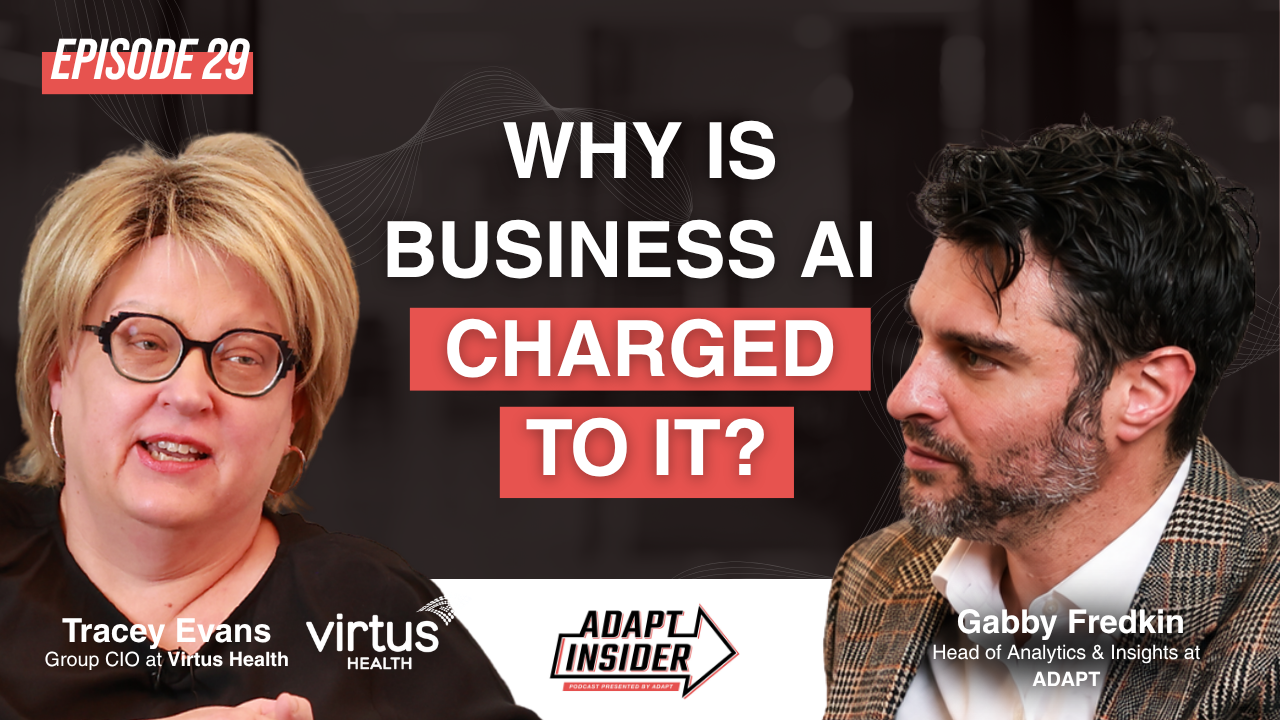


 Published Oct 27, 2026 in
Podcast
Data & AI Strategy
Contributors
Tracey Evans
Gabby Fredkin
Control through prohibition cannot keep pace when employees can access AI tools and build solutions themselves.
In this ADAPT Insider episode, Tracey Evans, Group CIO at Virtus Health, examines how technology teams can create safe environments for experimentation while maintaining clear security, regulatory and compliance guardrails.
She also discusses how business ownership strengthens delivery and how new interfaces can improve the experience of legacy systems.
Listen to the full episode on Apple Podcasts, Spotify or YouTube.
Key takeaways:
- Safe environments give employees room to test AI while maintaining clear controls around security, data and compliance.
- Business sponsors should remain involved from problem definition through to production, supported by technology teams.
- Securing legacy systems and building modern interfaces over them can improve access to information without wholesale replacement.
Guardrails give experimentation a safe path
The democratisation of AI allows employees to test tools and create solutions without waiting for a technology team to direct every decision.
Tracey’s approach at Virtus Health gives clinicians and business teams controlled environments for learning and experimentation.
Security, regulatory and compliance guardrails establish clear boundaries around what teams can test.
Technology teams work alongside users to understand the problem before introducing a solution.
This positions technology leaders as educators and guardians who help employees apply new tools responsibly.
Safe pathways allow useful ideas to develop while reducing the risk that unmanaged experimentation reaches sensitive data or production systems.
Business ownership strengthens delivery
Technology delivers stronger outcomes when the people closest to the problem help shape the response.
At Virtus Health, each business problem requires a business sponsor and a team that works alongside technology throughout delivery.
This shifts technology away from a back-office order-taking role and connects it directly to frontline priorities.
A digital consent program across 46 clinics demonstrates the model.
Clinical leaders helped define, standardise and refine the process, while the technology team supplied the capability and guardrails required to digitise it.
Virtus Health digitalised 26 consent processes within 12 months.
Clinical stakeholders also became champions for the change because they had shaped the program from problem identification through to production.
Legacy systems can support a modern experience
Legacy ERP, electronic medical record and laboratory systems remain central to operations at Virtus Health.
Replacing every underlying platform would introduce significant cost and operational risk.
Tracey focuses on securing existing databases and building new interfaces over them.
AI-enabled capabilities can then give clinicians and operational teams more useful ways to access the information those systems contain.
This approach modernises the user experience while preserving stable systems of record.
It also gives technology leaders a growing role in educating users about security, data governance, APIs and the limitations of AI-generated solutions.
Clear technical guidance helps teams turn early experimentation into solutions that are safe, scalable and ready for production.
 Tracey Evans
Group CIO at Virtus Health
A future forward CIO leading significant transformation whilst balancing the operational challenges of complex technology platforms operating across matrix organisations. A catalyst who understands how to manage complexity and improve business agility by employing disruptive and enabling technologies where needed most.
With a proven track record of driving a ‘culture first’ approach enabling and empowering teams using right sized technology frameworks to deliver innovative solutions, address unmet business needs, and develop strategies that drive revenue growth and expand market share. Skilled in navigating diverse technology services and platforms including AWS, Salesforce, SAP, Workday, Splunk, and Microsoft.
A positive and highly tenacious CIO who takes accountability for the work that needs to get done. A long history of engaging and collaborating with Boards, Executive teams, and stakeholder groups, to define and deliver from strategy through to outcome and tangible benefits. Always brings an ‘outside in’ perspective developed from broad industry expertise including digital services, professional services, not-for-profit, and financial services, with proven ability to adapt and evolve across changing industry segments.
Less Gabby Fredkin
Head of Analytics & Insights at ADAPT
As the Head of Analytics and Insights at ADAPT, Gabby Fredkin’s primary role is managing analysis to produce ADAPT’s actionable insights to identify trends supporting organisations in Australia.
With a passion for creating stories with data, Gabby is consistently rated as one of the top speakers at ADAPT’s events. In roundtable discussions, he specialises in using statistics to initiate thought-provoking discussions, enabling ADAPT’s customers to become more data-driven.
Using modern data science techniques, he provides ADAPT and its customers with confidence in the accuracy and validity of the information used for ADAPT’s research, advisory and events.
Working across artificial intelligence, machine learning, AI ethics, DevSecOps, end-user behaviour, and human-centred design, Gabby’s vast experience continues to grow, supported in part by a Master of Business Analytics from Deakin University.
Less Join the ADAPT
Insider Community
Get the latest A/NZ market research and insights on the core trends impacting leaders.
Join the ADAPT Insider Community
Get the latest A/NZ market research and insights on the core trends impacting leaders.