















Why retail teams need sharper trade offs between speed, cost, and quality
In this ADAPT Insider episode, Sakshee Kohli, Head of Technology - Store Customer Experience, explores how retail teams balance urgency, quality, and cost while building technology that can scale beyond a single use case.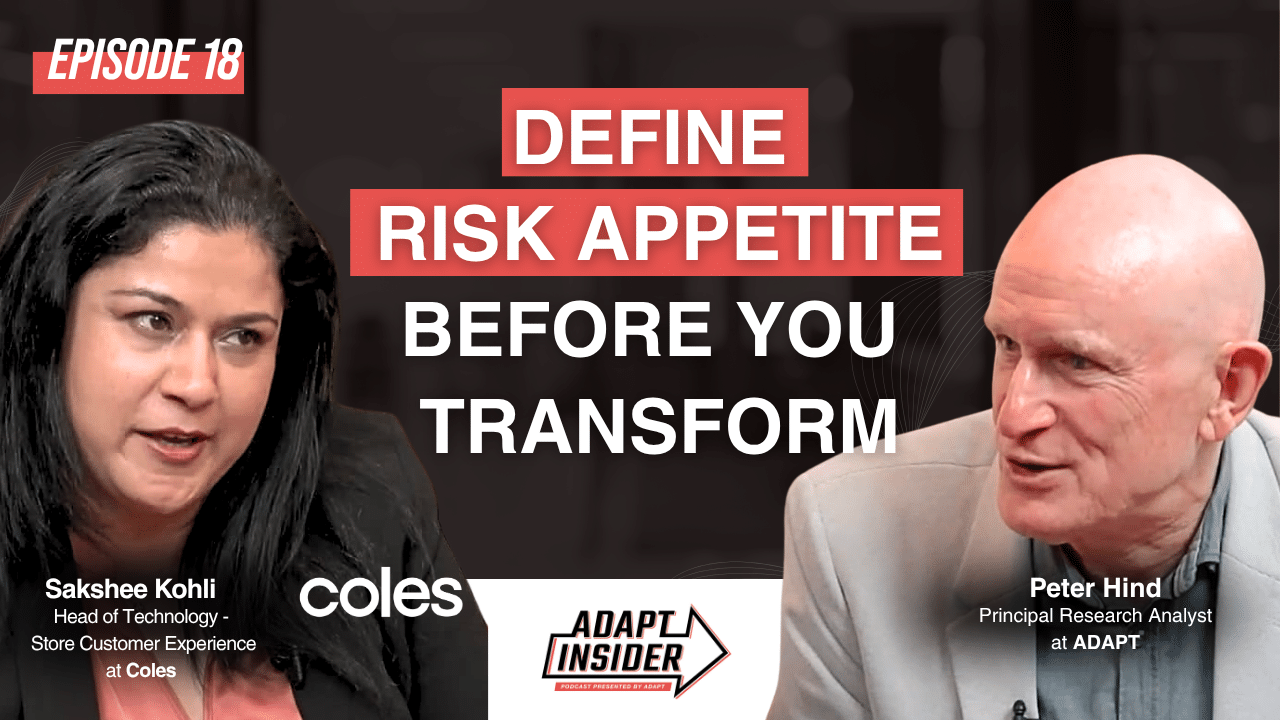


 Published Aug 11, 2026 in
Podcast
Digital Transformation
Contributors
Sakshee Kohli
Peter Hind
Published Aug 11, 2026 in
Podcast
Digital Transformation
Contributors
Sakshee Kohli
Peter Hind
In retail, speed only becomes useful when it helps move a business metric without creating a bigger operational problem somewhere else.
Coles’ Sakshee Kohli, Head of Technology – Store Customer Experience, says technology earns its place when it helps move a real business number, gets into customers’ hands quickly without degrading experience, and stays useful beyond the first release.
That makes the challenge less about chasing the newest tool and more about building systems that keep creating value over time.
Listen to the full interview on Apple Podcasts, Spotify, and YouTube.
Key takeaways:
- Technology becomes more useful when teams start with the business metric that needs to move, whether that is loss, freshness, affordability, or personalisation.
- Speed only matters when quality, cost, and customer experience stay under control. That requires clearer trade offs around risk appetite, perfection, and release discipline.
- The strongest retail platforms are built to solve more than one problem. Reusable, extensible technology creates more long term value than one off fixes that become expensive to maintain.
Business alignment is what makes retail technology useful
Retail technology decisions improve when they start with the commercial problem, rather than the architecture or the tool.
That changes the conversation straight away because it forces teams to focus on the number or outcome they are trying to shift.
That is the lens Sakshee applies to business engagement.
She explains that retail teams are trying to reduce skip scans, improve freshness, protect affordability, or create more relevant customer experiences.
In that context, AI, computer vision, and other technologies matter only insofar as they help solve that problem.
The value comes from aligning around the shared business goal first, then deciding how technology, process, and workforce change each contribute to the outcome.
Speed creates value only when quality and cost stay in balance
Moving fast is easy to talk about and much harder to do well at scale.
In retail, there is a difference between deploying quickly inside engineering and releasing quickly into the hands of customers without damaging their experience.
Sakshee makes that distinction clearly.
She tracks both deployment speed and release speed, but ties them back to confidence, quality, and cost.
That is why simpler architectures and stronger quality engineering matter in her model. They help teams move faster without creating downstream friction.
She is also clear that perfection can become a distraction.
Safety, security, and compliance are non negotiable, but beyond that, teams need a sharper view of what truly has to be perfect on day one and what can be managed through process as the product matures.
In practice, that is where risk appetite becomes a useful operating discipline rather than an abstract leadership phrase.
Future ready retail technology has to outlive the first use case
Large retailers do not get much value from solving one problem once.
The bigger payoff comes from building technology that can evolve, scale, and unlock value repeatedly across the business.
That is why Sakshee talks about creating for the future.
She argues that solving only for today can create a longer term cost if the platform lacks scalability or extensibility.
That mindset matters even more in a complex retail environment with diverse systems, store infrastructure, and many teams contributing to change at once.
Her example of skip scan technology shows the point well.
The business problem was loss, but the challenge was to get the capability live at scale across 550 stores, at speed, in a way that could keep supporting future value.
Looking ahead, she expects AI to play a larger role in targeted use cases such as loss analysis and consumer behaviour, while lifecycle management and technology sustainability remain critical operational pressures.
The underlying lesson is that future readiness comes from building technology that keeps paying back, rather than technology that solves one problem and leaves the business with another.
 Sakshee Kohli
Head of Technology - Store Customer Experience at Coles
Sakshee Kohli
Head of Technology - Store Customer Experience at Coles
I am an experienced and accomplished transformation executive with a deep passion for delivering “Business Value” and providing thought leadership.
My global 20+ years of experience in managing IT and business transformation-focused portfolios enables me to drive sustainable improvements across the technology services delivery process. By leveraging my skills in delivering positive business outcomes across banking, insurance, healthcare, and logistics domains, I successfully facilitate value-driven solutions to customers through measurable operational uplift and a keen ability to recover challenging at-risk programs and projects. I focus on uplifting the quality of business outcomes, the reliability of delivery commitments, and the implementation of standard practices for delivery governance and controls.
I invest time and effort into mentoring, developing, and inspiring a high-performing team, in addition to ensuring the success of my teams through effective management of financials, vendors, and resources.
Less Peter Hind
Principal Research Analyst at ADAPT
Peter Hind
Principal Research Analyst at ADAPT
Peter Hind has spent the last 25 years as an analyst and commentator on the ICT industry.
His primary areas of interest are the potential of technology to transform the way organisations operate, the change management obstacles executives encounter in realising this potential, as well as the tactics and techniques leaders have deployed to overcome these difficulties.
Peter now takes on multiple roles within ADAPT including the moderation of private events and roundtables, interviewing business executives about the strategies they are pursuing and assisting with the structuring of delegate surveys.
He also interrogates and analyses ADAPT’s treasure trove of end-user and C-suite data.
Less Join the ADAPT
 Insider Community
Get the latest A/NZ market research and insights on the core trends impacting leaders.
Join the ADAPT Insider Community
Get the latest A/NZ market research and insights on the core trends impacting leaders.