














Business process owners should carry AI ownership, says the University of Sydney’s CDAO
In this ADAPT Insider episode, David Scott, Chief Data and Analytics Officer at the University of Sydney, explains how complex organisations scale AI through aligned strategy, practical assurance, and business ownership that sits close to the impact.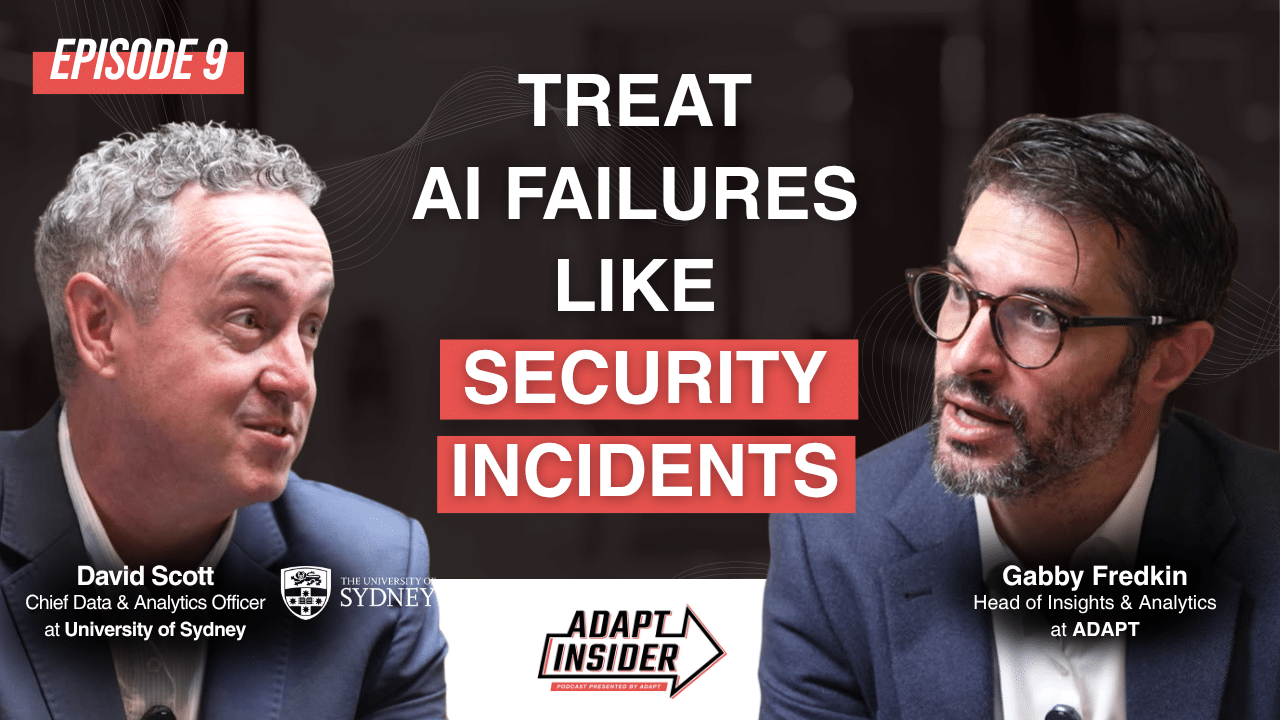


 Published Jun 2, 2026 in
Peer Insights
Data & AI Strategy
Contributors
David Scott
Gabby Fredkin
Published Jun 2, 2026 in
Peer Insights
Data & AI Strategy
Contributors
David Scott
Gabby Fredkin
Enterprise AI programmes stall when they are treated as technical capability rather than organisational responsibility.
AI adoption is a governance and ownership challenge.
In conversation with ADAPT’s Head of Analytics & Insights, Gabby Fredkin, David Scott argues that lasting impact comes from aligning AI to strategic outcomes, business accountability and existing performance measures.
Listen to the full episode on Apple Podcasts, Spotify, and YouTube.
Key takeaways:
- AI strategy scales more effectively when domain priorities are aligned to a shared institutional direction instead of forced into a single blueprint.
- AI assurance builds momentum when it gives people confidence that use cases are being developed and deployed responsibly.
- Ownership needs to sit with business process owners, with value measured through the metrics the organisation already trusts.
Strategy works best when it follows the institution’s priorities
Large organisations rarely run on a single operating reality.
Different parts of the business have different objectives, stakeholders, and constraints, which means AI strategy has to hold together without flattening those differences.
That is how David describes the University of Sydney’s approach.
The university’s work is anchored to its broader Sydney in 2032 strategy, while data, analytics, and AI initiatives are directed towards specific institutional priorities such as student experience, research, and operational effectiveness.
He is clear that this does not produce one standalone AI strategy.
It produces a set of aligned strategies tied to the areas where the institution most needs improvement.
Assurance gives people the confidence to use AI well
AI governance only becomes useful when it helps people believe the technology is being applied in ways that are responsible, credible, and fit for the setting they are working in.
David points to the university’s investment in AI readiness and its AI assurance framework as an example of that.
The framework draws on learnings from other organisations, then adapts them to the university’s own complexity.
He also highlights Cogniti, a classroom tool that lets academic staff shape how agents engage with course content, as an example of where controls are designed into the use case itself.
That matters because the scrutiny around AI governance is rising quickly, and confidence depends on visible assurance rather than generic policy statements.
Ownership and value both need to stay close to the work
Enterprise AI becomes harder to sustain when ownership is separated from the process it is meant to improve.
Local context shapes how agents are configured, how people use them, and whether outcomes hold up across different parts of the organisation.
David is direct on that point.
He says ownership should sit with the business process owner because they understand the local context and carry responsibility for the result.
Data and technology teams still matter, but their role is to enable, support, and help industrialise what works.
He also grounds value in the university’s existing metrics.
The two he points to most clearly are student satisfaction and student success, including early intervention that has helped reduce student fail rates.
That makes AI easier to evaluate because it is being measured through outcomes the organisation already recognises.
AI strategy stays aligned to institutional priorities, assurance is built to create confidence, and ownership sits with the people closest to the outcome.
In a complex organisation, that is what makes AI more likely to hold once it moves beyond early use cases.
 David Scott
Chief Data and Analytics Officer at University of Sydney
David Scott
Chief Data and Analytics Officer at University of Sydney
 Gabby Fredkin
Head of Analytics & Insights at ADAPT
Gabby Fredkin
Head of Analytics & Insights at ADAPT
As the Head of Analytics and Insights at ADAPT, Gabby Fredkin’s primary role is managing analysis to produce ADAPT’s actionable insights to identify trends supporting organisations in Australia.
With a passion for creating stories with data, Gabby is consistently rated as one of the top speakers at ADAPT’s events. In roundtable discussions, he specialises in using statistics to initiate thought-provoking discussions, enabling ADAPT’s customers to become more data-driven.
Using modern data science techniques, he provides ADAPT and its customers with confidence in the accuracy and validity of the information used for ADAPT’s research, advisory and events.
Working across artificial intelligence, machine learning, AI ethics, DevSecOps, end-user behaviour, and human-centred design, Gabby’s vast experience continues to grow, supported in part by a Master of Business Analytics from Deakin University.
Less
Join the ADAPT
Insider Community
Get the latest A/NZ market research and insights on the core trends impacting leaders.
Join the ADAPT
Insider Community
Get the latest A/NZ market research and insights on the core trends impacting leaders.