











What rising compute demand means for AI investment in Australia
UNSW Chief Societal Economist Richard Holden discusses compute costs, productivity and Australia’s AI infrastructure opportunities at CFO Edge.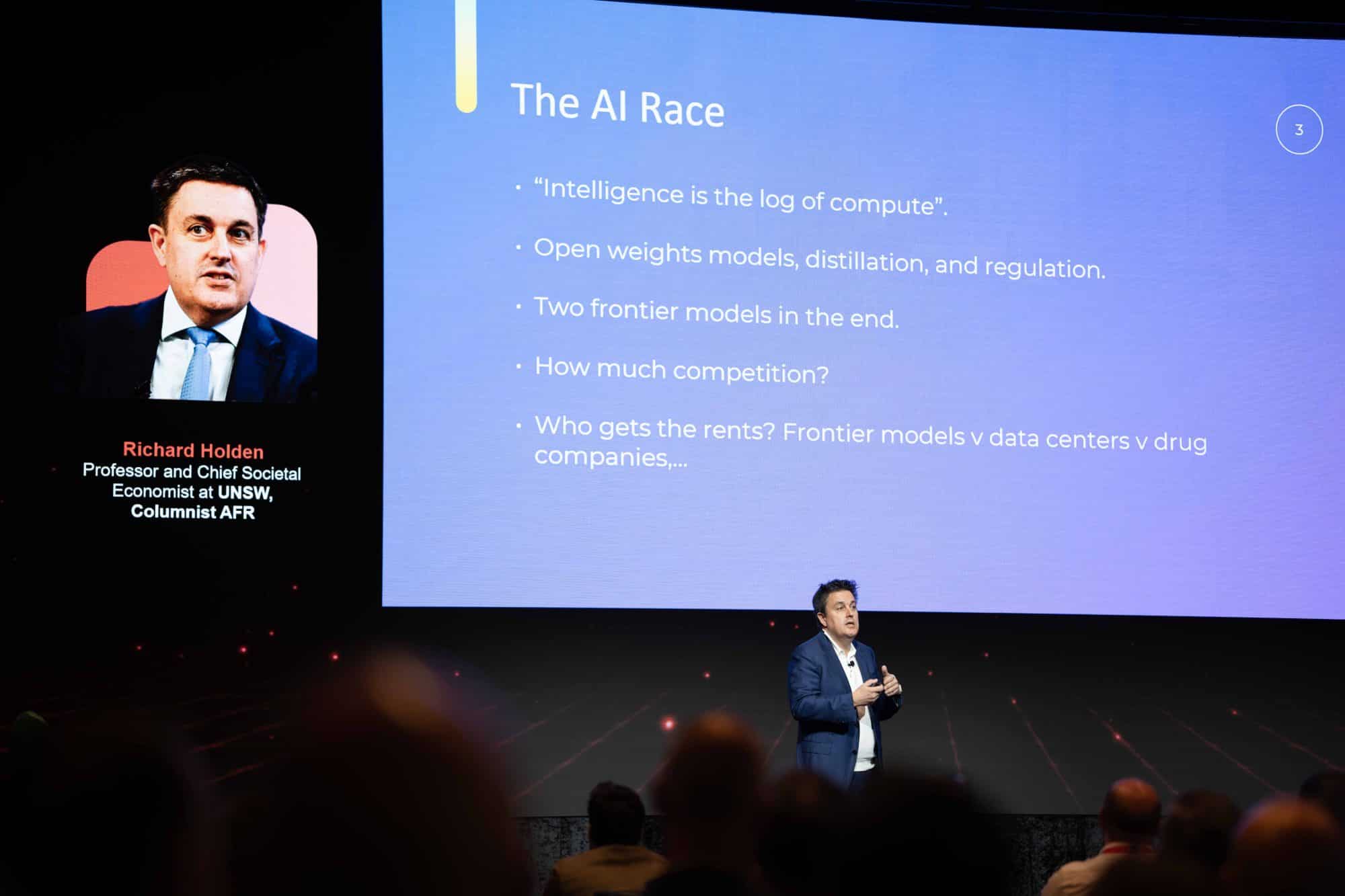


 Published Nov 26, 2026 in
Expert Presentations
Finance
Contributors
Richard Holden
Further gains in model capability can require substantially more computing power, putting pressure on costs and raising questions about who controls supply.
Richard Holden, Professor and Chief Societal Economist at UNSW and AFR Columnist, discussed the economics behind AI at CFO Edge, including how organisations can realise productivity gains and where Australia could compete in the global market.
He is also the co-author of The Lost Decade, which explores Australia’s missed economic and policy opportunities over the past ten years and proposes reforms across housing, energy, taxation and regulation.
Key takeaways:
- Factor compute costs, availability and provider concentration into AI investment plans.
- Redesign roles and processes to realise productivity gains from new technology.
- Assess where sensitive data goes, who controls the infrastructure and what risks third-party models introduce.
Model selection carries cost and security trade-offs
As AI models improve, each additional gain in capability can require substantially more computing power.
Growing demand for compute puts pressure on costs and raises questions about which providers will control supply and capture value.
Richard cautions against assuming open-weight models will always offer a safe, low-cost alternative to frontier models.
As open-weight models approach frontier capability, their safeguards may be easier to remove.
Organisations should assess model and provider choices against cost, security and the level of control they can retain.
Productivity gains come from changing how work is organised
Richard compares AI adoption with the spread of electricity.
Replacing an existing technology can produce limited gains, while larger productivity improvements emerge when organisations redesign how work is organised around the new capability.
These changes take time because restructuring processes, roles and systems is complex.
The distinction between tasks and jobs is also important when assessing workforce impact.
Roles comprising varied tasks may benefit from AI handling some activities, giving employees more time for work involving judgement and human interaction.
Roles built around a single, clearly defined task may face greater exposure to automation.
Australia’s opportunity in AI infrastructure and skills
Richard considers it unlikely that Australia will build its own frontier AI model, but sees opportunities to host training and inference for global providers and invest in local compute for research and specialised models.
Pursuing those opportunities involves attracting talent, securing community support for data centres and balancing copyright concerns with the development of local AI capability.
For Australian organisations, compute availability, sensitive data and supplier dependence are important investment considerations.
Richard also raises an unresolved question about whether submitting client material to a third-party model could affect legal professional privilege.
Clear policies on sensitive information and careful provider selection should form part of the investment decision.
 Richard Holden
Professor and Chief Societal Economist at UNSW
Richard Holden is Vice-Chancellor’s Professor and Chief Societal Economist at UNSW Sydney, Director of the Manos Institute for Cognitive Economics, and President Emeritus of the Academy of the Social Sciences in Australia. He previously held faculty roles at the University of Chicago and MIT, and has been a visiting professor at MIT, Harvard, the University of Chicago Law School and Columbia Law School. He holds an AM and PhD in economics from Harvard, is editor of the Journal of Law and Economics, and is a Fellow of the Econometric Society. He writes a weekly column for the Australian Financial Review.
Less
 Join the ADAPT
Insider Community
Get the latest A/NZ market research and insights on the core trends impacting leaders.
Join the ADAPT Insider Community
Get the latest A/NZ market research and insights on the core trends impacting leaders.