















CFOs shape digital transformation through value, accountability, and adoption
In this CFO Edge panel, finance and technology leaders from Westpac, Accenture, and the Australian Red Cross debate how CFOs can shape value, accountability, and adoption in digital transformation.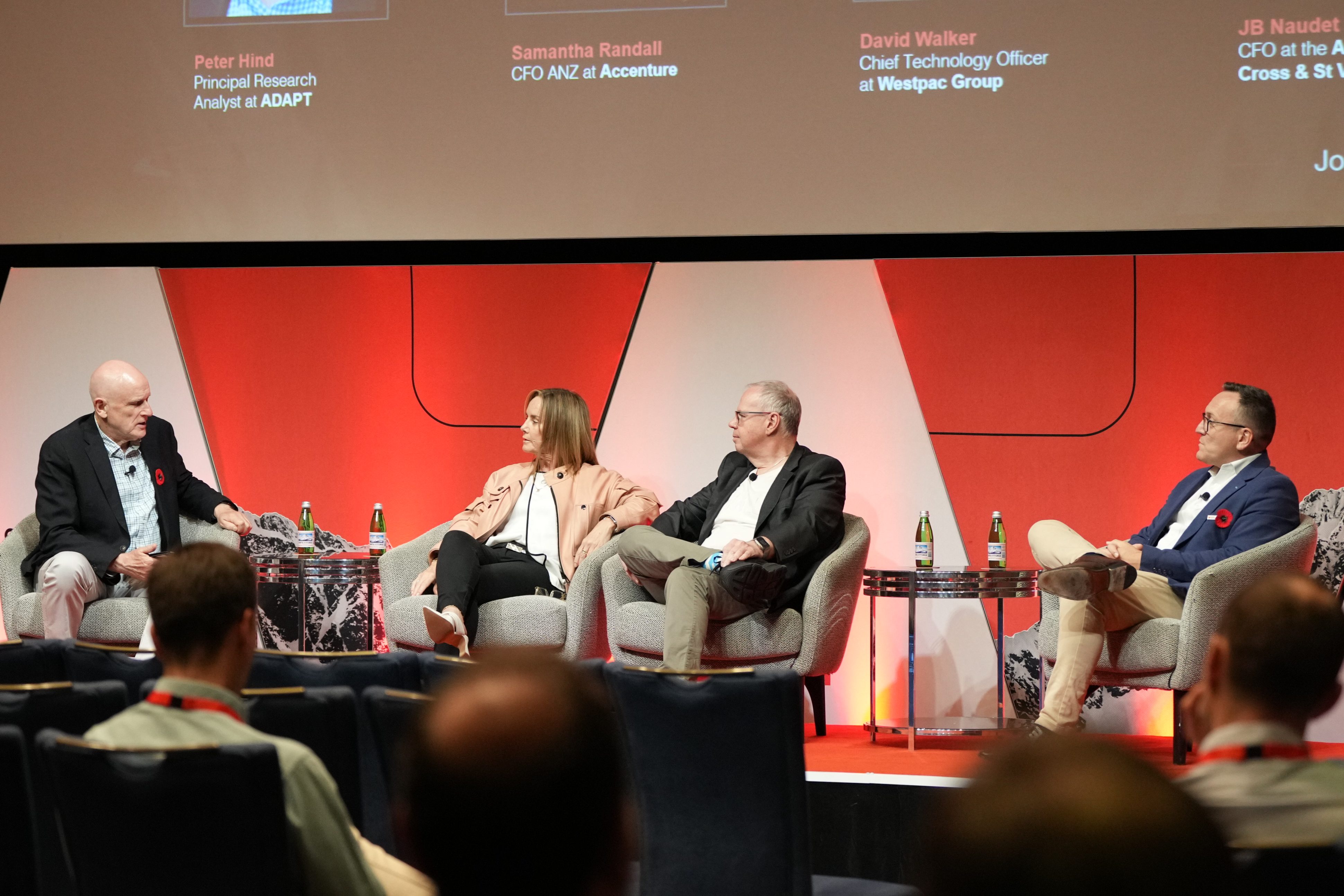


 Published Nov 17, 2025 in
Expert Presentations
Finance
Contributors
Samantha Randall
Jean-Baptiste Naudet
David Walker
Peter Hind
Published Nov 17, 2025 in
Expert Presentations
Finance
Contributors
Samantha Randall
Jean-Baptiste Naudet
David Walker
Peter Hind
In this CFO Edge panel, finance and technology leaders from Westpac, Accenture, and the Australian Red Cross debate how CFOs can shape value, accountability, and adoption in digital transformation.
Peter Hind, Principal Research Analyst at ADAPT, leads a discussion with David Walker, Group Chief Technology Officer of Westpac and DBS Bank, Samantha Randall, CFO ANZ at Accenture, and Jean-Baptiste Naudet, CFO at the Australian Red Cross.
The panel examines how the expectations placed on CFOs are shifting as digital transformation becomes a defining priority for Australian enterprises.
ADAPT’s latest research shows CEOs rank digital transformation as the leading issue affecting their ability to deliver on strategy.
Yet insights gathered during CFO Edge reveal that only 22% of CFOs view themselves as leading transformation efforts, 42% see it as a shared responsibility across the C-suite, and around a third adopt a more reactive stance.
The speakers agree that the CFO’s leadership is indispensable, given their role in financial stewardship, economic framing of digital value, and ownership of business cases that shape enterprise investment decisions.
David stresses that CFO leadership becomes most visible when financial rigor illuminates the true economics of transformation.
He shares how, at Westpac, the finance team validated a core metric showing it cost one dollar and seventy cents to deliver every dollar of change once technology complexity was accounted for.
That clarity anchored discussions with the executive team and provided the board with the confidence needed to invest.
JB builds on this by highlighting the importance of translating efficiency gains into meaningful organisational impact.
In a not for profit environment, this means ensuring that every improvement creates greater capacity to deliver on mission outcomes.
Samantha explains that genuine transformation requires shared accountability across the C-suite, supported by program leaders with clear targets and aligned measures of success.
She adds that strong partnerships between finance and technology teams reduce the risk of misalignment or projects becoming lost in translation.
For CFOs, this means setting expectations early, ensuring business cases reflect operational reality, and reinforcing the behaviours required to sustain progress.
The discussion turns to the human dynamics that determine the success or failure of transformation.
JB notes that systems must improve the lived experience of employees or resistance will slow adoption.
Practical improvements in workflow, service quality, or decision speed help build confidence across teams.
Samantha points to behavioural metrics, including system usage and adoption rates, as essential signals of progress.
She encourages leaders to monitor how people engage with new platforms rather than relying solely on financial measures.
David reflects on differing transformation models, contrasting iterative funding approaches such as the quarterly review cycles he experienced at DBS with the more structured roadmap in place at Westpac.
He explains that both models can succeed when they are supported by transparent data, frequent review points, and a willingness to redirect investment toward areas showing momentum.
The panellists agree that breaking complex transformation agendas into smaller components, demonstrating value early through pilots, and assigning top talent to these initiatives help sustain energy and build belief across the organisation.
The conversation reinforces that CFOs shape transformation through disciplined investment management, organisational influence, and the ability to articulate value in terms the business can act on.
Their leadership becomes central to bridging ambition with execution, ensuring digital initiatives translate into measurable and lasting performance improvements.
Key Takeaways
- CFOs play a decisive role in digital transformation, yet only 22% currently position themselves as transformation leaders.
- Financial clarity strengthens transformation outcomes, as seen in Westpac’s validation that delivering one dollar of change required one dollar and seventy cents of investment due to complexity.
- Adoption and people engagement determine long term success, reinforced by smaller work components, early value demonstrations, and better end user experiences.
 Samantha Randall
CFO ANZ at Accenture
Samantha Randall
CFO ANZ at Accenture
Experienced Finance Professional with a demonstrated history of working in the Information Technology and Services Industry. Highly skilled in all aspects of Corporate Financial Management, Advisory, Cash Flow, Treasury, Mergers & Acquisitions (M&A), Business Collaboration, mentoring and building High Performing Finance teams.
 Jean-Baptiste Naudet
CFO at Australian Red Cross
Jean-Baptiste Naudet
CFO at Australian Red Cross
JB is the CFO of the Australian Red Cross and also recently worked in another Not for Profit organisation as the CFO and Executive Director of Enabling Services of St Vincent de Paul NSW. Previously JB worked for Johnson & Johnson (J&J) for 10 years as Financial Controller of the Medical Device Division and then CFO of the Consumer Health Division.
JB worked also for the Pharmaceutical division as the APAC Commercial Director for Business Intelligence, New Business Development and Strategic Marketing. Prior to J&J, JB worked at Coca-Cola Amatil, Flight Centre, and Thales.
He has been recognised throughout his career for the ability to build and enhance strong team cultures and increase engagement outcomes. JB was born and educated in France but has been living in Australia for 25 years. He is a Chartered Accountant and a Graduate of the Institute of Company Directors.
Less David Walker
Group CTO at Westpac
David Walker
Group CTO at Westpac
David was appointed General Manager (Chief Technology Officer) with Group Technology at Westpac Group in August 2019. For the last 15 years, David has been in large, complex organisations. He worked in ANZ across a number of executive roles, in both Australia and Singapore.
Less Peter Hind
Principal Research Analyst at ADAPT
Peter Hind
Principal Research Analyst at ADAPT
Peter Hind has spent the last 25 years as an analyst and commentator on the ICT industry.
His primary areas of interest are the potential of technology to transform the way organisations operate, the change management obstacles executives encounter in realising this potential, as well as the tactics and techniques leaders have deployed to overcome these difficulties.
Peter now takes on multiple roles within ADAPT including the moderation of private events and roundtables, interviewing business executives about the strategies they are pursuing and assisting with the structuring of delegate surveys.
He also interrogates and analyses ADAPT’s treasure trove of end-user and C-suite data.
Less Join the ADAPT
 Insider Community
Get the latest A/NZ market research and insights on the core trends impacting leaders.
Join the ADAPT Insider Community
Get the latest A/NZ market research and insights on the core trends impacting leaders.