















What does a CIO playbook for enterprise transformation look like in the age of agentic AI?
At CIO Edge, Solly Brown, Partner at McKinsey and leader of QuantumBlack ANZ, outlined what CIOs needed to change across skills, spend, delivery, and operating models to turn agentic AI into enterprise advantage.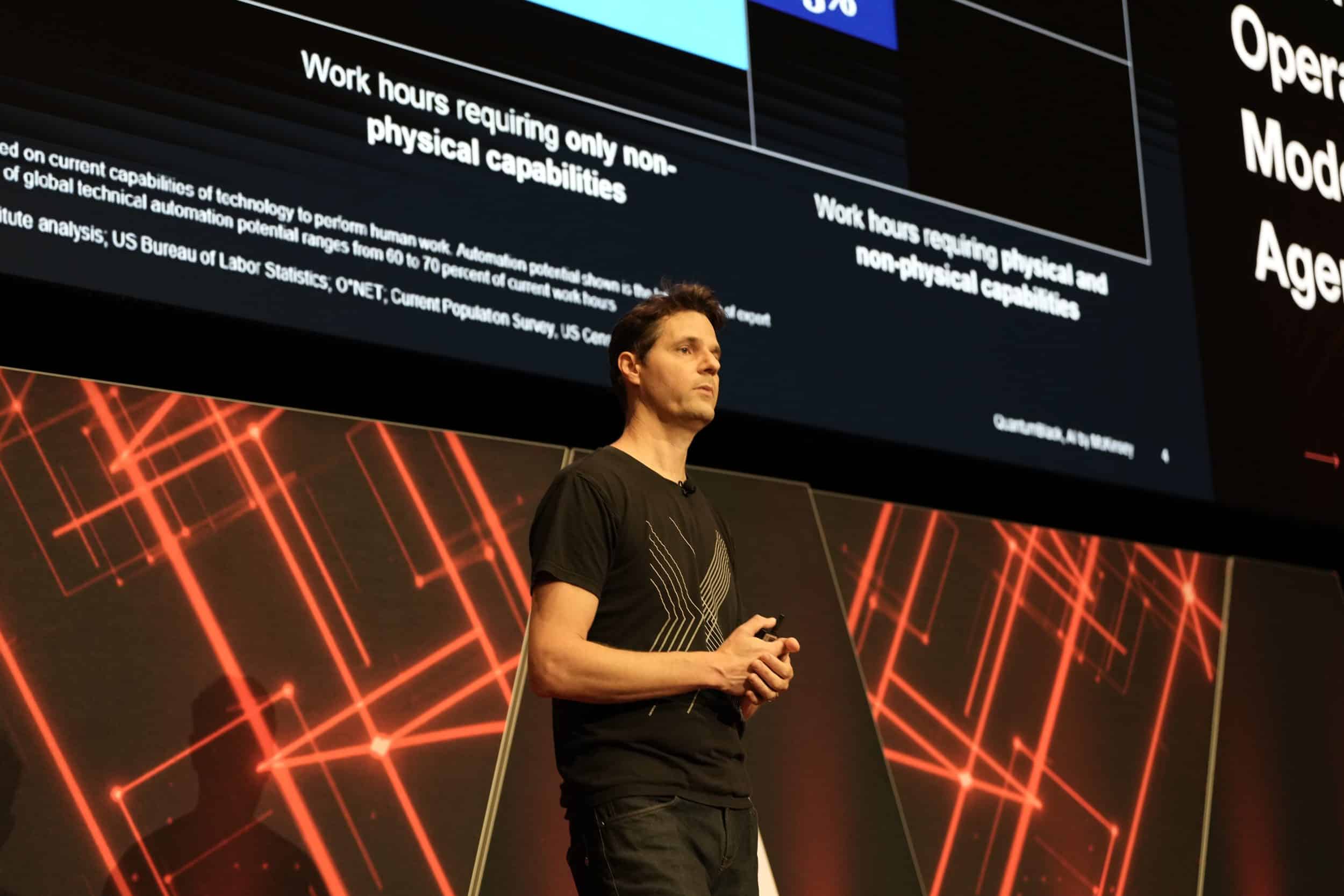


 Published Mar 5, 2026 in
Expert Presentations
Digital Transformation
Contributors
Solly Brown
Published Mar 5, 2026 in
Expert Presentations
Digital Transformation
Contributors
Solly Brown
As agentic AI gathered pace, CIOs were facing a harder question: how do you transform the IT function while also helping reshape the wider enterprise around it?
In his CIO Edge presentation, Solly Brown argued that the opportunity was no longer limited to testing new tools or improving isolated workflows.
It was about changing how technology teams operated, how transformation was funded, and how organisations built the speed to move ahead of competitors.
Key takeaways:
- CIOs were taking on a dual mandate, transforming the technology function while also helping reshape the wider enterprise around AI.
- The organisations moving faster were redesigning delivery models, applying agent first approaches, and building structural speed into software development and execution.
- The strongest CIO playbook combined investment, skills, delivery redesign, and clearer build versus buy decisions to turn AI into enterprise advantage.
CIOs were taking on a dual transformation mandate
Solly argued that CIOs were now carrying two jobs at once.
They had to transform the IT function itself while also helping lead broader enterprise transformation. In his view, this was what made the current moment different.
AI was no longer sitting at the edge of the business. It was starting to reshape delivery models, workforce design, and the economics of execution.
He pointed to the speed of capability improvement as a reason this challenge could not be deferred.
Frontier models were doubling the length of tasks they could complete every seven months, while McKinsey research showed that almost 60% of work hours were already technically automatable.
He made clear that this change would not hit every role all at once, but argued that almost every role would still see at least 20% of its tasks transformed.
That raised the pressure on CIOs to respond with more than experimentation.
The organisations moving faster were redesigning delivery around AI
Brown described the strongest performers as taking an agent first approach and applying AI across the software development lifecycle.
These organisations were not limiting AI to isolated productivity use cases.
They were redesigning operating models to support faster delivery, greater engineering capacity, and more continuous execution.
In some cases, that meant building toward 24 hour engineering cycles powered by agent factories.
His point was that competitive advantage would come from structural change, not scattered adoption.
High performers were already seeing double digit gains in speed, capacity, and quality because they were changing how work moved through the organisation.
That included rethinking spend, reshaping agile teams, and building the conditions for AI to operate at scale rather than as a bolt on.
The CIO playbook depended on where to invest, what to insource, and how to adapt
Solly also made clear that speed depended on sharper investment choices.
He said leading organisations were already allocating 20% or more of their digital budgets to AI and planned to increase that further.
ADAPT data supported the direction of travel, with 77% of organisations planning to invest in AI agents and 61% in AI development platforms.
But his playbook went well beyond budget allocation.
He argued that CIOs needed to decide where to build and where to buy, how to upskill talent, how to adapt operating models, and how to manage risk as AI became more central to business transformation.
He also stressed the importance of strengthening the data layer through ontologies and knowledge graphs, while insourcing key skills that would become strategically important over time.
The broader point was that organisations would move faster when they treated AI as a capability and operating model challenge at the same time.
 Solly Brown
Partner at McKinsey + QuantumBlack – contributor to McKinsey’s “CEO guide to GenAI”
Solly Brown
Partner at McKinsey + QuantumBlack – contributor to McKinsey’s “CEO guide to GenAI”
I am a Partner at McKinsey & Company based in Sydney, where much of my work is oriented around helping organisations on strategy, AI and transformation. I am leader in our analytics practice and QuantumBlack Australia (QuantumBlack is an analytics consulting firm acquired by McKinsey). My QB teams work with organisations on issues related to advanced analytics, machine learning, and artificial intelligence.
I also have a passion for public sector, where I serve organisations on strategy, organisation and transformation topics.
Before joining McKinsey I studied for a PhD in machine learning and artificial intelligence. Prior to this my background was in theoretical physics.
Less Join the ADAPT
 Insider Community
Get the latest A/NZ market research and insights on the core trends impacting leaders.
Join the ADAPT Insider Community
Get the latest A/NZ market research and insights on the core trends impacting leaders.