















Value prioritisation and AI guardrails were redefining the CIO mandate at NSW Government, Rest, and Village Roadshow
At CIO Edge, technology leaders from Village Roadshow, Rest, and the NSW Department of Customer Service discussed how the CIO role was expanding beyond delivery into business architecture, value prioritisation, and responsible AI adoption.


 Published Mar 2, 2026 in
Expert Presentations
Digital Transformation
Contributors
Arul Arogyanathan
Aarti Joshi
Jeremy Hubbard
Peter Hind
Published Mar 2, 2026 in
Expert Presentations
Digital Transformation
Contributors
Arul Arogyanathan
Aarti Joshi
Jeremy Hubbard
Peter Hind
Technology had moved too far into the core of service delivery for CIOs to remain in a supporting role.
In this CIO Edge panel, Arul Arogyanathan, CIO at Village Roadshow, Jeremy Hubbard, Chief Technology and Data Officer at Rest, and Aarti Joshi, CIO at NSW Department of Customer Service, argued that CIOs were increasingly being asked to shape operating models, influence business strategy, and define where technology could create the most value.
As digital capability became more central to growth, service delivery, compliance, and customer experience, the CIO’s role was becoming more commercial, more strategic, and more directly tied to organisational outcomes.
Key takeaways:
- CIOs were playing a larger strategic role because technology had become central to service delivery, growth, compliance, and customer outcomes.
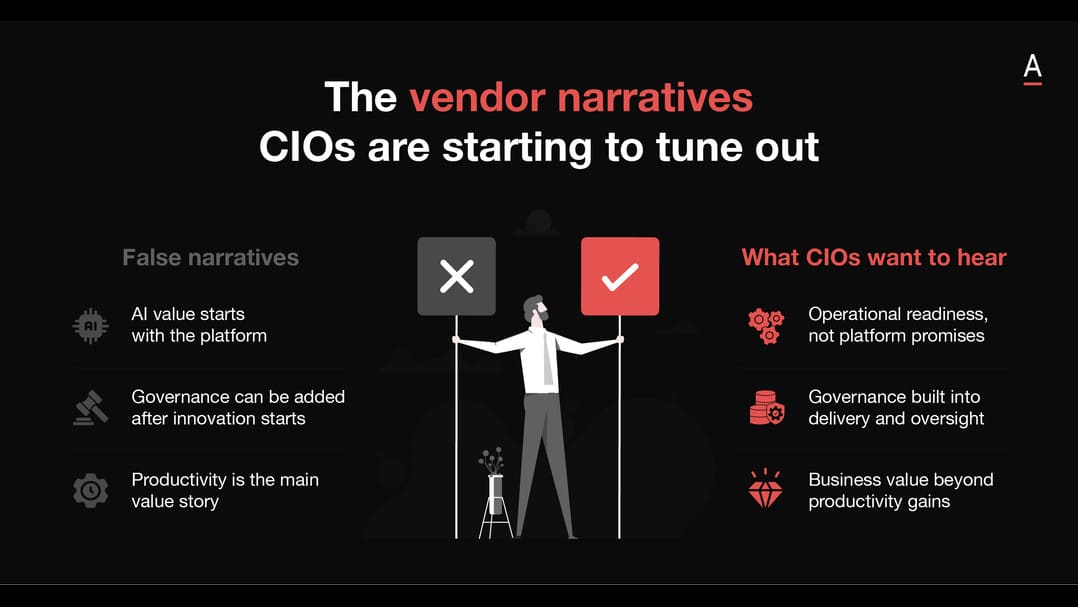
- AI progress depended more on business readiness and value clarity than on waiting for perfect data or technology foundations.
- Disciplined prioritisation, clear guardrails, and a small set of aligned metrics were helping CIOs direct resources toward the initiatives that delivered the strongest impact.
CIOs were shaping business architecture, not just technology delivery
The panel argued that the CIO now held a firmer mandate to drive organisational and operational change.
Technology sat at the centre of modern service delivery, whether in licensing, identity, customer experience, or regulatory reform, and that had pulled the CIO closer to core business decision making.
Reporting lines were continuing to move nearer to the CEO, strengthening the CIO’s influence and reflecting the reality that digital capability now underpinned almost every important outcome.
That shift was also changing how success was measured. KPIs were becoming more focused on customer centricity, business value, and growth rather than technical delivery alone.
The result was a more front footed role, with CIOs expected to help shape business architecture and strategic direction rather than simply respond to enterprise demand.
AI progress was depending more on business readiness than perfect foundations
On AI, the panel’s view was pragmatic.
Organisations needed to prioritise progress over perfection. Even where data foundations were still incomplete, targeted and contained use cases could still deliver measurable value.
Jeremy Hubbard pointed to Rest’s contact centre, which handled 2,000 to 2,500 calls a day, where AI was already being used to automate call wrap ups and reduce handling time before full data modernisation had been completed.
The panellists also stressed that the biggest barriers to AI return on investment were not primarily technical.
They noted that only 22% of ROI barriers came from technology and 14% from data, while the remaining 64% came from business readiness, prioritisation, and understanding where value sat.
To move faster, Arul Arogyanathan argued for democratising AI by giving teams the ability to use it within clear guardrails, using a model of centralised governance and federated execution.
Value discipline was becoming the CIO’s operating lens
The panel also made clear that prioritisation had become more important in a tighter economic environment. Investment decisions were being assessed through a mix of business and technology strategy, regulatory obligations, growth potential, cost efficiency, and sustainability.
Jeremy Hubbard described allocating funding across core operations, transformation, and a protected innovation budget so experimentation could continue without being crowded out by immediate pressures.
Aarti Joshi framed prioritisation through citizen impact, regulatory risk, and service operability, noting that public sector value often played out over a longer horizon.
Across sectors, the panel agreed that scarce resources needed to be directed through a small number of clear metrics, with every initiative aligned to them.
In their view, that discipline was what allowed CIOs to connect architecture, value, and innovation rather than treating them as separate conversations.
 Arul Arogyanathan
Chief Information Officer at Village Roadshow (#1 in CIO50 2025)
Arul Arogyanathan
Chief Information Officer at Village Roadshow (#1 in CIO50 2025)
I am a transformational top 50 CIO (#13 in 2024 and #1 in 2025) with extensive experience in hypergrowth and turnaround situations. Seeing the full picture in the development of strategy and practical solutions, I have provided critical direction to organisations in times of pressure and urgency, bringing together a mix of commercial and tech knowledge to drive performance, market position and profit through simplification, optimisation and innovation. In every leadership role I’ve held, I have radically altered tech environments, modernising enterprise system and infrastructure landscapes while seamlessly immersing tech solutions into business processes to enable business decision-making, goal setting, and the achievement of essential business results.
In short, I’ve moved IT away from a back-office function and made it a key driver of business strategy. This is demonstrated in a solid track record in delivering year on year cost savings, reducing technology debt and creating lean and scalable technology operations that can adapt to constantly changing business needs. Key achievements include repositioning technology as a strategic value driver for Village Roadshow with multimillion-dollar cost savings and significant simplification and maturation of the IT landscape; architecting and delivering one of the largest cloud-native data platforms in ANZ for Flybuys; securing Board endorsement and multi-million dollar in funding for a three-year technology and data transformation roadmap for Sigma; and preventing extortionate monthly penalties by rescuing a multi-million-dollar, multi-vendor transformation program and delivering an integrated customer platform ahead of a high-risk deadline for EnergyAustralia.
Less Aarti Joshi
Chief Information Officer at Department of Customer Services
Aarti Joshi
Chief Information Officer at Department of Customer Services
A passionate, dynamic leader with a proven track record of delivery across large scale enterprise, Aarti’s strengths are in leading and motivating people, and she is driven to achieve results.
Having led diverse, multidisciplinary teams across geographies, Aarti is committed to maximizing engagement across all levels of the business.
Aarti’s ability to co-innovate and collaborate makes her a trusted advisor, whilst her focus on strategic business and technology alignment makes her a catalyst for true partnership and change.
With an MBA from Macquarie Business School (Sydney, Australia), Aarti brings a global mindset to her role.
It is her relentless pursuit for excellence that ultimately enables Aarti to improve business outcomes, transform business models, modernize technology and enhance customer experience.
Less Jeremy Hubbard
Chief Technology and Data Officer at Rest
Jeremy Hubbard
Chief Technology and Data Officer at Rest
I’m a disruptive, delivery-focused technolgy leader with over 25 years’ experience driving digital strategy and solutions across Australia, China and the United Kingdom. I’m currently leading technology, data and information security at Rest where I’m driving rapid technology change and innovation across the organisation. Prior to working at Rest, I played a key role in the development and deployment of UBank’s digital and financial products since 2008. I led the implementation of UBank’s market leading digital home loan capability which launched in 2011. I spearheaded UBank’s AI journey including the launch of Australia’s first ever virtual assistant to support the home loan application process.
Less Peter Hind
Principal Research Analyst at ADAPT
Peter Hind
Principal Research Analyst at ADAPT
Peter Hind has spent the last 25 years as an analyst and commentator on the ICT industry.
His primary areas of interest are the potential of technology to transform the way organisations operate, the change management obstacles executives encounter in realising this potential, as well as the tactics and techniques leaders have deployed to overcome these difficulties.
Peter now takes on multiple roles within ADAPT including the moderation of private events and roundtables, interviewing business executives about the strategies they are pursuing and assisting with the structuring of delegate surveys.
He also interrogates and analyses ADAPT’s treasure trove of end-user and C-suite data.
Less Join the ADAPT
 Insider Community
Get the latest A/NZ market research and insights on the core trends impacting leaders.
Join the ADAPT Insider Community
Get the latest A/NZ market research and insights on the core trends impacting leaders.