















Why Australia’s listed companies find large scale AI transformation harder than the US, according to Maile Carnegie
In this discussion at CIO Edge, Innovation and Growth Leader Maile Carnegie explains why Australia’s listed enterprises face deeper structural barriers to AI adoption, and what technology leaders must do to drive progress anyway.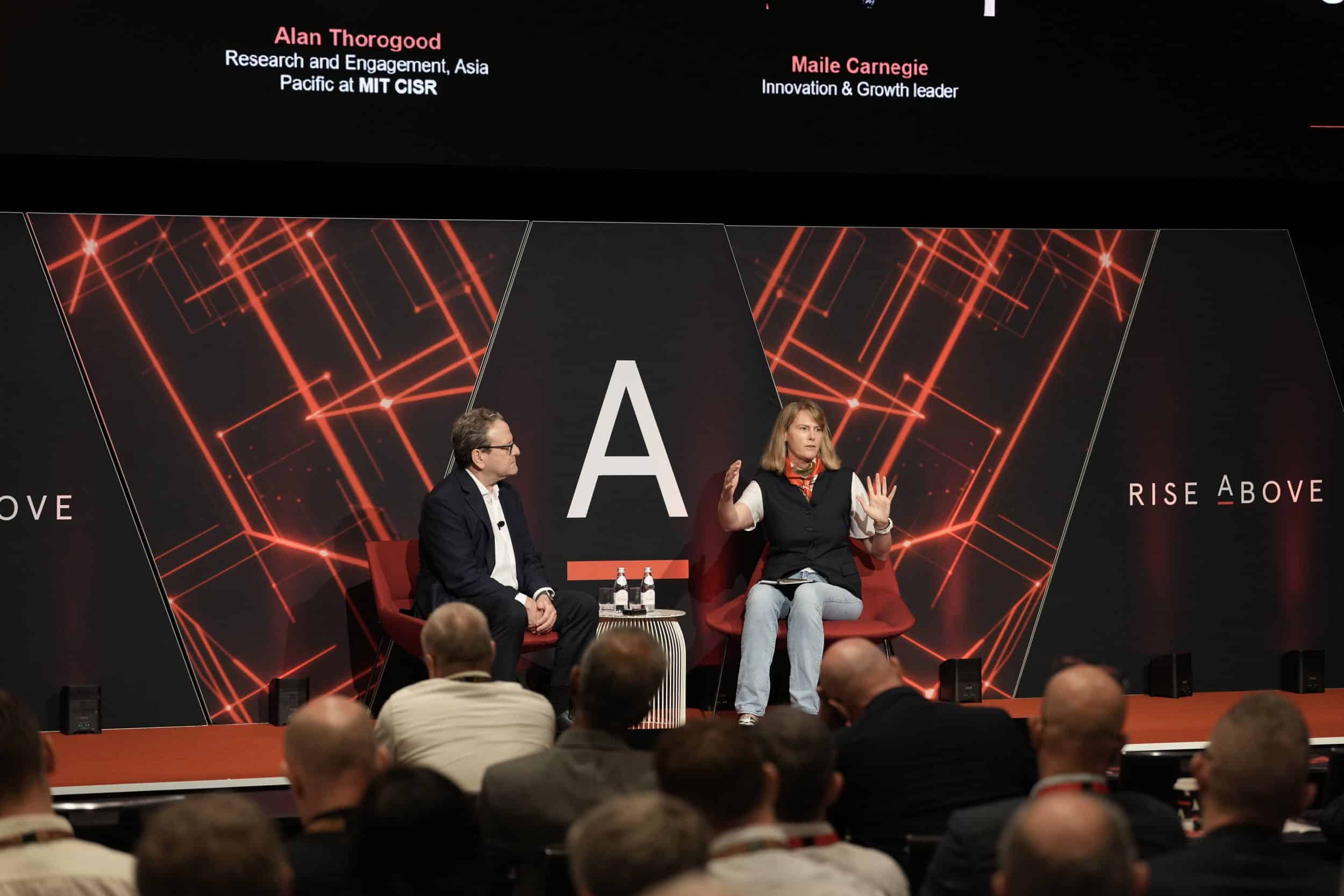


 Published Mar 5, 2026 in
Expert Presentations
Digital Transformation
Contributors
Maile Carnegie
Alan Thorogood
Published Mar 5, 2026 in
Expert Presentations
Digital Transformation
Contributors
Maile Carnegie
Alan Thorogood
Australia’s AI challenge is not a shortage of ambition. It is a system that rewards caution more than bold reinvention.
In this CIO Edge discussion with Alan Thorogood, Research and Engagement at MIT CISR, Innovation and Growth Leader Maile Carnegie argues that many of the barriers holding back enterprise transformation sit well beyond the technology itself.
They are embedded in board expectations, regulatory settings, capital structures, and the way risk is managed inside large public companies.
Her view is that Australian organisations can still move, but only if leaders reshape how they frame value, build trust, and bring the business into the transformation effort.
Key takeaways:
- Australia’s large public companies face structural barriers to AI adoption because the system around them rewards stability, scrutiny, and caution more than disruptive reinvention.
- Board accountability, regulatory uncertainty, and capital market settings reduce the risk appetite needed for bold AI moves, especially when compared with US public company environments.
- Technology leaders need to respond by proving value within one year horizons, strengthening governance and compliance confidence, and partnering closely with business leaders to unlock judgement driven, capability centred transformation.
Australia’s corporate environment makes bold AI moves harder
Maile Carnegie sees stronger potential in smaller private companies than in large publicly listed organisations.
According to her, Australia’s corporate system is geared more toward stability than disruption, which makes it harder for boards and executives to pursue the courage, capital access, talent, and risk appetite needed for agentic AI and large scale transformation.
She contrasts this with the US, where public companies operate in ecosystems more supportive of growth, experimentation, and rapid change.
In Australia, several systemic pressures pull in the other direction.
Board directors face higher personal accountability, including stepping stone liability, and broader social licence expectations.
Principles based regulation can make experimentation easier to begin, but harder to pursue with confidence when future regulatory or legal exposure remains unclear.
Access to growth capital is also tighter, shaped by franking credits that skew investor expectations toward yield and by a low cost shareholder activism environment that increases pressure on leadership teams.
Together, these settings make large scale AI transformation harder to back and harder to defend.
Tech leaders need to reframe AI around trust, proof, and short horizon value
Given those constraints, Maile Carnegie’s advice is pragmatic.
Leaders need to chunk AI initiatives into one year horizons, giving boards and executives a clearer, more defensible path to return on investment.
In this environment, multi year promises are far less persuasive than near term proof.
She also argues that trust has to be built deliberately.
That means helping leadership teams get comfortable with compliance and control, especially around explainability, observability, and governance.
The challenge is not simply generating interest in AI. It is reducing the institutional fear that comes with deploying it at scale.
Technology leaders therefore need to do more than advocate for new tools.
They need to create the conditions in which boards and business leaders believe the upside is real and the risks are manageable.
Real transformation depends on deeper business partnership
Maile Carnegie’s final point is that agentic AI cannot be advanced by the technology function alone.
These systems rely on judgement, context, and decision logic that sit inside business teams, not just in process maps or technical workflows.
That makes deep partnership with business unit leaders essential.
To move forward, organisations need to align storytelling, strategy, and operating models around a shared view of where AI enabled business models are heading.
Maile Carnegie describes this as a shift from human centred architectures to capability centred ones, supported by curated information, common language, and closer collaboration across functions.
The organisations that progress will be the ones that help business leaders see AI as an operating model question, not a technology side project.
 Maile Carnegie
Innovation & Growth leader
Maile Carnegie
Innovation & Growth leader
Maile Carnegie is a senior Australian business leader and former Group Executive, Australia Retail at ANZ, where she led the bank’s largest division, serving around five million customers across a national branch and ATM network and leading digital and mobile banking experiences. She previously held ANZ Group Executive roles spanning Digital Banking and enterprise wide digital and transformation, and carried group accountability for design and marketing, including brand and sponsorships. She also served as a Non Executive Director of ANZ Bank New Zealand Limited.
Before ANZ, Carnegie was Managing Director for Australia and New Zealand at Google. She spent more than 20 years at Procter and Gamble, including Managing Director Australia and New Zealand, General Manager Asia Strategy, Marketing and Design, and senior commercial roles in the United States and Singapore. Carnegie has also contributed to public and industry initiatives, including the independent review of the Australian Public Service, the ASIC External Advisory Panel, and Innovation and Science Australia. She holds a Bachelor of Business Administration in Finance, Economics and Marketing from the University of Technology Sydney.
Less Alan Thorogood
Research and Engagement at MIT CISR
Alan Thorogood
Research and Engagement at MIT CISR
At the Massachusetts Institute of Technology, Alan looks after CISR’s Research and Engagement for the Asia Pacific region. Previously, he held senior digital executive roles and managed digital strategy teams where he built and ran successful consulting businesses for Accenture and PwC. He was the Head of Digital Strategy for the Turnbull government of Australia.
 Join the ADAPT
 Insider Community
Get the latest A/NZ market research and insights on the core trends impacting leaders.
Join the ADAPT Insider Community
Get the latest A/NZ market research and insights on the core trends impacting leaders.