

















Why DBS spent a decade rebuilding the bank before scaling AI
At Digital & AI Edge, DBS Bank's MD and Group Head of Consumer Banking, Sanjoy Sen, explains why AI scale depends on years of investment in technology, data, operating models and culture.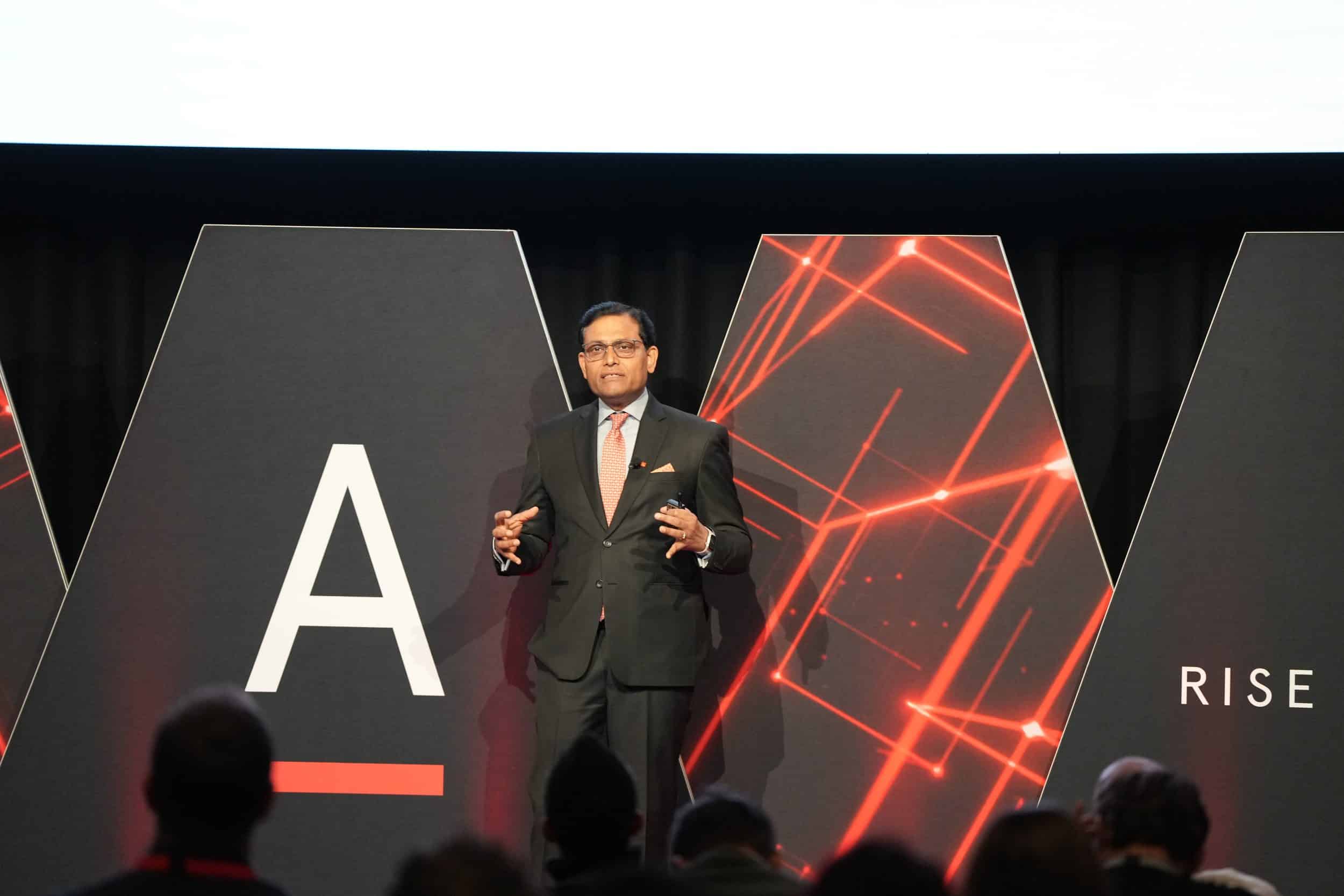


 Published Jul 1, 2026 in
Expert Presentations
Data & AI Strategy
Contributors
Sanjoy Sen
Published Jul 1, 2026 in
Expert Presentations
Data & AI Strategy
Contributors
Sanjoy Sen
While many organisations are focused on deploying AI, DBS focused first on rebuilding the foundations underneath it.
At ADAPT’s Digital & AI Edge, Sanjoy Sen, MD and Group Head of Consumer Banking at DBS Bank, shared how one of the world’s most recognised digital banks spent more than a decade rebuilding its technology architecture, data foundations and operating model before AI became a meaningful competitive advantage.
The result is an AI enabled organisation with more than 2,500 models deployed across 430 use cases, embedded into core workflows, customer interactions and decision making.
For DBS, AI was never the transformation. It was the outcome of one.
Key takeaways:
- AI scale depends on strong foundations, including cloud architecture, unified data and modern operating models.
- AI is reshaping how work gets done, requiring organisations to redesign workflows, decision making and team structures.
- Competitive advantage increasingly comes from ecosystems, partnerships and intelligence layers rather than traditional industry boundaries.
Strong foundations determine how far AI can scale
AI only creates lasting value when it is built on years of investment in technology, data and operating models.
Many organisations approach AI as the catalyst for transformation. DBS took the opposite path.
The bank spent years modernising its architecture, building cloud enabled platforms, creating API driven systems and establishing a unified data lake before scaling AI across the organisation.
That transformation included building engineering hubs across Singapore, India and China, adopting platform based ways of working and creating a data driven operating model that gave employees access to real time insights and experimentation capabilities.
Today, more than 2,500 AI models support 430 use cases across the bank.
The difference is that those models are embedded into business processes rather than layered on top of them.
AI is supported by infrastructure, governance and operating models that were built long before generative AI entered the mainstream.
AI is reshaping workflows, teams and decision making
AI changes more than productivity. It changes how organisations operate.
Traditional workflows were designed around human decision making, organisational hierarchies and manual handoffs.
As AI becomes embedded into customer engagement, underwriting, wealth management and service operations, those assumptions need to be reconsidered.
At DBS, hyper personalisation generates 30 million customer nudges each month, using thousands of data points to tailor recommendations and interactions to individual customers.
AI powered wealth copilots help relationship managers prepare for client conversations, while agentic systems assist with underwriting, customer service and operational processes.
These capabilities are freeing employees from administrative tasks and allowing them to focus on judgement, relationships and higher value activities.
Supporting that shift required more than new technology.
DBS reorganised around platform teams where business and technology leaders share accountability, expanded access to enterprise data and encouraged experimentation throughout the organisation.
The goal was to create an environment where AI could become part of how work happens every day.
Data turns AI into a business capability
The quality of AI outcomes is determined by the quality of the data underneath it.
DBS spent nearly five years building a unified data lake capable of bringing together thousands of customer, behavioural and operational data points in real time.
That foundation enables everything from hyper personalised engagement to fraud detection and intelligent decision making.
Sanjoy compared the bank’s approach to Formula One racing, where success increasingly depends on how effectively teams capture, analyse and act on data.
In the same way that racing teams use telemetry to optimise performance, DBS uses real time data to guide customer interactions, improve service delivery and support AI driven decision making across the organisation.
The focus extends beyond access to data. Governance, accountability and transparency are equally important.
The bank applies what it calls the PURE principles, ensuring AI use cases remain purposeful, unsurprising, respectful and explainable.
As AI becomes more deeply embedded into business processes, the ability to manage data responsibly becomes as important as the technology itself.
Ecosystems are becoming the new competitive battleground
AI is changing who organisations compete against.
Rather than benchmarking against traditional banking peers, DBS increasingly measures itself against specialised fintechs and technology platforms.
Payments, lending, investing and customer engagement are all becoming more accessible through AI driven services, lowering barriers to entry across financial services.
This shift is forcing organisations to think beyond products and channels. DBS has responded by embedding banking into broader customer journeys, creating what Sanjoy describes as “invisible banking”, where financial services become part of the customer experience rather than a separate destination.
The bank is also building partnerships across the AI ecosystem, working with providers including OpenAI, Google, Microsoft, DeepSeek and Perplexity to accelerate innovation and expand its capabilities.
Emerging areas such as agentic commerce represent the next stage of that evolution.
As AI agents become capable of completing transactions on behalf of customers, organisations will need to rethink how products, services and customer relationships are delivered.
For DBS, becoming an AI enabled bank required far more than adopting new technology.
It meant rebuilding the foundations of the organisation, creating new operating models and establishing a culture capable of adapting continuously.
AI scale is earned long before the first model reaches production.
 Sanjoy Sen
MD - Group Head - Consumer Bank at DBS Bank (Singapore)
Sanjoy Sen
MD - Group Head - Consumer Bank at DBS Bank (Singapore)
Sanjoy is the Group Head of Consumer Bank at DBS Bank and a member of the DBS Group Management Committee. DBS, headquartered in Singapore, is a leading financial services group in Asia, recognized globally as the “World’s Best Bank” by Euromoney and Global Finance, and as the “World’s Best Digital Bank” by Euromoney.
In his role, Sanjoy oversees the bank’s consumer business across the region, driving strategy, market development, and business performance while leading the expansion of DBS’s regional footprint. He is responsible for advancing the Consumer Bank’s digital transformation, developing new ecosystem partnerships, and leveraging DBS’s banking and technology capabilities to scale the business.
Sanjoy brings more than 30 years of international consumer banking experience and joined DBS in 2018. Prior to DBS, he led ANZ Bank’s Consumer and Private Bank across the Asia Pacific region for five years. Before that, he spent 22 years at Citibank, where his last role was Consumer Bank Head for the Middle East and North Africa.
He currently serves on several boards within DBS, including DBS Bank Taiwan, DBS Vickers Holding, and DBS Vickers Thailand. Sanjoy also sits on the board of the DBS Foundation, where he helps oversee sustainability initiatives and champion social enterprises.
Beyond DBS, he is actively involved in a number of external boards and committees. He serves as Board Director and Treasurer at the Singapore Institute of Management and is a Governor on the Board of the Singapore International Foundation, supporting its mission to build enduring people to people connections around the world. He is also a member of the Strategic Advisory Council of the Singapore FinTech Association, contributing to the strategic growth and global expansion of Singapore’s fintech ecosystem.
Previously, Sanjoy served as a Board Director for ANZ’s subsidiaries in Cambodia and Vietnam, and as a Director of Metrobank Cards Corporation in the Philippines. He has also held honorary positions with the National Volunteer & Philanthropy Centre and the Singapore Institute of Directors, and served on the board of the Tanglin Club for several years.
In recognition of his contributions to the industry, Sanjoy was conferred the IBF Fellow Award for Consumer Banking in 2019. He is a regular keynote speaker at international conferences and leading business schools, and teaches in the Asia Financial Leadership Program, of which he is also an alumnus.
Less Join the ADAPT
 Insider Community
Get the latest A/NZ market research and insights on the core trends impacting leaders.
Join the ADAPT Insider Community
Get the latest A/NZ market research and insights on the core trends impacting leaders.