


















Readiness is separating AI leaders from followers, says former Westpac and DBS CTO
David Walker explains why adaptability, leadership alignment and organisational readiness are becoming critical advantages in the age of AI.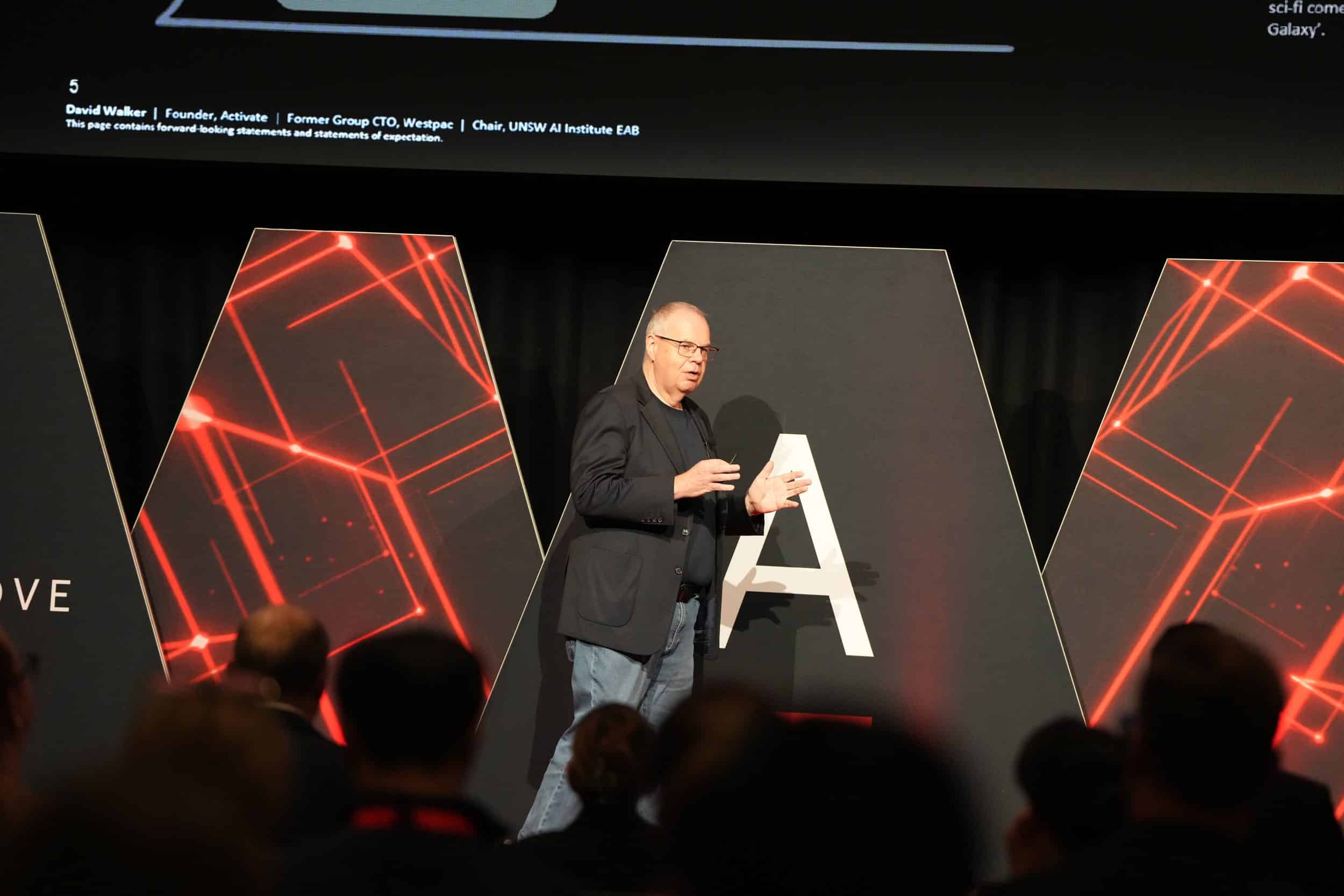


 Published Jun 23, 2026 in
Expert Presentations
Data & AI Strategy
Contributors
David Walker
Published Jun 23, 2026 in
Expert Presentations
Data & AI Strategy
Contributors
David Walker
Technology shifts have a habit of reshuffling industry leaders. The organisations that emerge stronger are often those that adapt fastest, rather than those with the most resources.
In his Digital & AI Edge keynote, David Walker, former Group Chief Technology Officer at Westpac and DBS and Chair of the AI Council at UNSW, argued that AI belongs to a rare category of technologies that reshape industries, operating models and competitive dynamics. Success will depend as much on organisational design as technology investment.
Key takeaways:
- AI is creating a temporary window where organisations that adapt quickly can outperform larger competitors.
- Organisational readiness has a greater influence on AI outcomes than technology capability alone.
- Nimbleness, leadership alignment and operating model change are becoming critical sources of competitive advantage.
AI is creating a rare window for competitive change
AI belongs to a small group of technologies that fundamentally reshape industries and economies.
These general purpose technologies influence how work gets done, how decisions are made and how organisations compete.
History shows they often create opportunities for challengers to gain ground on incumbents.
The rise of personal computing saw companies such as Microsoft, Dell and Compaq outperform dominant incumbents including IBM.
The issue was rarely a lack of capability. Large organisations often struggled because their structures made adaptation slower and more difficult.
David argued that AI is creating a similar moment.
Organisations that can respond quickly to changing conditions have an opportunity to create disproportionate value during this period of disruption.
Organisational readiness is shaping AI outcomes
Most organisations are investing heavily in AI capabilities while overlooking the factors that have the greatest influence on success.
This helps explain why returns from AI remain difficult to achieve at scale.
While technology continues to improve rapidly, many organisations lack the governance, funding models, leadership alignment and workforce adoption needed to translate capability into value.
Research across 40,000 organisations identified more than 1,300 factors that influence AI success.
Only around 9% were technical. The overwhelming majority related to leadership, governance, finance, culture and organisational capability.
AI outcomes are determined less by access to technology and more by an organisation’s ability to adapt around it.
Nimbleness determines who captures value first
The defining advantage in the AI era is organisational nimbleness.
Nimble organisations can adapt quickly at the edges while continuing to reinvent core systems and processes.
That ability allows them to capture value earlier and build momentum faster than competitors.
David pointed to DBS as an example.
The bank transformed from a traditional financial institution into one of the world’s leading digital banks by embedding a set of capabilities that supported continuous change:
- CEO led ownership of transformation
- Deep customer centric decision making
- Organisation wide innovation
- Continuous learning and talent mobility
- Modern governance and funding models
- Relentless waste elimination
- Flexible technology foundations
- Seamless collaboration across teams
These capabilities supported rapid AI adoption and generated more than $1 billion in measurable value.
The lesson extends beyond financial services.
Organisations that can adapt, simplify decision making and continuously evolve their operating models will be better positioned to capture value as AI reshapes industries.
As AI continues to accelerate change, the ability to reinvent the organisation may prove more valuable than the technology itself.
As an ADAPT Executive Advisor, David helps enterprise leaders understand how AI, operating model change and organisational readiness are reshaping competitive advantage.
 David Walker
(former) Group Chief Technology officer at Westpac & DBS and Chair of the AI Council at UNSW
David Walker
(former) Group Chief Technology officer at Westpac & DBS and Chair of the AI Council at UNSW
David Walker was appointed Westpac Group’s Chief Technology Officer in August 2019. He led Westpac through its technology transformation – simplifying and merging the bank, building 4th gen cloud-native applications, establishing and operating evergreen platforms, leading Westpac’s AI technology, and building a culture of passionate and forward-thinking tech and emerging talent.
David began his technology career in 1987 as a software engineer, focusing on coding complex systems. After a decade of evolving his software engineering craft, David founded a data science consulting. Over the following decade, it became the number one expert data insights company in Australia and Southeast Asia.
For the last 15 years, David has held executive roles in large, complex organisations across the APAC region. Prior to joining Westpac, David was part of the leadership team of Singaporean bank, DBS. In his ten years there, David helped transform DBS from a traditional bricks and mortar bank with little brand presence or recognition outside Singapore, to being recognised as the ‘Best Bank in the World’ and the ‘Best Digital Bank in the World’ by leading global financial publication Euromoney.
Less Join the ADAPT
 Insider Community
Get the latest A/NZ market research and insights on the core trends impacting leaders.
Join the ADAPT Insider Community
Get the latest A/NZ market research and insights on the core trends impacting leaders.