














Enterprise discipline will decide who captures AI value
At the 30th CIO Edge in Melbourne, ADAPT’s Joey Meynink links AI value to stronger economics, redesigned workflows, and organisational readiness.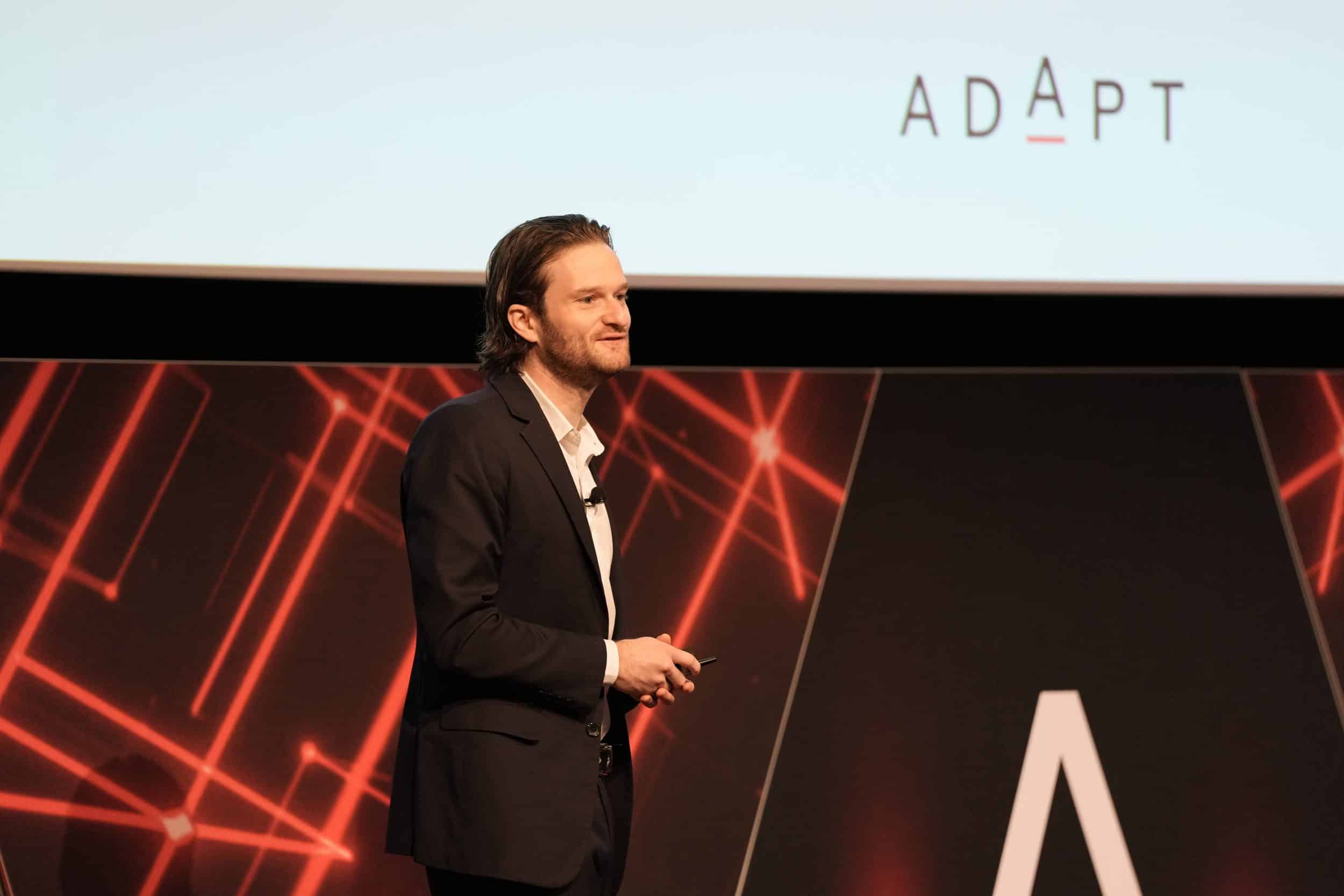


 Published Aug 21, 2026 in
Expert Presentations
Data & AI Strategy
Contributors
Joey Meynink
Published Aug 21, 2026 in
Expert Presentations
Data & AI Strategy
Contributors
Joey Meynink
Weak economics, unchanged workflows, and limited organisational readiness are holding back enterprise AI value.
Joey Meynink, Head of Strategy at ADAPT, drew on ADAPT research across Australian and New Zealand executives to show where organisations need to strengthen execution: commercial measurement, workflow redesign, and leadership capability at CIO Edge.
Key takeaways:
- Measure value before expanding investment: Track cost per successful outcome, revenue, risk, and CFO-backed financial measures rather than relying on adoption or deployment metrics.
- Redesign three to five high-value workflows first: Focus on high-volume, high-friction processes where agents can materially change execution, decisions, and cost.
- Build leadership and workforce capability alongside the technology: Judgement, adaptability, accountability, and commercial acumen shape whether organisations can turn new capability into enterprise value.
AI economics have to survive the business case
Adoption and deployment metrics show whether the technology is being used.
They do not show whether it creates financial value.
38% of CIO Edge respondents track AI usage or adoption without tracking value, while just 1% consistently measure enterprise-level AI value with CFO involvement.
Cost per successful outcome exposes what usage metrics miss.
Joey highlighted an Australian bank where a task costing around $0.08 per successful human outcome rose to approximately $1.40 when completed by an agent.
Across 200,000 tasks, the cost moved from roughly $16,000 to $280,000, a 17-fold increase.
A deployment metric could still record that initiative as successful. The economics show the opposite.
Organisations need to measure token, task, and outcome costs from the start, then connect them directly to revenue, cost, risk, and the financial measures used to allocate capital.
Workflow redesign creates structural value
AI delivers limited enterprise impact when existing processes, hand-offs, decisions, and role structures stay intact.
Redesigning the workflow clarifies where agents should execute, where people should apply judgement, and where accountability should remain with a person or team.
71% of CIO Edge respondents said their organisations were not prepared to manage an agentic workforce, while more than half lacked formal AI controls.
Joey frames organisational maturity across three stages. AI-enabled organisations use the technology to augment existing tasks.
AI-first organisations rebuild workflows and decisions around it. AI-native organisations design value propositions with it at their core.
Start with three to five high-volume, high-friction workflows where the economics justify deeper change.
Redesign the full flow of work, shift suitable execution to agents, and direct people towards judgement, critical thinking, and higher-value decisions.
Leadership and workforce capability separate stronger performers
Wider access to the same models, platforms, and vendors reduces the advantage of technology access alone.
Stronger performers make better decisions about where to invest, redesign work across functions, assign clear accountability, and build the skills required to operate with AI.
The 71% agentic workforce readiness gap shows how far organisational capability trails investment.
Capable agents create little value when leaders cannot judge the economics, teams cannot redesign workflows, or responsibility remains unclear.
Joey links stronger performance to judgement, adaptability, accountability, and commercial acumen.
These capabilities help leaders choose the right use cases, challenge weak business cases, redesign work, and maintain clear decision rights as agents take on more execution.
As the tools commoditise, the quality of the organisation around them will determine the value they create.
 Joey Meynink
Head of Strategy at ADAPT
Joey Meynink
Head of Strategy at ADAPT
Joey leads ADAPT’s Strategy function, working closely with business and technology leaders to help build more agile, innovative and resilient organisations.
Joey has led key client engagements including:
- Kyndryl, Executive Dinner: AI & Global Resiliency with CIOs & Chief Data Officers, co-hosted with Kyndryl CEO Martin Schroeter
- ServiceNow Vivid Experience: AI Enabled Customer & Employee Experience with Heads of Strategy & Customer Experience – customer and VP interview and panel
- AWS, Redhat & Apptio Executive Lunch: Controlling Cloud Costs, Enabling Efficiency & Unlocking AI with Heads of Cloud & Infrastructure – event moderation
- Led Roundtables for: Rimini Street, Octopus Deploy, LivePerson, Redactive, Netskope, MicroStrategy, Diligent, Akamai and more.
Prior to ADAPT, Joey led strategic and technology implementation initiatives at Accenture, focused on financial services clients and Generative AI. 7 years in strategy, research and product roles at Gartner Australia and the UK and held business service analysis roles at Bain & Co.
Less Join the ADAPT
 Insider Community
Get the latest A/NZ market research and insights on the core trends impacting leaders.
Join the ADAPT Insider Community
Get the latest A/NZ market research and insights on the core trends impacting leaders.