
















How vendors can stay relevant as CDAOs demand measurable AI value
Australian CDAOs are demanding clearer AI outcomes as pressure grows on vendors to prove governance, readiness, and measurable business value.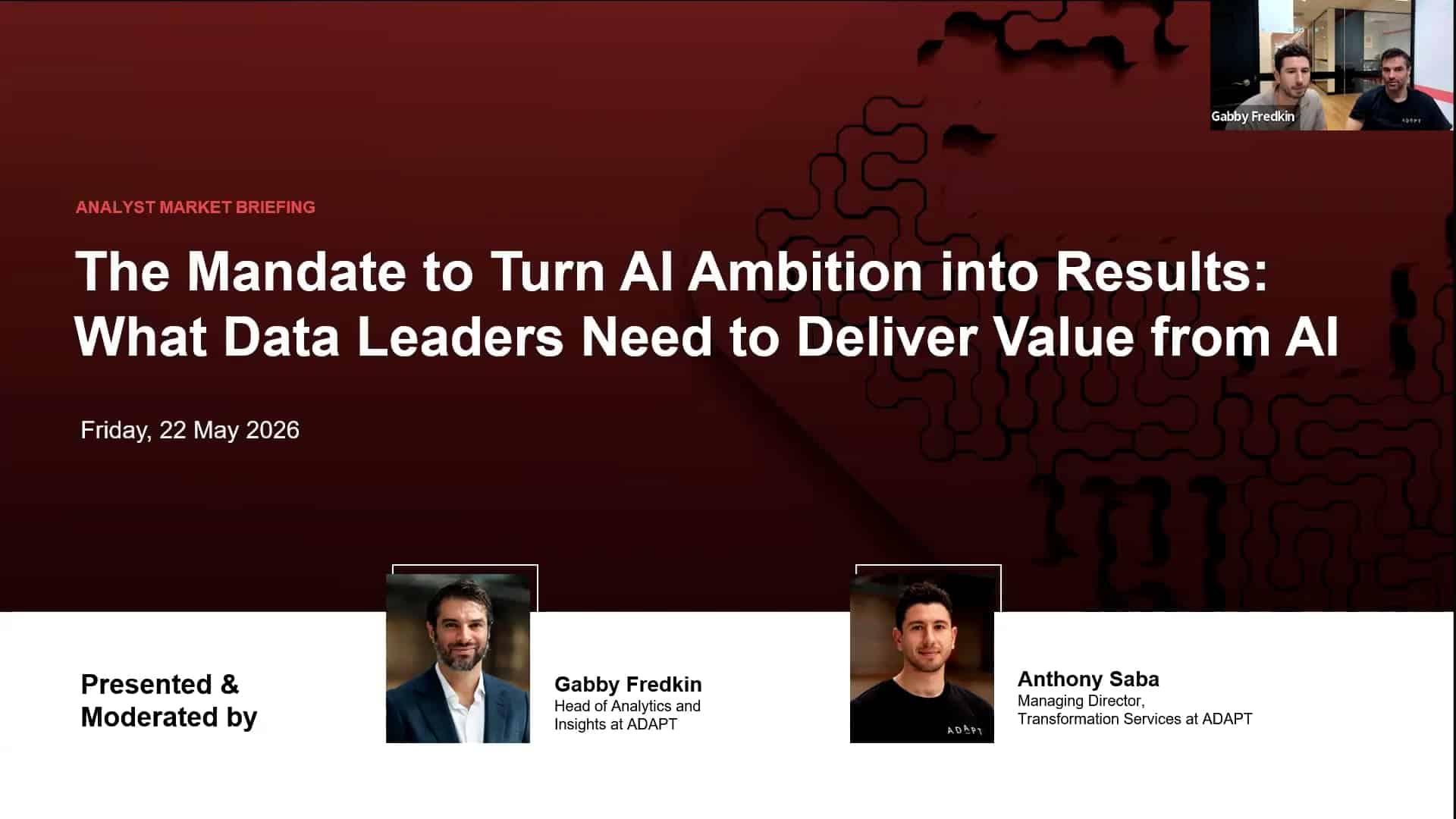


 Published May 28, 2026 in
Articles
Go-To-Market
Contributors
Justina Uy
Published May 28, 2026 in
Articles
Go-To-Market
Contributors
Justina Uy
AI ambition is colliding with enterprise reality.
Australian organisations are increasing investment in data, AI, and agentic automation at record pace, but most still lack the operational maturity required to scale those initiatives confidently.
Governance remains inconsistent, ROI measurement is immature, and workforce readiness continues to lag behind executive expectations.
The result is a new mandate for CDAOs: operationalise AI before organisational complexity overwhelms it.
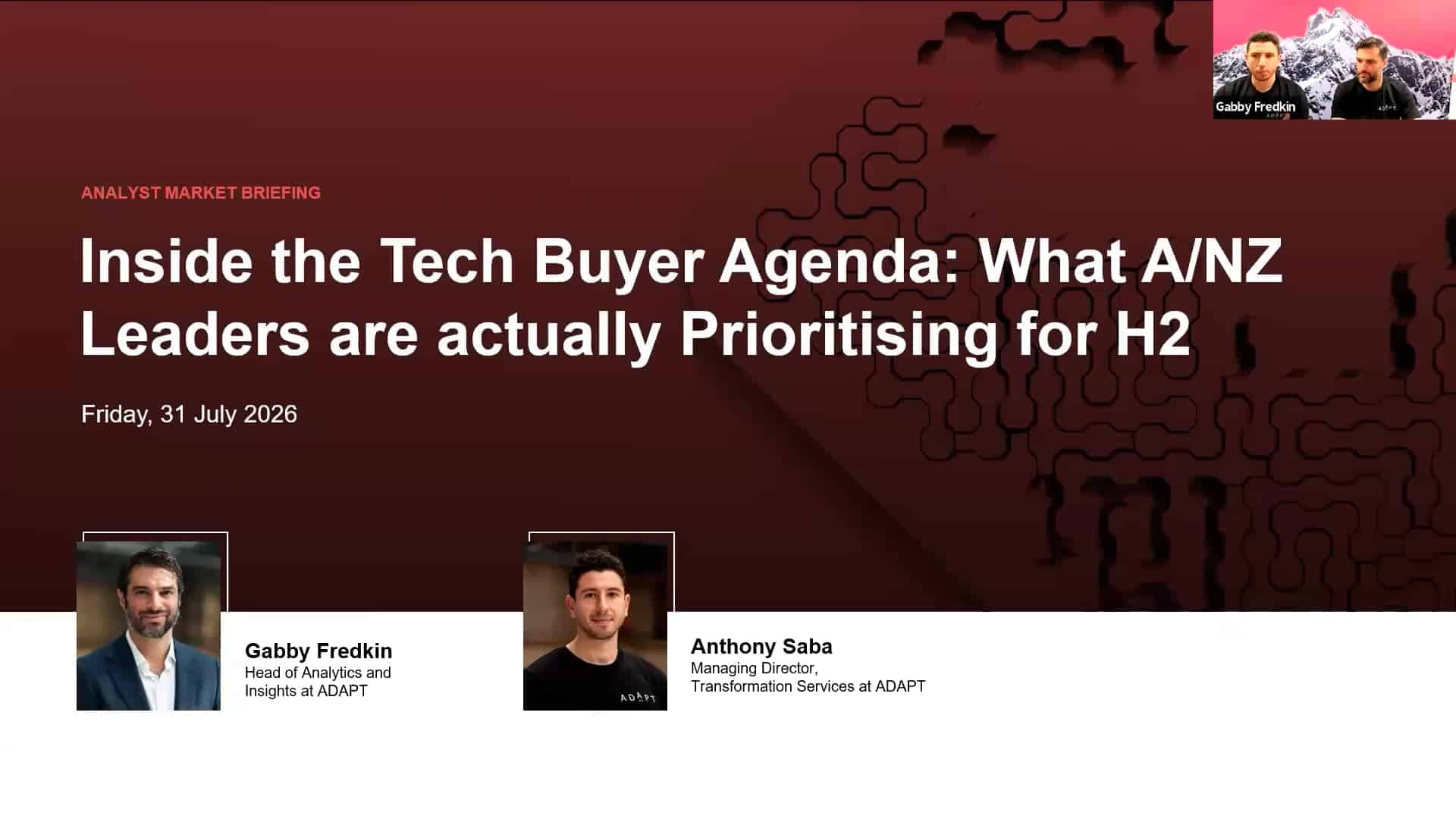
That tension sat at the centre of ADAPT’s Analyst Market Briefing on 22 May 2026, drawing on insights from more than 160 Australian data, analytics, and AI leaders.
For technology vendors, the briefing showed where enterprise AI conversations now need to shift: from ambition and experimentation to readiness, governance, measurable value, and the operational support buyers need to turn AI investment into results.
The video above is just an excerpt. Access the full webinar replay.
Weak data foundations are slowing AI execution
Enterprise AI maturity is still being constrained by poor operational foundations.
Only 8% of organisations say their data is optimised to enable AI at scale.
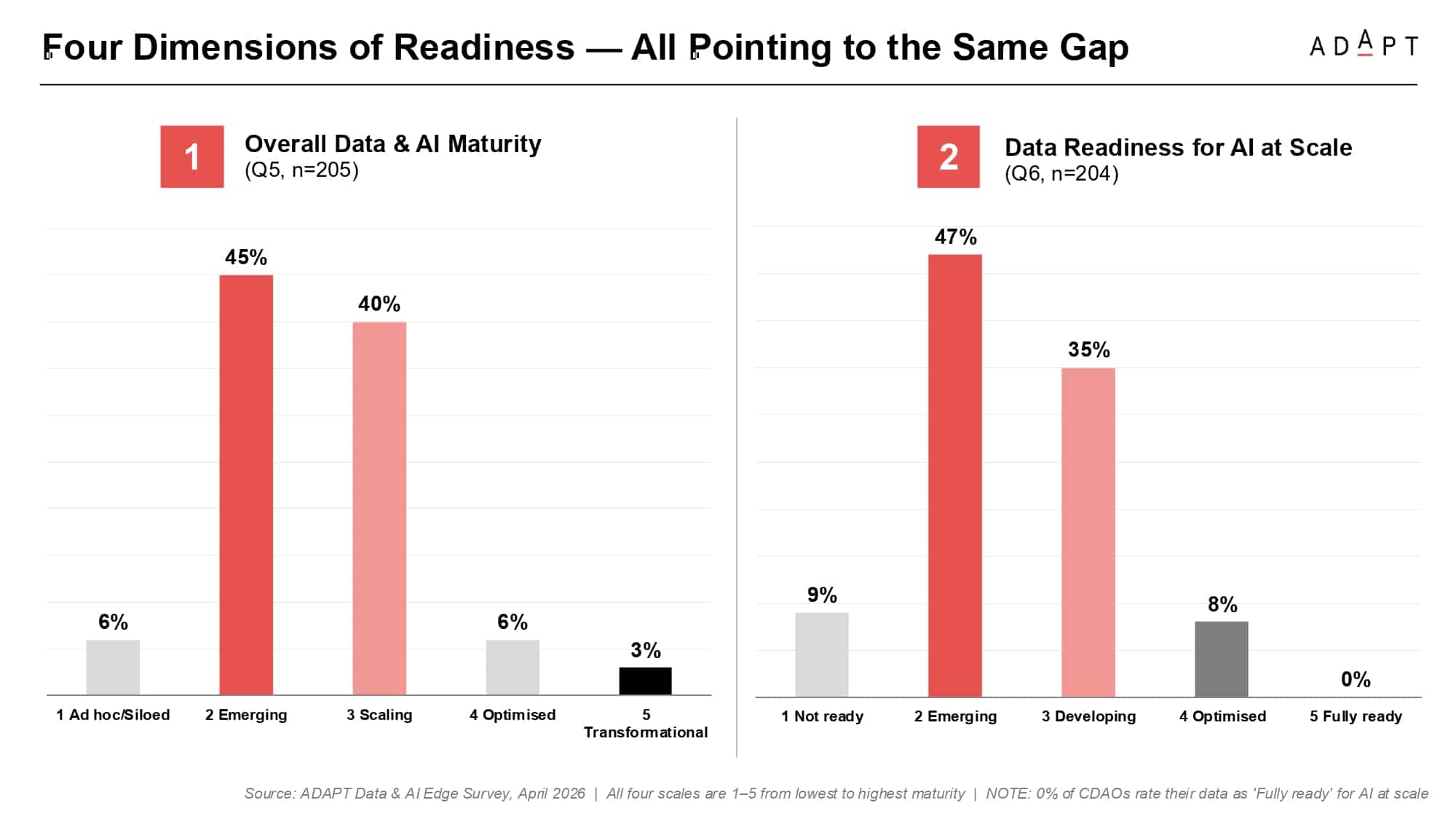
That gap is now directly affecting deployment confidence, scalability, and governance consistency across the enterprise.
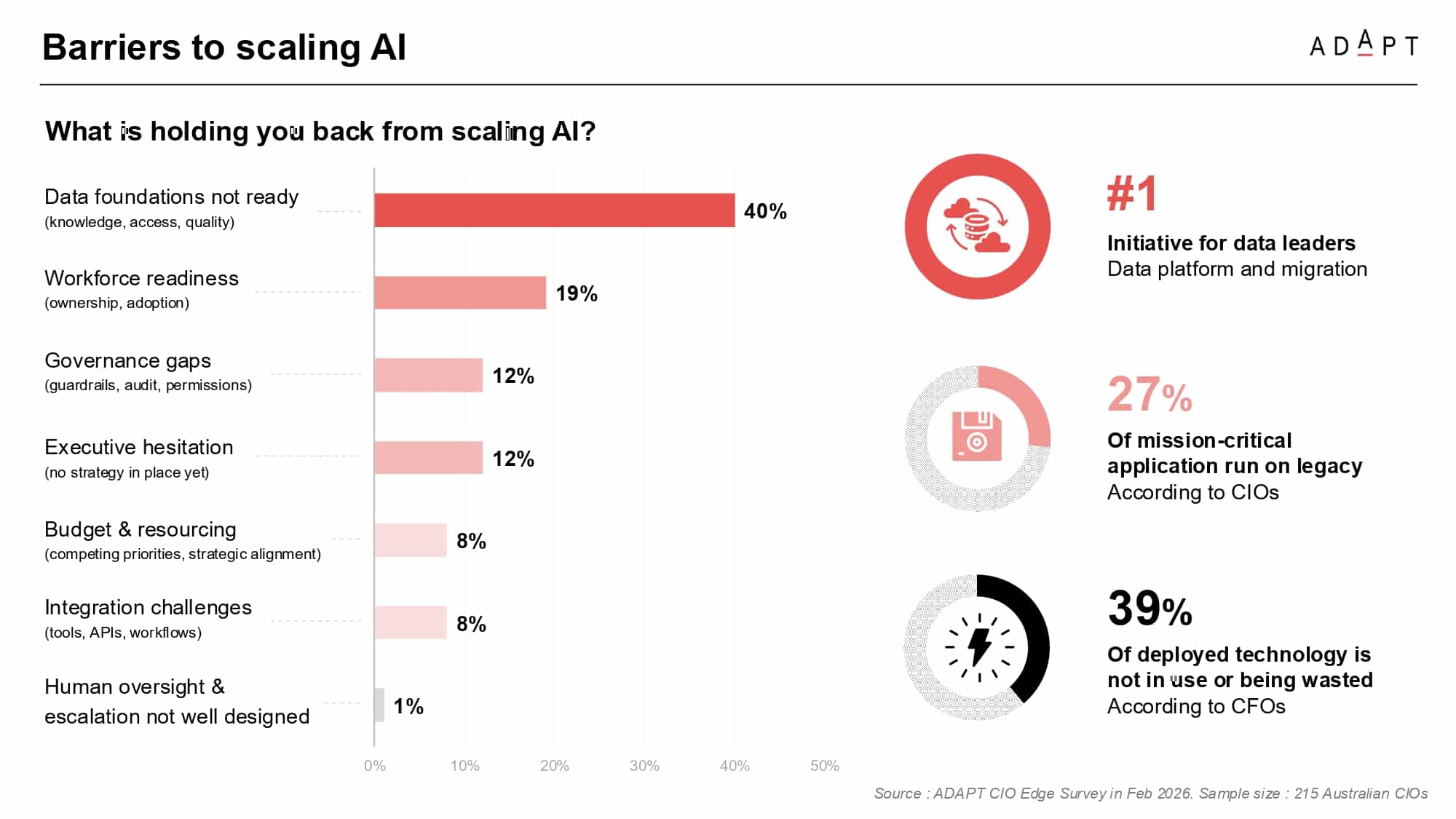
When CIOs were asked what is holding organisations back from scaling AI, data foundations ranked as the largest barrier ahead of governance, integration complexity, workforce readiness, and budget pressure.
Gabby Fredkin, Head of Analytics and Insights at ADAPT, explained during the briefing that many organisations are modernising platforms without fixing the fragmented processes, governance gaps, and operational habits underneath them.
Legacy environments continue to compound the issue.
According to ADAPT’s CIO research, 27% of mission critical applications still operate on outdated technology environments that are poorly suited to AI deployment.
At the same time, CFO scrutiny is increasing.
Finance leaders estimate that 39% of deployed technology is either unused or underutilised, creating greater pressure on technology and data leaders to justify further investment with clearer business outcomes.
Enterprise buyers are increasingly looking for providers who can help reduce operational friction, modernise fragmented environments, and improve AI readiness beyond isolated pilots.
Agentic AI enthusiasm is running ahead of operational maturity
Agentic AI has rapidly entered enterprise roadmaps, but most organisations are still operating in tightly controlled deployment environments.
Administrative workflows, code generation, operational improvements, and knowledge management currently dominate deployment activity.
Higher autonomy use cases such as strategic decision support, fraud management, and customer facing operations remain heavily concentrated in pilot phases.
The biggest challenge is proving value.
Only 5% of organisations report significant ROI from agentic AI initiatives, while 83% say returns remain limited, unclear, or entirely unmeasurable.
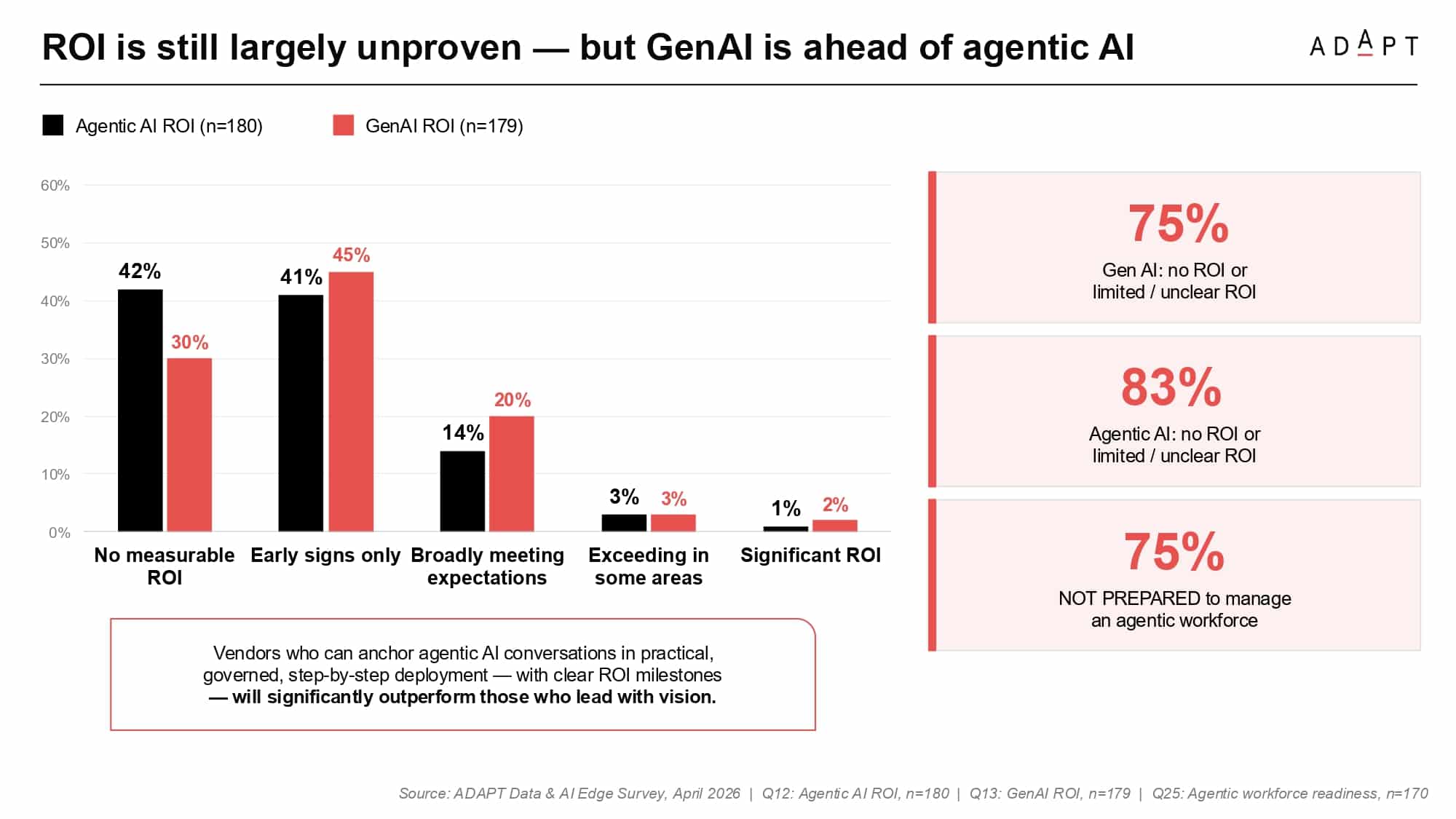
Anthony Saba, Managing Director of Transformation Services at ADAPT, argued that many organisations are still relying on outdated ROI models centred on headcount reduction rather than operational throughput, workflow acceleration, or improved decision quality.
Operational readiness is another major constraint.
Three quarters of organisations admit they are unprepared to manage an agentic workforce.
Questions around ownership, escalation, oversight, and accountability remain unresolved as AI systems become more autonomous.
That is reshaping buyer expectations.
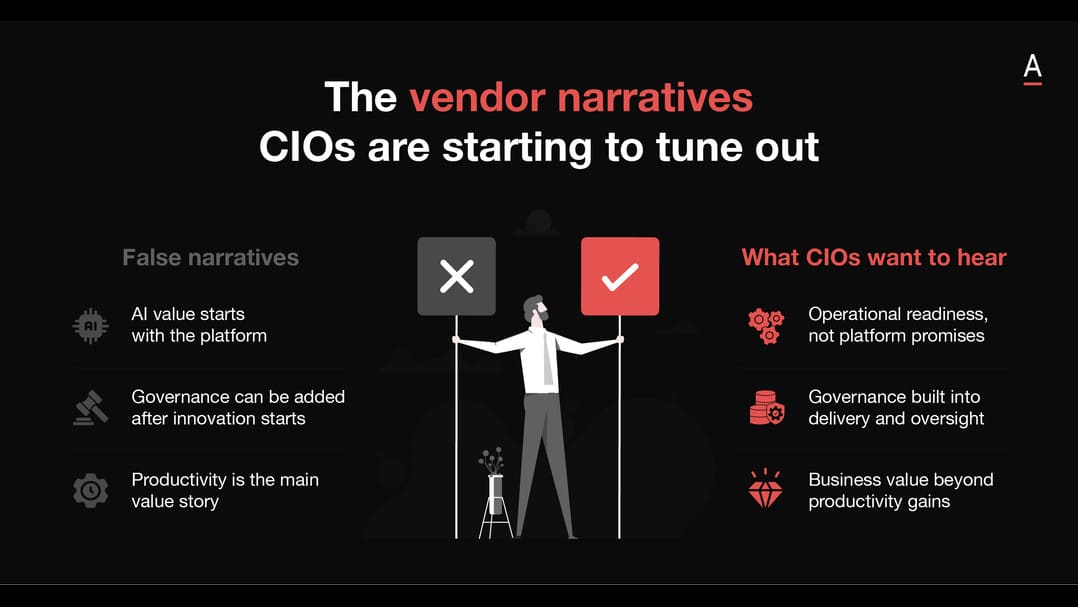
Vendors leading with broad autonomy narratives without practical deployment models, governance structures, or measurable milestones are increasingly disconnected from where enterprise buyers actually are.
AI governance is becoming the defining execution challenge
Governance emerged as one of the clearest operational gaps across enterprise AI adoption.
ADAPT found that 50% of AI pilots and deployments are not covered by a formal governance framework, showing how much AI activity is already operating beyond mature governance coverage.
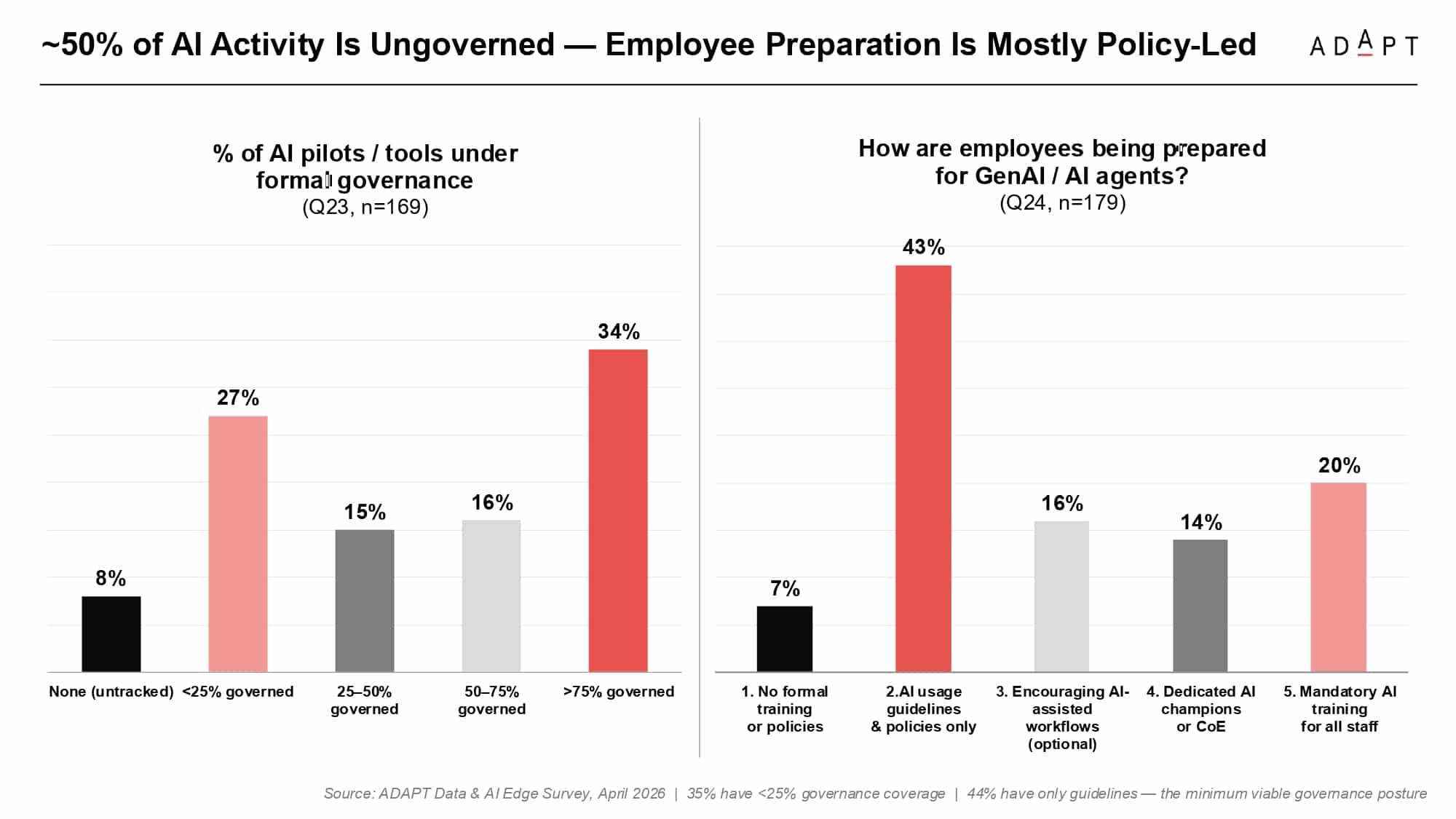
As AI deployment spreads across business units, governance responsibility is becoming harder to contain within technology teams alone.
The briefing highlighted that many organisations still lack clarity around ownership, accountability, and operational oversight.
While governance often defaults toward CIO or data functions, AI deployment increasingly affects finance, legal, operations, HR, risk, and executive leadership simultaneously.
Leading organisations are beginning to treat governance as an operational enabler rather than purely a compliance layer.
Gabby pointed to organisations using governance frameworks to move AI use cases into production faster by reducing exception handling, improving accountability, and creating clearer operational guardrails.
Anthony also noted that governance becomes more difficult with agentic systems because AI behaviour changes continuously over time, making governance an ongoing operational discipline rather than a one time implementation exercise.
That shift explains why AI governance now ranks as the top near term investment priority for CDAOs in 2026.
AI investment is entering a more accountable phase
Enterprise investment in data and AI continues accelerating, with average budgets increasing 140% year over year across surveyed organisations.
But executive scrutiny is rising alongside that growth.
While 41% of organisations still justify AI spending through strategic alignment alone, 38% now require formal business cases tied to measurable ROI expectations.
That pressure is reshaping how CDAOs engage internally and how vendors engage externally.
Data leaders are increasingly expected to communicate AI economics clearly to CFOs, boards, operational stakeholders, and risk teams.
According to Anthony, many organisations still struggle to define what successful AI outcomes should actually look like commercially.
The briefing also reinforced how buyer expectations around vendor engagement are changing.
CDAOs ranked value demonstration, proof of impact, practical relevance, and client-centric engagement as the strongest indicators of effective vendor outreach.
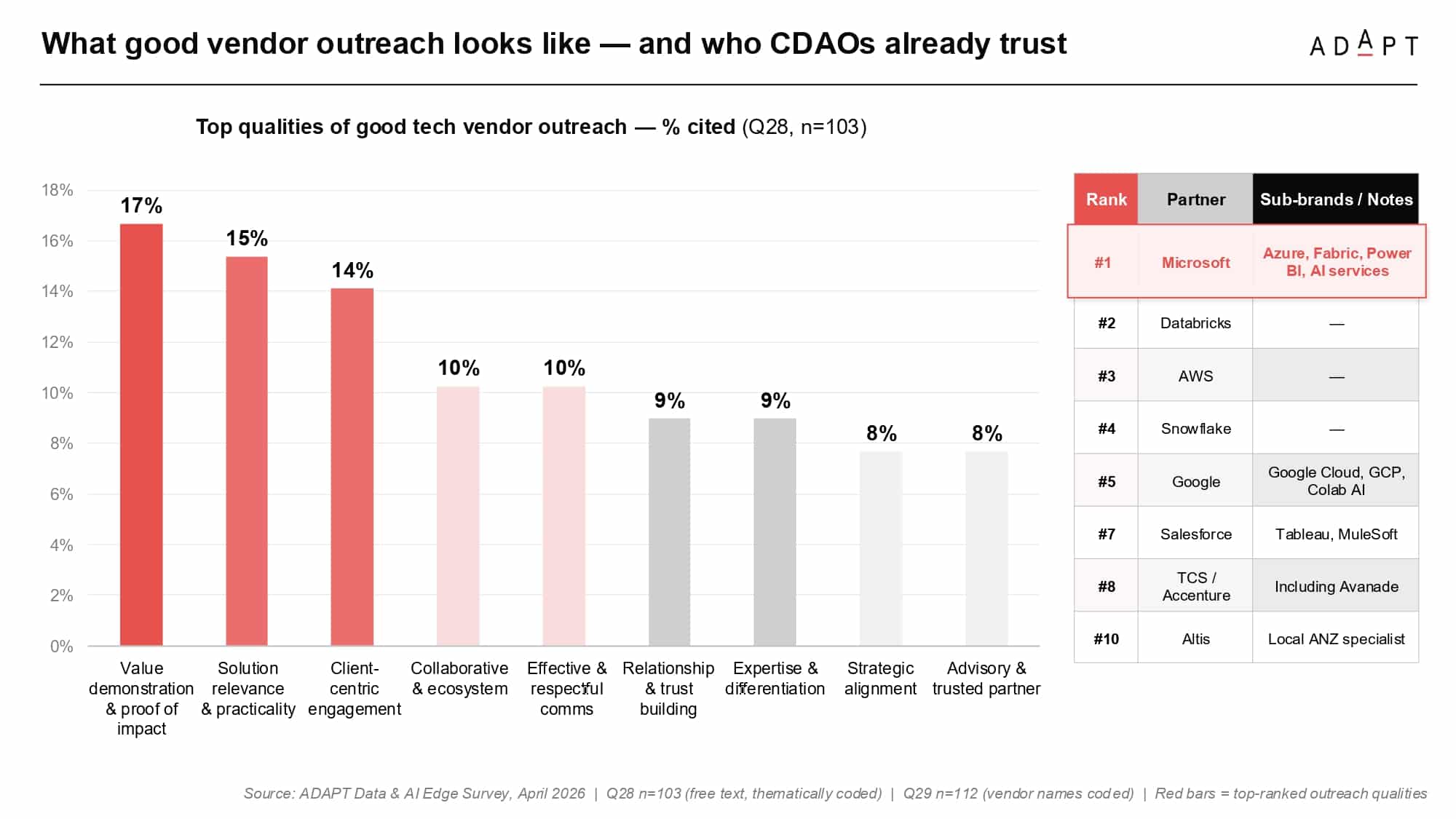
Generic AI messaging is losing effectiveness as buyers demand clearer operational relevance and measurable business alignment.
Recommended actions for technology vendors
The briefing points to a clear shift in buyer expectations. CDAOs are under pressure to turn AI ambition into measurable enterprise outcomes, but many are still dealing with immature data foundations, uneven governance, unclear ROI models, and limited workforce readiness. Vendors need to help buyers close that execution gap, not add more noise to an already crowded AI conversation.
- Reframe AI conversations around execution maturity. Lead with operational constraints such as data readiness, governance coverage, integration complexity, and workforce capability.
- Help CDAOs define measurable value earlier. Bring practical frameworks for identifying outcomes, setting milestones, and explaining AI economics to CFOs and executive stakeholders.
- Position governance as an enabler of scale. Show how stronger governance can accelerate deployment, reduce operational friction, and improve accountability.
- Ground agentic AI messaging in practical deployment. Focus on controlled use cases, oversight models, escalation paths, and measurable operational outcomes.
- Support buying group alignment. Equip data leaders with proof points and business language that help them engage finance, security, operations, legal, HR, and executive sponsors.
- Replace generic AI messaging with operational relevance. Buyers are responding to vendors who demonstrate practical understanding of enterprise execution challenges and measurable impact.
 Justina Uy
Content Marketing Manager
Justina Uy
Content Marketing Manager
Justina Uy is a data-driven content marketer that thrives on democratising elite know-how to empower Australia’s underdogs.
Skilled at translating complex ideas into a compelling story across formats and channels, she shifts seamlessly between writing long-form articles, creating viral social media posts, and producing thumb-stopping videos.
Since 2015, Justina executes her vision through a sophisticated understanding of the rapidly evolving digital and business landscape to serve entertaining and educational insights to the executive community.
Less Join the ADAPT
 Insider Community
Get the latest A/NZ market research and insights on the core trends impacting leaders.