
















How to earn buyer attention when only 9% of vendor engagement goes to new providers
A/NZ technology leaders are prioritising AI readiness, operational control and measurable value. ADAPT’s Analyst Market Briefing examined the challenges shaping these priorities and what they mean for technology vendors.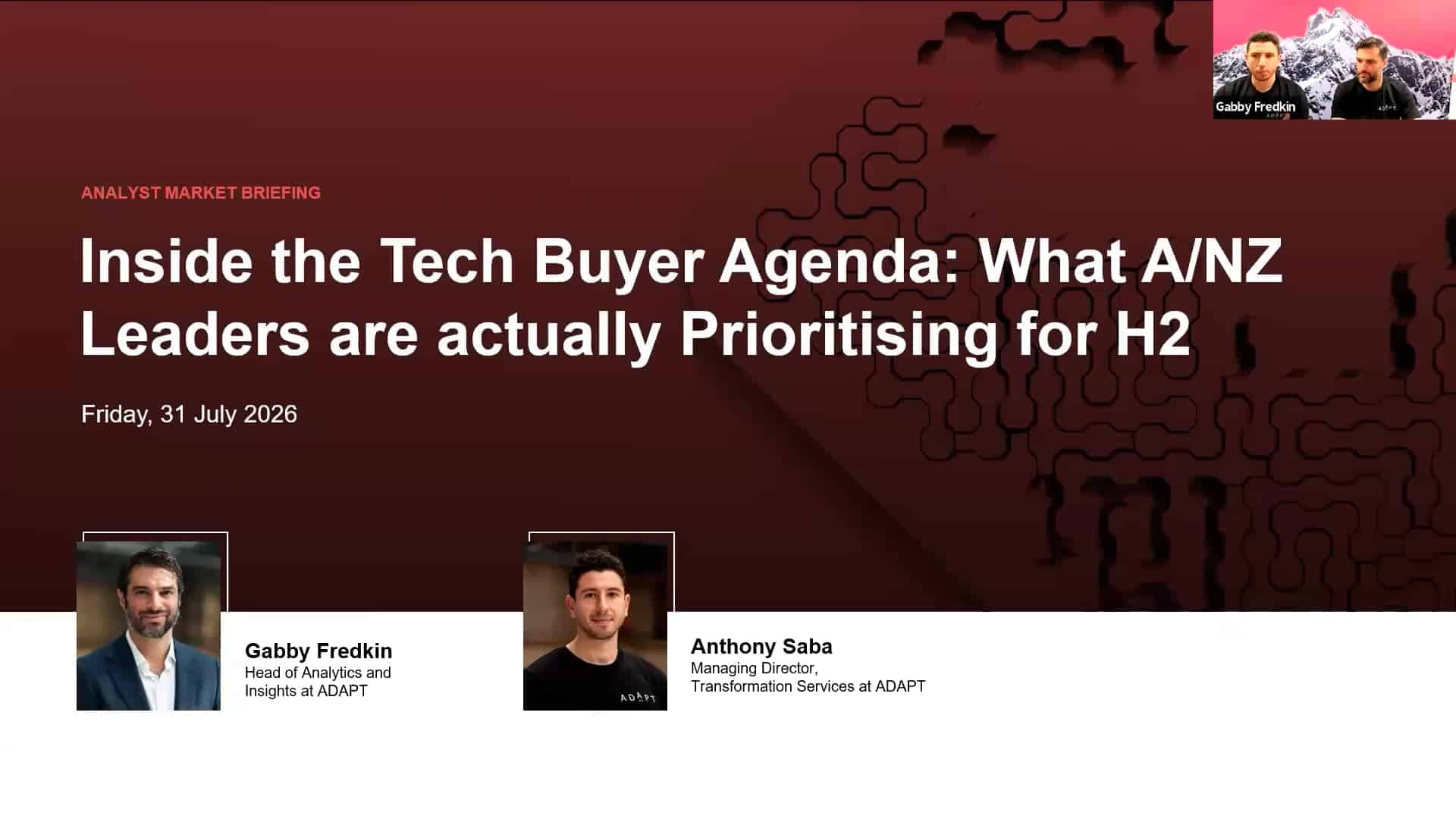


 Published Aug 5, 2026 in
Articles
Go-To-Market
Contributors
Justina Uy
Published Aug 5, 2026 in
Articles
Go-To-Market
Contributors
Justina Uy
Australian technology buyers enter H2 2026 with a sharper focus on value, readiness, control and execution.
As they assess where AI, modernisation and cyber resilience can be justified, governed and scaled, vendors face a higher bar for relevance and proof.
Australian enterprise purchases involve an average of 10 decision-makers and 26 influencers, while major technology buying cycles extend to 416 days.
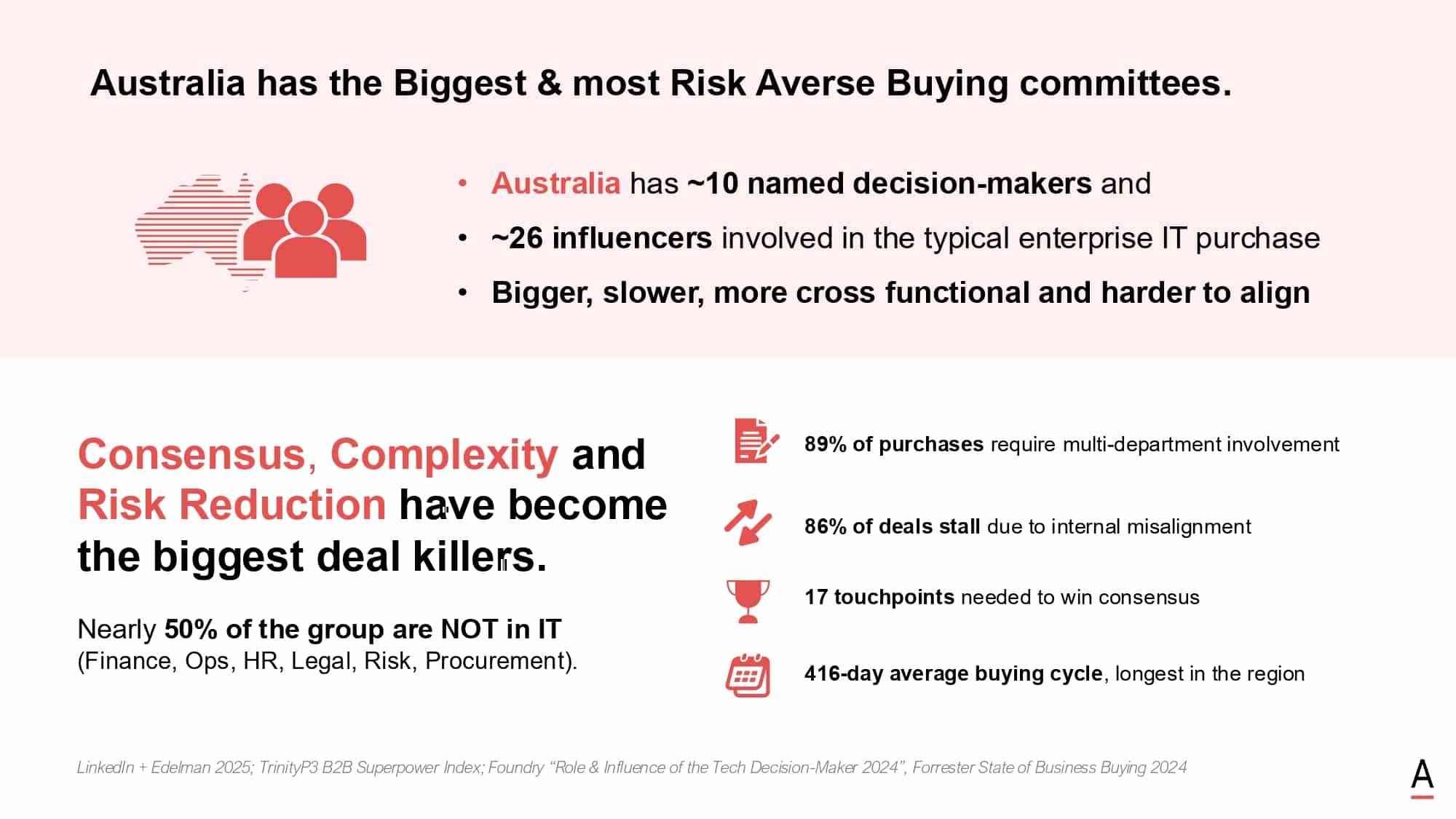
Therefore, they need to establish relevance across a broad stakeholder group and sustain confidence throughout a lengthy decision process.
In ADAPT’s Analyst Market Briefing, Gabby Fredkin, Head of Analytics and Insights, presented findings from more than 1,000 A/NZ survey respondents during the first seven months of 2026.
Gabby explored three areas shaping the buyer agenda: the operating changes required to realise value from AI, the growing importance of security and sovereignty, and the evidence vendors need to earn investment and engagement.
Key takeaways:
- AI strategy has become a leading executive priority, but data foundations, process design and workforce readiness continue to restrict value at scale.
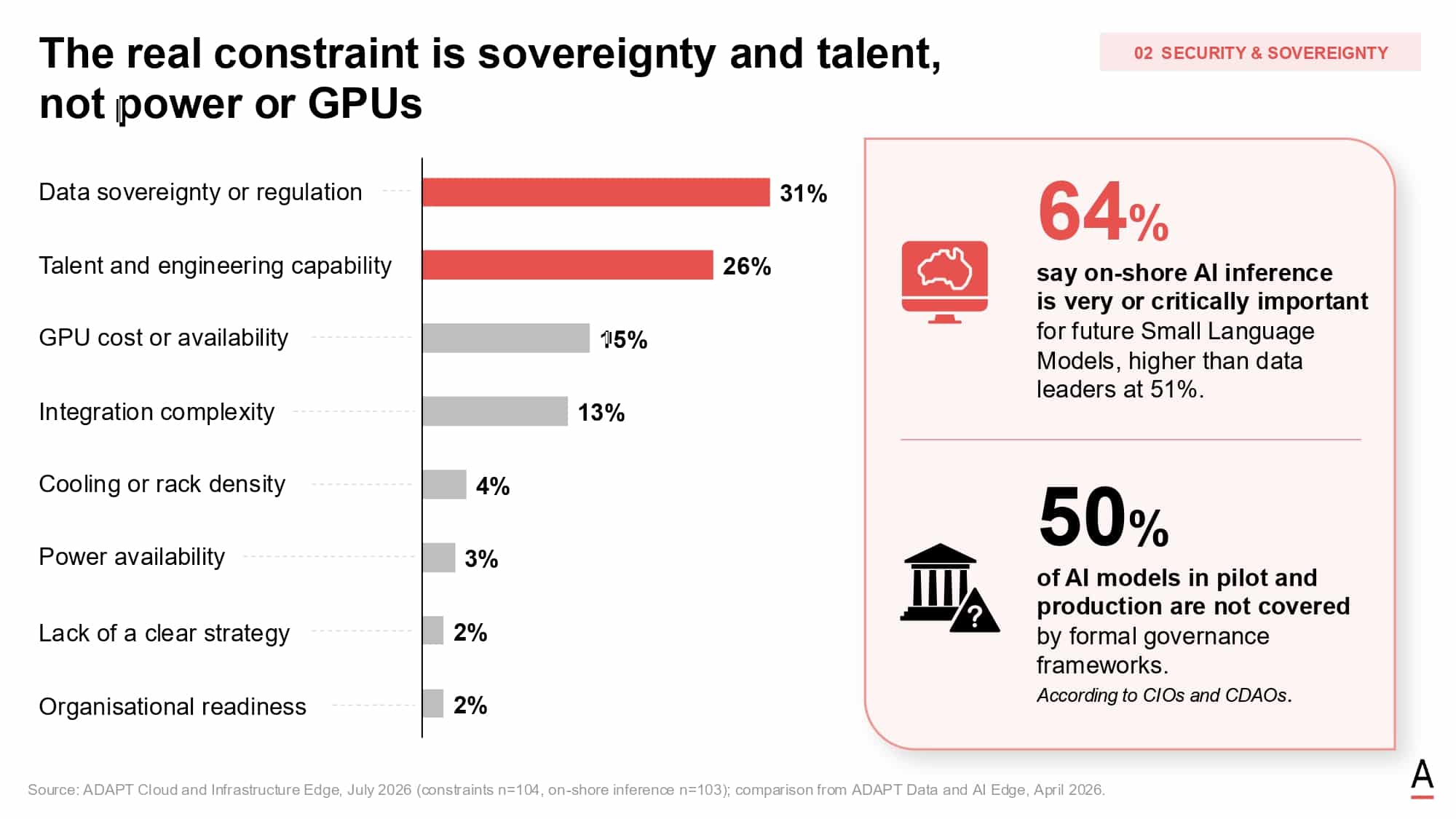
- AI governance is becoming an operational issue involving visibility, data access, identity, cost and sovereignty.
- Technology investment remains under scrutiny as buyers look for stronger evidence of business value and production economics.
- Vendors need to connect their propositions to problems already on the customer’s roadmap, provide relevant proof and tailor engagement to the buyer’s environment.
The above video is an excerpt.
ADAPT Research and Advisory Advantage clients can access the full webinar and slides.
Register to access the full webinar recording.
Operating model redesign unlocks AI value
Developing an AI strategy and roadmap rose from fifth place in 2025 to the leading priority across ADAPT’s executive leadership surveys in 2026.
Yet only 7% of CIOs report reaching operational scale or above with agentic AI.
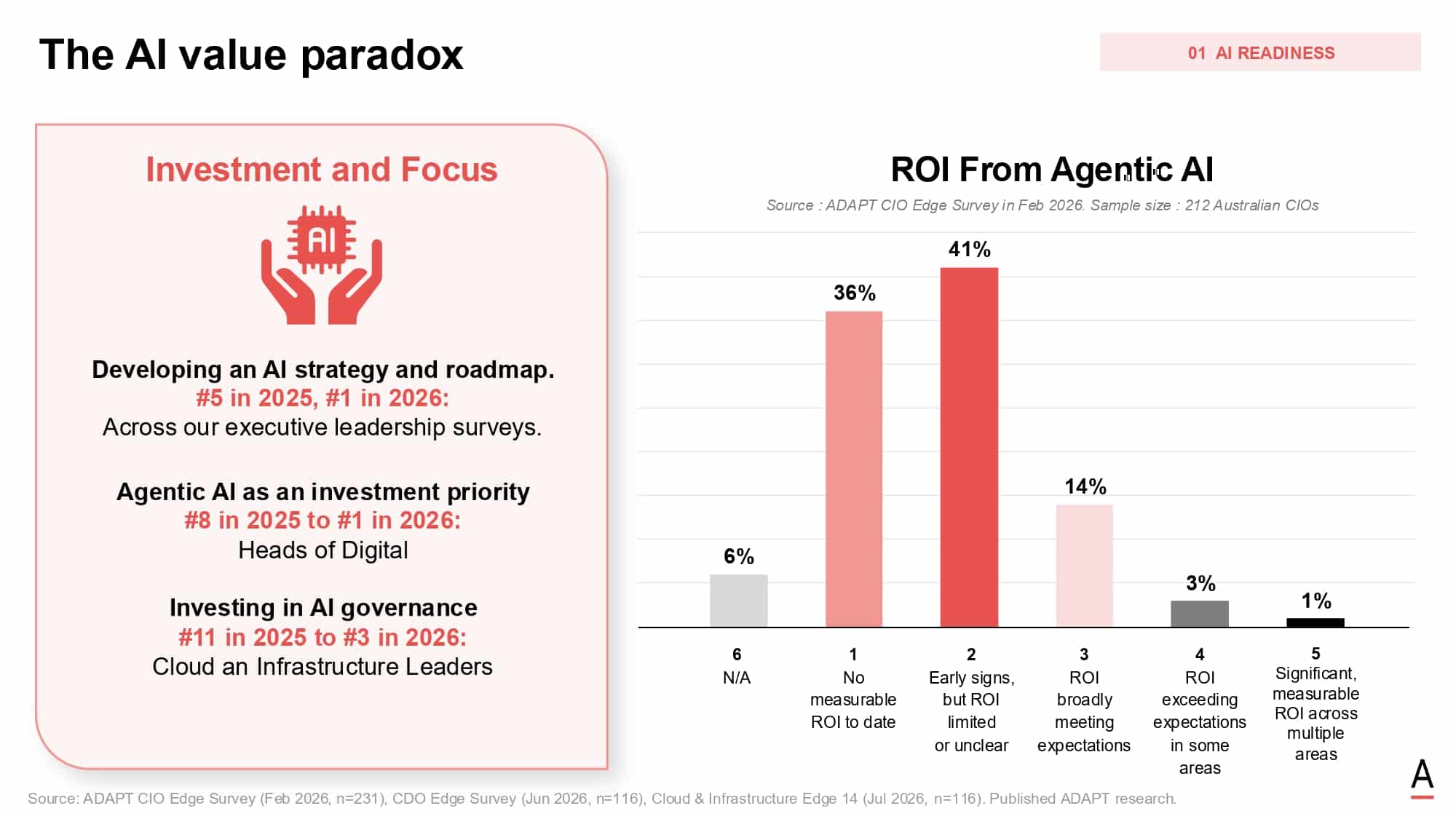
Gabby described a value paradox: organisations can access many of the same AI models, platforms and tools, but few are translating that access into meaningful value.
Data foundations remain the leading barrier.
Gabby explained that organisations frequently migrate to new platforms with embedded data and governance capabilities while carrying across the same poor processes and legacy mindsets.
The technology changes, but the underlying constraints remain.
Process and operating-model redesign are therefore becoming more important.
Gabby questioned whether organisations are simply adding AI to existing processes or redesigning work from first principles.
The conversation is shifting away from isolated AI use cases towards the business problems organisations need to solve, such as reducing costs, improving service speed or strengthening customer outcomes.
Workforce readiness presents a similar challenge.
AI usage guidelines remain the most common response in many organisations, but Gabby characterised them as risk reduction rather than enablement.
Policies alone do not help people absorb AI into their everyday work.
Production also changes the economics.
Gabby shared an example in which a task requiring 100 effort points from a person required 30 from an agent in a controlled pilot, but 140 once the agent entered production.
Clean pilot data gives way to integration requirements, compliance, variable user behaviour and real customer interactions.
Reliability can also deteriorate across multi-agent workflows.
Gabby demonstrated that five agents operating at 92% reliability individually produce approximately 66% reliability across the complete chain.
For buyers, AI value depends on the performance and cost of the whole workflow, not the capability of one agent in isolation.
Recommended actions for technology vendors:
- Redesign workflows around the business outcome: Map the current process, identify where AI can improve it and define the operating-model changes needed to realise value.
- Prove the economics in production: Demonstrate performance after integration, reliability, compliance, human oversight and total cost are factored in.
- Address the customer’s readiness gaps: Show how the solution works within their existing data, workforce and governance constraints without creating another platform burden.
Relevance and proof drive technology investment
Technology leaders report limited funding and competing priorities as barriers to delivery.
At the same time, CFOs estimate that an average of 40% of deployed technology is unused or wasted.
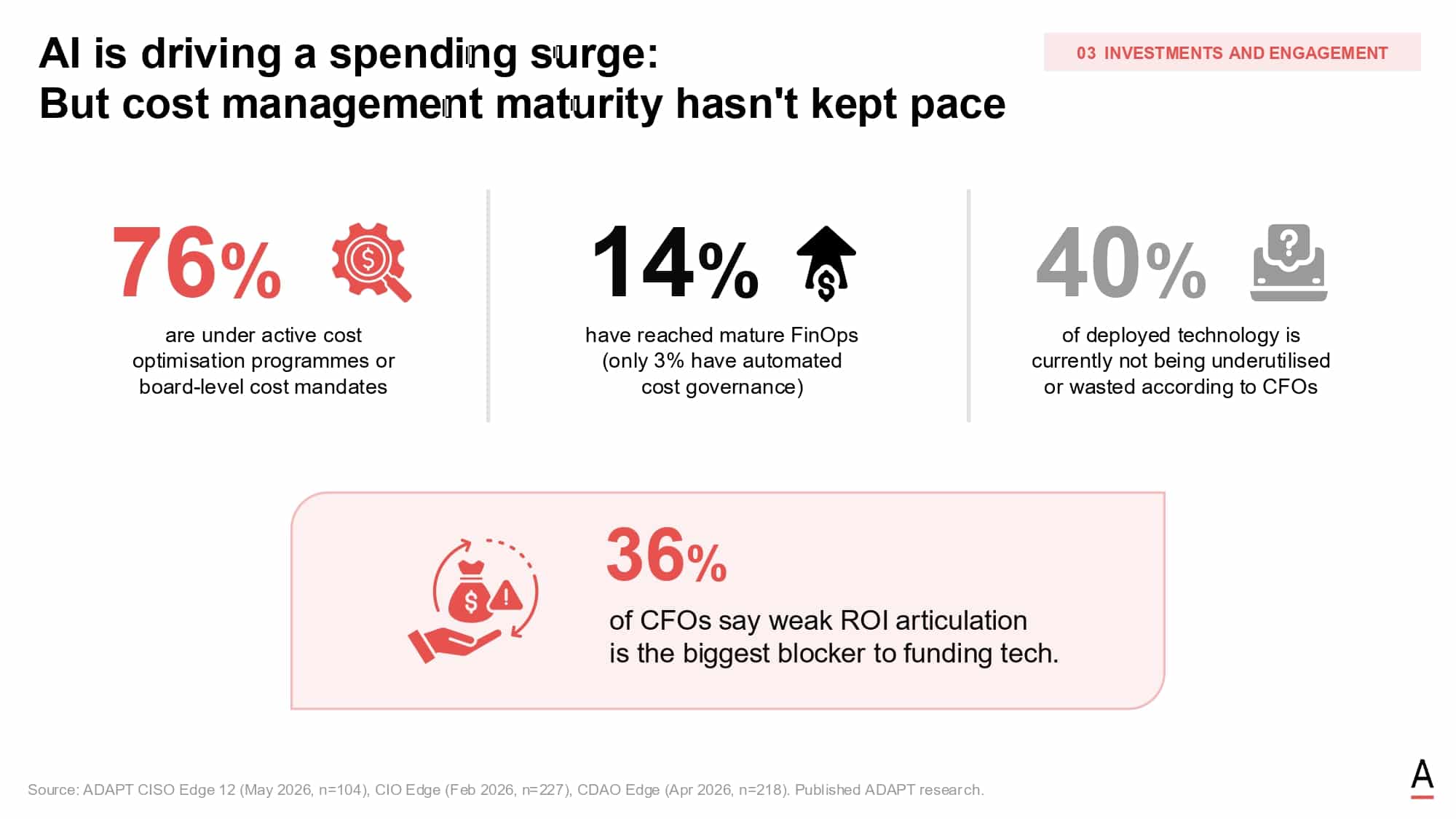
Gabby identified a disconnect between technology leaders seeking more funding and CFOs looking for clearer evidence of value.
That scrutiny becomes more complex with AI, where token consumption, changing user behaviour and the cost of unsuccessful outcomes do not fit neatly within established financial models.
FinOps practices will need to evolve accordingly.
Gabby explained that tokens behave more like a meter than a conventional line item, while CFOs are taking a more strategic role in evaluating technology spend, investment and ROI.
For vendors, earning engagement is part of the same value challenge.
Approximately 80% of vendor outreach is rated ineffective, with buyers placing the greatest value on client-centric engagement.
Gabby said relevance and personalisation will determine which vendors stand out.
Buyers want providers to understand their organisation, role and immediate problems before introducing an offering.
Relevant evidence also matters.
Local customer success stories and strategic thought leadership are each considered useful during the pre-sale stage by 54% of CIOs.
Gabby highlighted the particular influence of examples from the buyer’s own industry, where the provider can demonstrate experience with a comparable environment and problem.
Access to senior vendor leaders can strengthen confidence further.
Some 53% of CIOs consider meeting a vendor’s local executive leadership very important or essential before a major purchase.
Gabby explained that these relationships give CIOs a trusted escalation point and support more strategic, business-level conversations during a buying cycle that can last more than a year.
Recommended actions for technology vendors:
- Align the proposition with an existing business priority. Connect the solution to a defined problem already on the customer’s roadmap.
- Equip buyers to build internal consensus. Provide relevant customer evidence, ROI modelling and a clear account of business value and risk reduction.
- Tailor engagement to the buyer’s environment. Adapt messaging and proof to the organisation’s sector, size, maturity and operating constraints.
- Establish local executive accountability. Give buyers access to senior local leaders who can support strategic conversations, resolve issues and remain engaged throughout the buying cycle.
Earning relevance with A/NZ technology buyers
A/NZ technology buyers are not assessing AI, security and investment as separate conversations.
They are examining whether new technology can produce measurable value within the organisation’s data, operating, governance and financial constraints.
Vendors that understand those conditions and support their propositions with relevant evidence will be better positioned to earn attention and maintain confidence across complex buying groups.
The above video is an excerpt.
ADAPT Research and Advisory Advantage clients can access the full webinar and slides.
Register to access the full webinar recording.
 Justina Uy
Content Marketing Manager
Justina Uy
Content Marketing Manager
Justina Uy is a data-driven content marketer that thrives on democratising elite know-how to empower Australia’s underdogs.
Skilled at translating complex ideas into a compelling story across formats and channels, she shifts seamlessly between writing long-form articles, creating viral social media posts, and producing thumb-stopping videos.
Since 2015, Justina executes her vision through a sophisticated understanding of the rapidly evolving digital and business landscape to serve entertaining and educational insights to the executive community.
Less
Join the ADAPT
Insider Community
Get the latest A/NZ market research and insights on the core trends impacting leaders.