















How can CIOs design an operating model that turns AI investment into business value?
At ADAPT’s CIO Network Effect, Australian technology and transformation leaders examined how to redesign operating models, establish enterprise ownership, and measure the real economics of AI in production.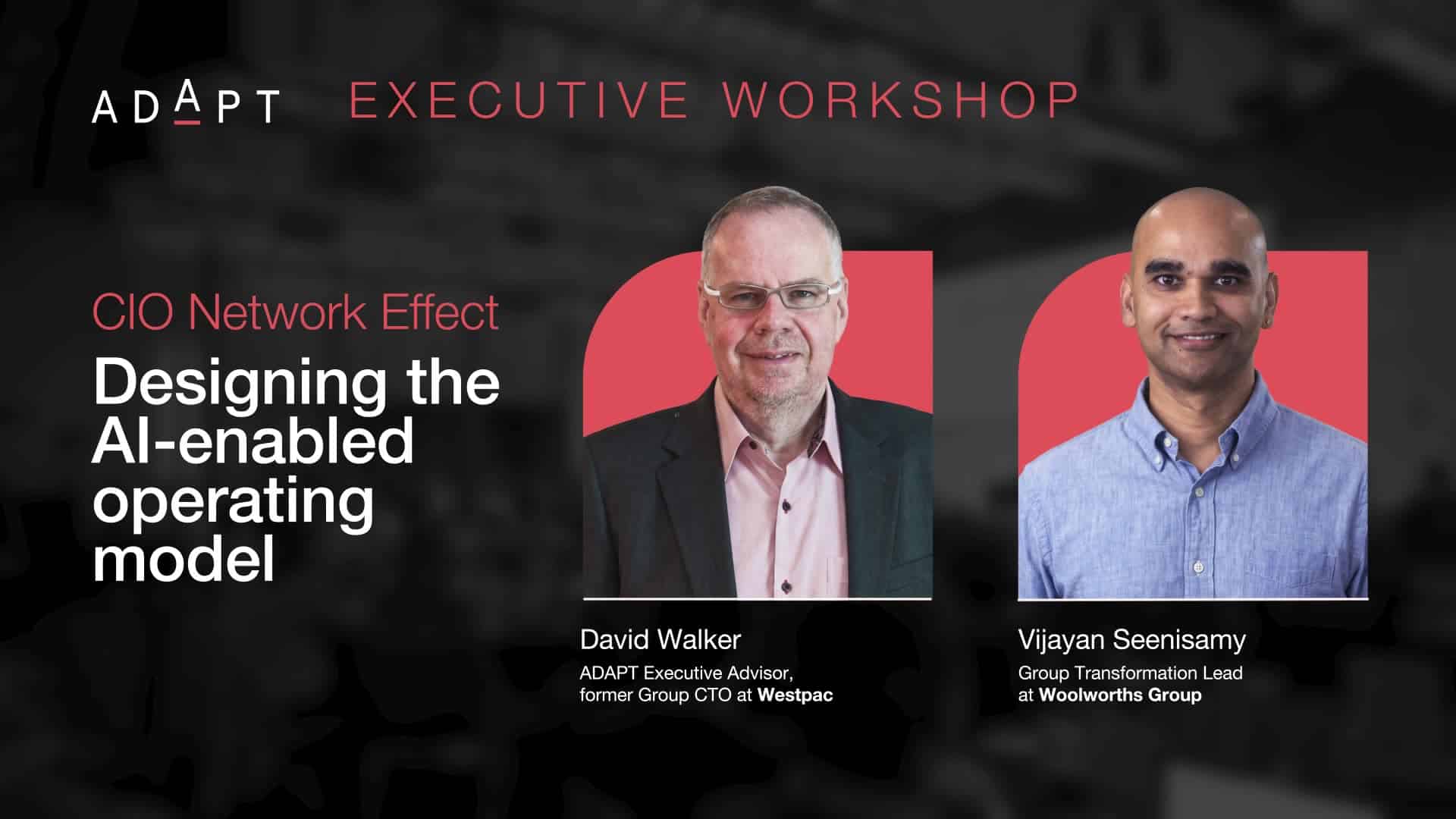


 Published Aug 19, 2026 in
Articles
Data & AI Strategy
Contributors
Justina Uy
Published Aug 19, 2026 in
Articles
Data & AI Strategy
Contributors
Justina Uy
Australian CIOs are moving beyond AI pilots to redesign how work, decisions, and accountability operate across the enterprise.
AI challenges the structures organisations use to govern technology investment and deliver change.
Funding pilots, deploying agents, or appointing an AI leader will not produce value while existing processes, decision rights, financial models, and accountabilities remain unchanged.
At ADAPT’s CIO Network Effect last May 2026, CEOs, CIOs, and transformation leaders examined what organisations must change to embed AI into core business execution.
Lisa Drum, Head of Product at ADAPT, facilitated a panel with David Walker, former Group CTO at Westpac and DBS Bank, and Vijayan Seenisamy, ASX 30 Group Transformation Executive.
Their discussion focused on redesigning work around AI, assigning ownership across the enterprise, and measuring whether AI systems create value once they enter production.
This article covers:
- Redesigning workflows around AI
- Establishing enterprise-wide accountability
- Measuring AI economics in production
- Building the capabilities required to scale A
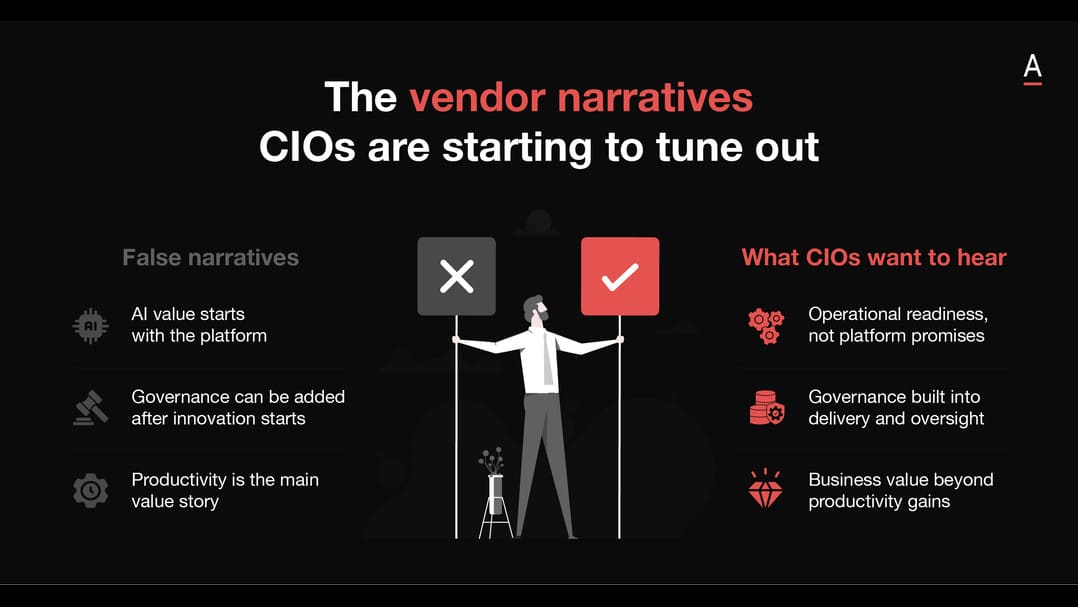
AI value starts with operating-model redesign
Many organisations still apply conventional technology delivery structures to AI.
David said CIOs face restricted funding and executive scepticism shaped by technology programs that missed their promised outcomes. CFOs want to know why AI investment will perform differently.
Vijayan said capability-led pitches fail to answer that question.
Technology leaders should start with an end-to-end workflow, establish its current unit economics, and calculate how AI changes cost, speed, reliability, and customer value.
Previous technologies helped people complete work more efficiently.
AI agents perform parts of the work, forcing organisations to reconsider how tasks, decisions, and accountability are divided.
Adding an agent to an existing process preserves its limitations. Workflow redesign changes how the organisation creates value.
David said this redesign extends across finance, operations, workforce structures, customer propositions, and decision-making.
Business leaders must own these changes, supported by technology teams.
He shared Westpac’s Shark Tank program, which equipped employees to identify AI opportunities and redesign work through innovation training.
CIOs must distribute this capability within enterprise standards for data, risk, investment, and production.
Vijayan said leaders must also determine the appropriate level of agent autonomy while retaining human responsibility for judgement and outcomes.
AI-enabled operating models must define:
- The work assigned to people and agents
- The authority each participant holds
- The person accountable for the final outcome
These controls allow organisations to move AI from pilots into production.
Enterprise AI requires CEO ownership
David said DBS Bank’s digital transformation began within technology and shifted to CEO ownership once its enterprise-wide impact was understood.
David and the DBS technology leadership team helped the CEO understand what digital technologies would change across the bank.
This positioned the transformation as a business agenda rather than a technology program.
AI requires the same ownership model.
CIOs often identify the change first, while finance models, workforce development, customer propositions, operating processes, and risk controls remain owned across the enterprise.
Vijayan identified three common approaches: placing AI under the CIO or CTO, assigning it to the chief data officer, or appointing a dedicated AI executive.
Each structure fails when responsibility sits with one leader who lacks the authority, budget, or decision rights to change other functions.
ADAPT views CEO sponsorship alone as insufficient.
The CEO must set the mandate, each executive must own the redesign within their function, and the CIO must connect those changes through a coherent enterprise model.
David advised CIOs to frame AI around each leader’s priorities.
Finance leaders need the economics, while customer leaders need to understand the impact on service, experience, and competitive position.
He also shared how Westpac brought risk, cyber, operations, finance, and technology representatives into one AI accelerator.
Participants held decision-making authority and worked together from the outset, replacing sequential approvals with shared learning and faster decisions.
This structure offers a practical model for enterprise AI governance: distribute ownership across the functions affected, involve control teams early, and give participants the authority to resolve issues within the delivery process.
AI economics must measure successful production outcomes
Most enterprise AI measures track deployment and adoption rather than business value.
Vijayan said organisations assess agents like conventional software, focusing on launch dates, availability, and user adoption.
Agents should instead be managed as business assets and measured against:
- Cost
- Output
- Reliability
- Margin contribution
- Risk exposure
His primary measure is cost per successful outcome: the complete cost of producing an accepted result through AI, including tokens, retries, failures, integration, human review, escalation, and compliance.
Leaders must also account for the financial, regulatory, and reputational exposure created when an agent fails.
Measures such as productivity, cycle time, and customer experience should then reflect the workflow being assessed.
Vijayan shared an example from a customer-facing agent ecosystem that initially produced a successful outcome for approximately $0.08.
After deployment and increased transaction volume, the cost rose to approximately $1.40 as upstream data changed, users asked more complex questions, and the system invoked more sub-agents and retries.
The pilot economics did not survive production.
ADAPT sees this as a critical gap in AI business cases.
Initial projections often exclude the operating conditions that determine commercial performance, leaving leaders unable to see when an AI system starts destroying value.
Organisations must monitor these economics throughout the agent’s lifecycle and manage AI initiatives as a portfolio.
Vijayan proposed a simple test: has the organisation retired an agent or AI project?
If every initiative remains active, leaders are accumulating experiments rather than managing performance.
The panel also challenged headcount reduction as the default value measure.
David said workforce savings overlook the people required to supervise, maintain, govern, and improve AI systems.
Vijayan framed the decision around autonomy rather than replacement.
Organisations must define how much of each workflow an agent performs, where human judgement remains essential, and who carries accountability for the outcome.
For CIOs, production readiness requires continuous economic measurement, clear thresholds for intervention, and the discipline to improve, redirect, or retire agents that fail to deliver sufficient value.
Building the AI-enabled operating model
AI value requires coordinated change across work, leadership, governance, and economics.
CIOs need to redesign complete workflows rather than insert agents into existing processes.
CEOs need to lead the enterprise agenda while executives retain ownership of the changes within their functions.
Risk, cyber, finance, operations, and workforce leaders need decision rights inside the delivery model from the outset.
AI systems also need commercial measures grounded in production.
Cost per successful outcome, reliability, margin contribution, and risk exposure provide a clearer account of value than deployment milestones, adoption rates, or token consumption alone.
The CIO’s task is to connect these elements.
By translating AI into business economics, distributing ownership across the enterprise, and establishing accountability for human and machine work, CIOs create the operating conditions required to turn AI investment into measurable performance.
 Justina Uy
Content Marketing Manager
Justina Uy
Content Marketing Manager
Justina Uy is a data-driven content marketer that thrives on democratising elite know-how to empower Australia’s underdogs.
Skilled at translating complex ideas into a compelling story across formats and channels, she shifts seamlessly between writing long-form articles, creating viral social media posts, and producing thumb-stopping videos.
Since 2015, Justina executes her vision through a sophisticated understanding of the rapidly evolving digital and business landscape to serve entertaining and educational insights to the executive community.
Less Join the ADAPT
 Insider Community
Get the latest A/NZ market research and insights on the core trends impacting leaders.