
















RMIT University’s Professor Vishaal Kishore on building the infrastructure for safer healthcare innovation
In this interview, Professor Vishaal Kishore, Executive Chair at the RMIT Cisco Health Transformation Lab, shares how NIIN is scaling safer care today.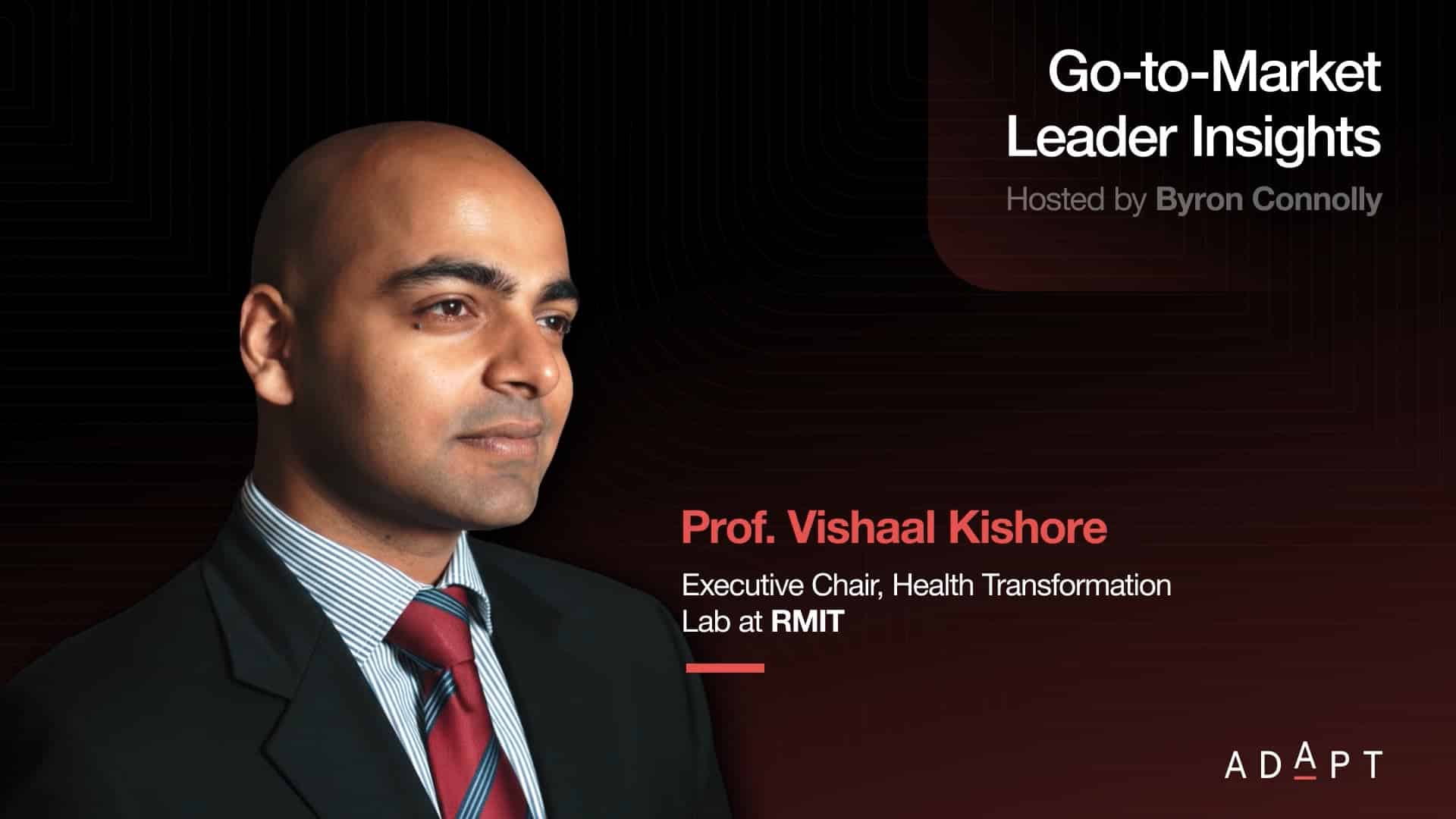


 Published Mar 16, 2026 in
Peer Insights
Strategic Business Initiatives
Contributors
Vishaal Kishore
Byron Connolly
Published Mar 16, 2026 in
Peer Insights
Strategic Business Initiatives
Contributors
Vishaal Kishore
Byron Connolly
In this interview with ADAPT’s Head of Programs & Value Engagement Byron Connolly, Professor Vishaal Kishore, Executive Chair at the RMIT Cisco Health Transformation Lab, shares how NIIN is scaling safer care today.
Australia’s healthcare leaders are tackling compounded pressures, including fragmented digital infrastructure, escalating cyber risks, constrained budgets and workforces stretched by administrative load.
This prevents clinicians from operating at the top of scope and slows progress on improving patient outcomes.
One organisation working to address these issues is the National Industry Innovation Network (NIIN) Health Alliance, which brings together government, university partners and industry to drive tech advancements in healthcare.
NIIN runs 6 innovation centres as well as 2 health-focused labs and tech centres. These serve as hubs for digital innovation across the sector.
Professor Vishaal Kishore, Executive Chair at the RMIT-Cisco Health Transformation Lab, a NIIN alliance member, describes the organisation as a ‘machine’ that can solve some of Australia’s biggest healthcare problems.
Speaking to ADAPT, Kishore says one of these challenges is the fragmentation of governance around digital healthcare innovations, where systems are operated separately by various state and federal governments.
“In the digital space it’s very fascinating because we know that the technologies are out there, but how do they work together? How do they interface with the governance structures and the ethical networks we have in play in different parts of our systems? These are non-trivial questions.
“Everybody’s got their own pet AI or pet digital health project. The question is, ‘When you bring all of those projects together, what happens?’ Do you get an optimised system or just a bunch of point solutions working together?’”
Kishore adds that one of the greatest barriers to success is demonstrating the value of great ideas and technologies.
“There’s a gulf of practice there that we need to find increasingly intelligent ways to traverse.”
Recent healthcare innovations
Over the past year, NIIN has launched industry-partnered pilots and proof-of-concepts with around 50 organisations, attracting more than $11 million in project funding.
Significant initiatives include virtual ED [emergency department] programs, combine telehealth data with ED capabilities when patients are unable to attend hospitals.
Other initiatives include smart glasses technologies (augmented reality headsets), which provide an improved interface for clinicians delivering virtualised care models.
Also, technologies that enable aged care providers to ethically monitor patients in home and residential care settings.
“So, we know, for example, when we serve food to people, are [they] eating it or not? Is anybody touching the tray? [This helps] get resources to where we need people checked in at the right moment.
“We also got some very exciting emotional monitoring technologies that help us know when people are distressed, when are they angry and when they are despondent. So we can target care in the right kinds of ways. All of this comes with really important privacy and ethical considerations.”
The University of the Sunshine Coast, a NIIN partner, has also been testing AI software running on cameras to monitor people with dementia and delirium in high-risk hospital settings.
A deployment is expected this year across several hospital rooms at the Sunshine Coast University Hospital.
“NIIN is proving that if you take those constraints and you build for the real world that we live in, we can achieve a lot right now with the technology that we have, while persevering and indeed, enhancing, some of those dimensions”, says Kishore.
Viewing tech as an investment
Healthcare organisations are notorious for – some would rightly say – focusing on controlling costs rather than viewing technology as an investment.
During an ADAPT roundtable discussion in late 2025, one healthcare industry chief executive noted a cultural shift over the past 18 months, where clinicians feel that the availability of generative AI tools like ChatGPT negates the need for a dedicated technology department.
Kishore agrees that the sector needs to starting viewing technology as a competitive advantage.
“We’re deploying technology in real ‘live fire’ settings…people live or die based on the kinds of care that we are able to give them [patients] and the kinds of technology that we’re able to use or not use.
“I don’t critique providers for being cautious, because [there are] real life and death situations.
The time is absolutely right for [finding] ways to use what we might call the ‘infrastructure’ around the [healthcare] system.
“So, how can we help providers innovate in safer spaces and then gently scale into their live fire settings? And that’s what NIIN can do really well. We have a network of innovation labs around the country; we can trial technologies in those labs.
“We can then interface with the hospital or care setting, for example, and then scale. This de-risks the development and deployment of technology so that by the time we get into the clinical setting or the ward or similar, we’ve done so much testing and we know the ‘ins and outs’ of it so much better.”
 Vishaal Kishore
Executive Chair, Health Transformation Lab at RMIT
Vishaal Kishore
Executive Chair, Health Transformation Lab at RMIT
Professor Vishaal Kishore is a strategist, political economist, academic and commentator. He is a leading thinker at the boundary of the public and private, the human and the technological.
Vishaal is Professor of Innovation and Public Policy at RMIT University, where he founded and leads the Health Transformation Lab and is architect of a number of applied innovation initiatives. He co-founded The MedTech Actuator – Australia’s National MedTech Catalyst, sits on the Investment Committee of Artesian Venture Partner’s MedTech venture capital fund, and holds a number of board and advisory positions across the Australian and regional innovation and impact ecosystems.
He has previously been Deputy Secretary at the Department of Health and Human Services; director for government strategy in EY’s management consulting practice; a mergers and acquisitions lawyer; and an Associate at the Federal Court of Australia. Vishaal has held academic/research fellowships at Harvard and Brown Universities in the United States, and the University of Melbourne and Monash University in Australia.
Vishaal holds a doctorate from Harvard University, where his work focused on the intersection of law, political economy and socio-political theory.
Less Byron Connolly
Head of Programs & Value Engagement at ADAPT
Byron Connolly
Head of Programs & Value Engagement at ADAPT
Byron is a highly experienced technology and business journalist, editor, corporate writer, and event producer.
Prior to joining ADAPT, he was the editor-in-chief at CIO Australia and associate editor at CSO Australia. He also created and led the well-known CIO50 awards program in Australia and The CIO Show podcast.
Byron creates valuable insights for our community of senior technology and business professionals that help them reach their organisational and professional goals. He has a passion for uncovering stories about the careers and personal philosophies of Australia’s top technology and digital executives.
When he is not working, Byron enjoys hot yoga, swimming, running and spending time with his family. He completed the North Face 100km ultra marathon in the NSW Blue Mountains in 2012 and 2013.
Less Join the ADAPT
 Insider Community
Get the latest A/NZ market research and insights on the core trends impacting leaders.
Join the ADAPT Insider Community
Get the latest A/NZ market research and insights on the core trends impacting leaders.