















High-performing organisations connect AI to impact before efficiency, says Alyve CEO
In this ADAPT Insider episode, Mark Cameron shares why the strongest AI performers link the technology to mission, leadership alignment, and learning speed.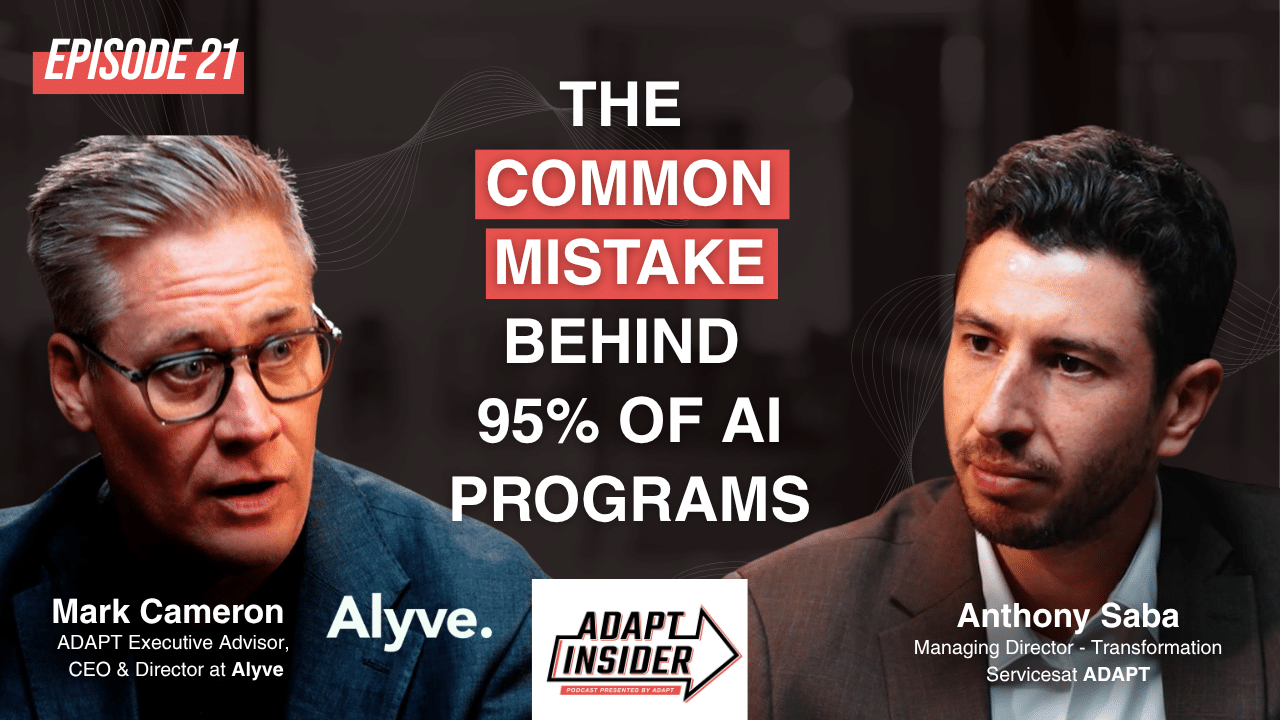


 Published Aug 31, 2026 in
Podcast
Data & AI Strategy
Contributors
Mark Cameron
Anthony Saba
Published Aug 31, 2026 in
Podcast
Data & AI Strategy
Contributors
Mark Cameron
Anthony Saba
The organisations getting the most from AI are using it to expand what the business can do, where it can grow, and how quickly it can adapt.
In this ADAPT Insider conversation, Mark Cameron, ADAPT Executive Advisor and CEO & Director at Alyve, argues that this shift starts with leadership.
When leaders connect AI to mission and impact, the business gets a clearer reason to move.
Listen to the full episode on Apple Podcasts, Spotify, and YouTube.
Key takeaways:
- High-performing organisations link AI to mission, growth, and impact, which gives the technology a stronger direction.
- Leadership alignment helps reduce friction and gives AI a clearer place in the business.
- Learning speed becomes a more durable advantage as organisations move towards adaptive operating models.
Impact gives AI a stronger direction than efficiency alone
Mark’s view is that high-performing organisations use AI to ask a bigger question than how to do the same work faster.
They focus on what more the organisation could achieve with the technology in place.
That creates room for growth, new value, and stronger strategic choices.
That mindset also changes the business case.
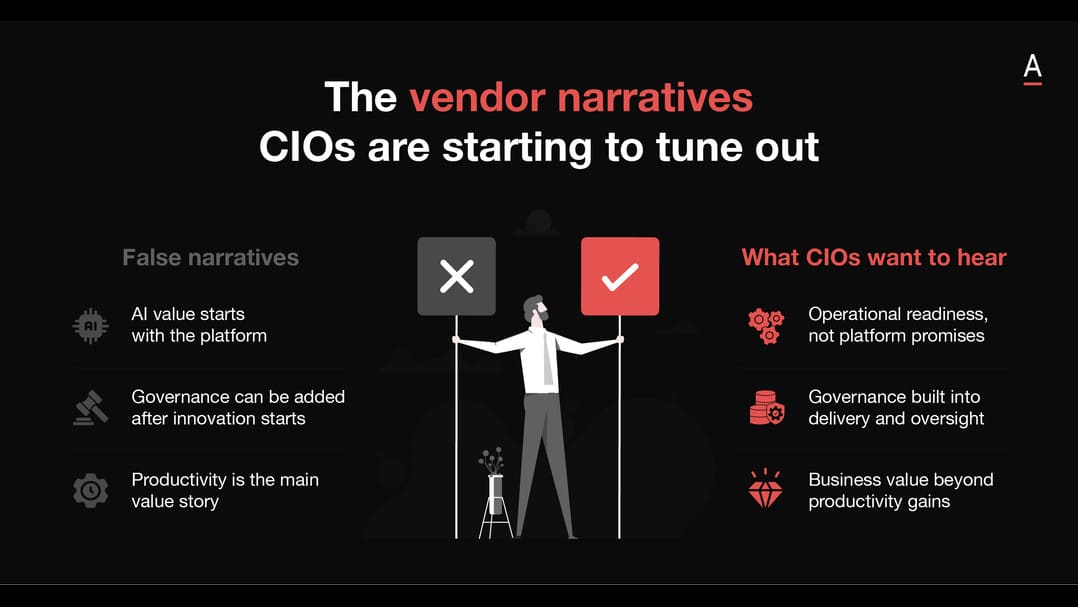
The strongest performers still see major productivity gains, but those gains come through a broader ambition around mission, growth, and impact.
In practice, that gives teams a more meaningful reason to adopt AI and helps leaders connect the technology to something the business already cares about.
Leadership alignment shapes whether AI gets traction
Mark also points to alignment as the main difference between organisations making progress and those stuck in inertia.
Boards, CEOs, finance leaders, product leaders, and risk leaders may all believe AI matters, but each can still pull in a different direction if the organisation has not agreed on what the technology is there to do.
That creates friction, slows decisions, and turns AI into a collection of disconnected efforts.
The organisations moving faster are the ones where leaders agree on purpose, direction, and what AI means for the business.
That shared understanding reduces ambiguity and helps teams act with more confidence.
Learning speed becomes the real advantage
Mark’s broader argument is that AI pushes organisations away from rigid operating models and towards more adaptive ones.
In that environment, advantage comes from how quickly an organisation can sense change, respond, learn, and improve.
That is why he frames the future organisation as an intelligence-centred enterprise.
The goal is not simply to automate tasks.
It is to build stronger feedback loops between people, systems, and AI so the business can learn faster than competitors and act on that learning sooner.
 Mark Cameron
CEO at Alyve, ADAPT Executive Advisor
Mark Cameron
CEO at Alyve, ADAPT Executive Advisor
I am the CEO of Alyve, a specialist digital transformation consultancy.
I have written over 500 digital strategy-focused articles in columns for BRW, CMO.com.au and Marketing Magazine. I also write for Social Media Today, Social Media Monthly and Smart Data Collective.
Less Anthony Saba
Partner & Managing Director, Transformation Services at ADAPT
Anthony Saba
Partner & Managing Director, Transformation Services at ADAPT
Anthony leads the growth, strategy, and delivery of ADAPT’s Transformation Services and Go-to-Market Services Business Units.
He is driven by a core belief that we are experiencing a modern industrial revolution, one that will fundamentally reshape how business is done and pose serious challenges to the future of many Australian organisations and industries.
In this environment, success will not necessarily favour incumbents, or those with the deepest pockets or broadest resources, but rather organisations who are most able to ADAPT quickly and effectively to the evolving needs of their customers, employees and ecosystems.
With this belief, ADAPT is evolving into a critical platform that Australia’s enterprise leaders, local solution providers, and trusted advisors can rely on to succeed over the next decade.
By removing barriers, democratising access to proven expertise, promoting local ANZ innovation, and enabling rapid, meaningful connections between leaders and experts, ADAPT is committed to helping Australia not just survive, but thrive in the complex and uncertain times ahead.
Less Join the ADAPT
 Insider Community
Get the latest A/NZ market research and insights on the core trends impacting leaders.
Join the ADAPT Insider Community
Get the latest A/NZ market research and insights on the core trends impacting leaders.