














Better baselines and end-to-end measures improve AI ROI, says Teachers Mutual Bank’s CIO
In this ADAPT Insider episode, Dan Chesterman shares how most AI ROI stays hidden because organisations track activity more closely than outcomes.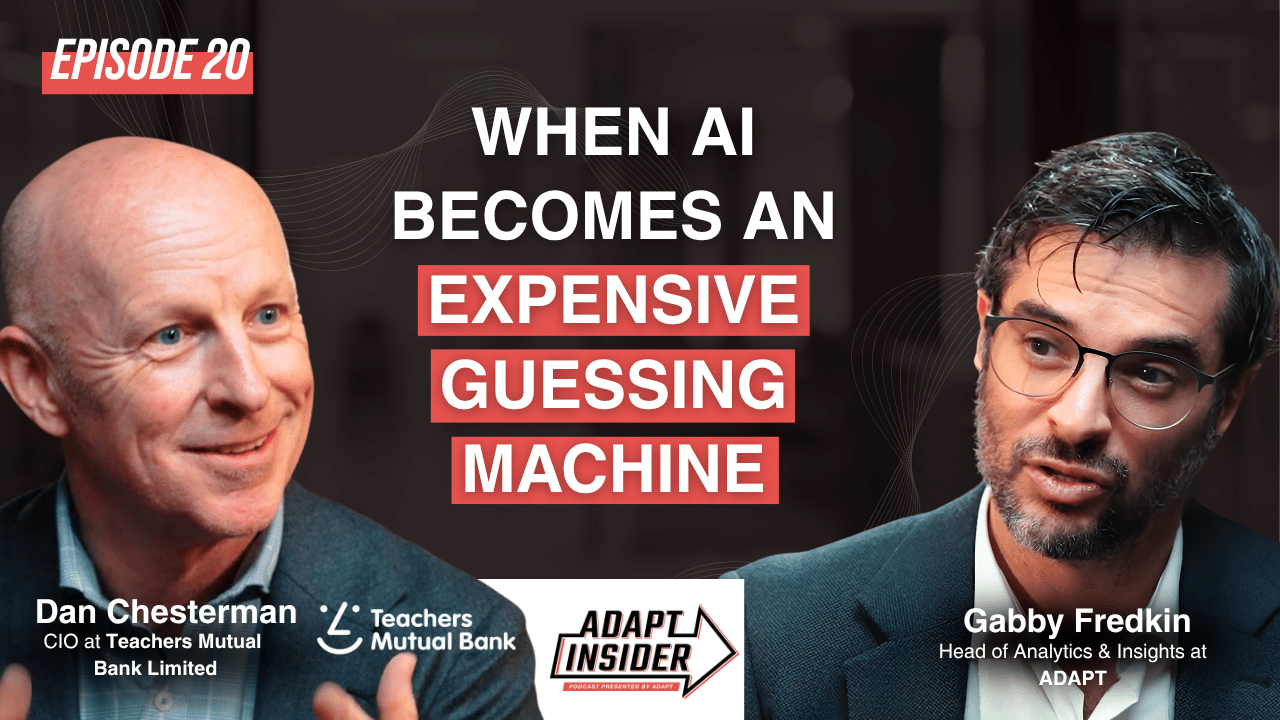


 Published Aug 24, 2026 in
Podcast
Data & AI Strategy
Contributors
Dan Chesterman
Gabby Fredkin
Published Aug 24, 2026 in
Podcast
Data & AI Strategy
Contributors
Dan Chesterman
Gabby Fredkin
Many AI programs can show momentum, but not what actually changed for the business.
In this ADAPT Insider conversation, Dan Chesterman, CIO at Teachers Mutual Bank Limited, argues that the issue usually starts earlier.
Organisations need a clearer view of what they are trying to improve, how that process performs today, and which outcome would prove the investment worked.
Listen to the full episode on Apple Podcasts, Spotify, and YouTube.
Key takeaways:
- AI ROI becomes clearer when organisations start with a strong baseline and measure business improvement against it.
- Use cases, model choice, and governance need to match the decision or process being improved.
- End-to-end outcomes give a more useful picture of AI value than local productivity gains alone.
ROI starts with a baseline
Dan’s view is that AI performance is hard to judge when the starting point is vague.
If an organisation cannot describe current process performance, customer experience, or another measurable business outcome, it becomes much easier to celebrate implementation than improvement.
That is why he puts so much weight on baselining.
Once the current state is visible, AI can be measured against something real.
That also makes it easier to separate activity metrics from business metrics.
Token consumption, model usage, and go-live dates may show movement, but they do not show value on their own.
Clear use cases matter more than broad AI ambition
Dan also points to overapplication as a common problem.
AI can easily become a catch-all label for projects that have weak purpose, poor fit, or an inflated cost base.
Organisations can end up applying more expensive models than the task requires and calling that progress.
His framing is practical. Start with the use case, the decision, or the workflow that needs to improve.
Then choose the level of intelligence, cost, and governance that fits it.
Some tasks need prediction. Some need precision. Some need human judgement at key points.
Once that context is clear, AI becomes easier to apply with discipline.
End-to-end outcomes matter more than local gains
Dan is equally clear that improving one step in a process does not guarantee a better result overall.
A faster task can still create friction elsewhere, or save time that never becomes reusable because it disappears into other work.
That is why he pushes leaders towards end-to-end measures.
Completion rates, customer outcomes, process performance, and cost per successful outcome all give a better picture of whether AI is helping the system work better.
In that sense, AI value comes from what changes across the journey, not from one isolated efficiency win.
 Dan Chesterman
Chief Information Officer at Teachers Mutual Bank
Dan Chesterman
Chief Information Officer at Teachers Mutual Bank
Dan is an experienced and dynamic technology leader. He is passionate about driving transformative change and innovation. With a proven track record as a Chief Information Officer and Technology and Data Executive, his career spans a diverse range of industries, from financial services and stock exchanges to consulting, advisory and start-ups in multiple geographies.
Less Gabby Fredkin
Head of Analytics & Insights at ADAPT
Gabby Fredkin
Head of Analytics & Insights at ADAPT
As the Head of Analytics and Insights at ADAPT, Gabby Fredkin’s primary role is managing analysis to produce ADAPT’s actionable insights to identify trends supporting organisations in Australia.
With a passion for creating stories with data, Gabby is consistently rated as one of the top speakers at ADAPT’s events. In roundtable discussions, he specialises in using statistics to initiate thought-provoking discussions, enabling ADAPT’s customers to become more data-driven.
Using modern data science techniques, he provides ADAPT and its customers with confidence in the accuracy and validity of the information used for ADAPT’s research, advisory and events.
Working across artificial intelligence, machine learning, AI ethics, DevSecOps, end-user behaviour, and human-centred design, Gabby’s vast experience continues to grow, supported in part by a Master of Business Analytics from Deakin University.
Less Join the ADAPT
 Insider Community
Get the latest A/NZ market research and insights on the core trends impacting leaders.
Join the ADAPT Insider Community
Get the latest A/NZ market research and insights on the core trends impacting leaders.