















What it takes to move enterprise AI from experimentation into production
In this Data & AI Edge session, cloud and AI leaders from Oracle and NVIDIA examine how AI factories, inference economics, and sovereign architectures are reshaping enterprise execution.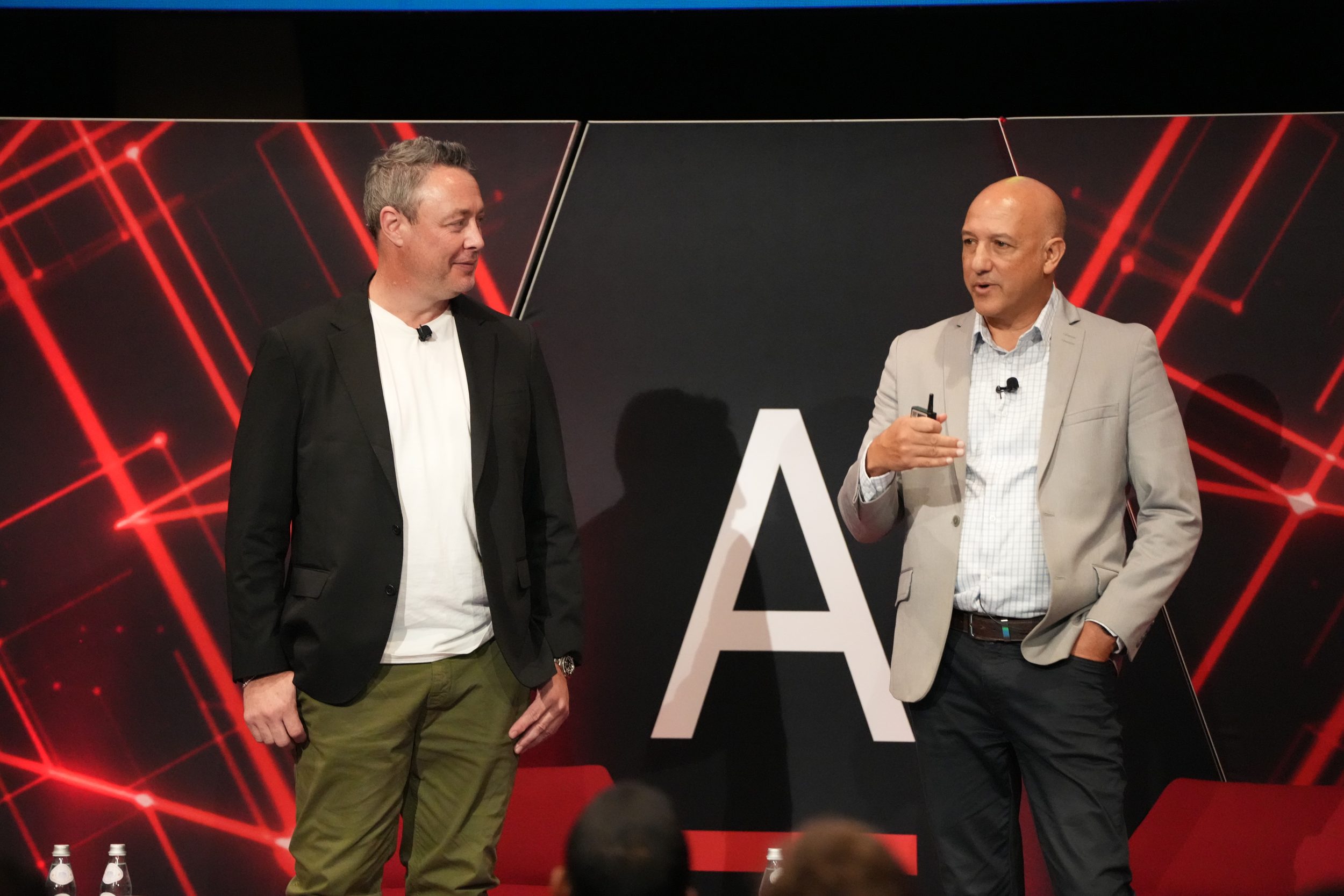


 Published Apr 8, 2026 in
Expert Presentations
Data & AI Strategy
Contributors
Angelo Joseph
Johann Kruse
Published Apr 8, 2026 in
Expert Presentations
Data & AI Strategy
Contributors
Angelo Joseph
Johann Kruse
The hard part of enterprise AI starts after the prototype.
Once AI is expected to deliver real work at scale, the pressure shifts to inference economics, full stack design, and sovereign deployment choices that can survive production.
That is the gap Angelo Joseph, Head of ANZ Cloud Engineering at Oracle, and Johann Kruse, Strategic AI Partnerships Lead at NVIDIA, addressed at the 5th Data & AI Edge.
Key takeaways:
- AI creates more value when organisations redesign work around new capacity, rather than treating it as another tool rollout.
- Inference is becoming the point where enterprise AI starts generating measurable business value, with speed, throughput, and deployment economics shaping outcomes directly.
- Production scale depends on full stack readiness, including usable data, infrastructure choices, and sovereign deployment models that support secure execution.
Enterprise AI changes the business before it changes the technology stack
Enterprise AI has moved beyond incremental uplift.
The bigger change comes when organisations redesign how work is executed, how capacity is used, and how performance is measured.
Angelo makes that case directly.
He argues that the pace of change is already outstripping organisations’ ability to absorb it, while the consumerisation of AI has changed workforce expectations across the enterprise.
He also points to a different order of ambition, where the target is no longer marginal gains, but 10x and 35x improvements in efficiency and throughput.
That shifts AI from a side initiative into a structural business capability.
Inference is where enterprise AI starts doing real work
The centre of gravity is shifting away from model training alone and towards inference, where AI is actually producing intelligence that can be used in operations, products, and decision making.
Johann explains that shift through the idea of an AI factory.
He is clear that this is a capability, not simply a room full of servers.
Good usable data goes in, intelligence comes out, and that intelligence is then used to run the business.
He also pushes back on the idea that enterprise AI is just a hardware story.
In his framing, AI is full stack by nature, spanning software, infrastructure, models, and the delivery ecosystem that makes those capabilities usable at scale.
Deployment speed now depends on architecture, sovereignty, and readiness
Production AI will increasingly be constrained by deployment readiness, not by access to the next model release.
That is why infrastructure and sovereignty are moving closer to the centre of enterprise AI strategy.
Johann describes GTC 2026 as a deployment focused moment, with attention on capabilities that will reach enterprise environments over the next six to eighteen months rather than on research demos alone.
Angelo connects that to the practical decisions organisations already face around sovereign AI, deployment options, and faster time to market.
Enterprise AI moves faster when architectures are designed to reduce data movement, keep intelligence close to trusted environments, and build control into the stack from the beginning rather than retrofitting it later.
 Angelo Joseph
Head of Cloud Engineering ANZ at Oracle
Angelo Joseph
Head of Cloud Engineering ANZ at Oracle
Angelo Joseph is a technology executive with over two decades of experience driving innovation and enterprise transformation across business, government, and education sectors in the region.
As the head of Oracle’s Cloud Engineering team in Australia and New Zealand, Angelo leads the team of expert architects and technologists who empower organisations to accelerate their digital transformation using Oracle Cloud Infrastructure and Applications.
Throughout his career, Angelo has been at the forefront of major technological advancements, from early web technologies, Java, and networking to eCommerce, security, and modern cloud platforms. His leadership experience includes senior roles at IBM, Sun Microsystems, and Google.
Angelo is an industry speaker and thought leader, regularly sharing insights on technology innovation and cloud transformation. He holds a Bachelor of Electrical Engineering with a major in Telecommunications from the University of Technology Sydney.
Less Johann Kruse
Director Strategic AI Partnerships at NVIDIA
Johann Kruse
Director Strategic AI Partnerships at NVIDIA
Johann joined NVIDIA in 2024 to lead Strategic AI Partnerships in Australia. He works with leading enterprises, AI natives, sovereign model builders, and research institutions to scale advanced AI infrastructure and accelerate real-world deployment. His focus is strengthening Australia’s long-term productivity and global competitiveness by building the capability, talent, and compute foundations required for sovereign AI leadership.
 Join the ADAPT
 Insider Community
Get the latest A/NZ market research and insights on the core trends impacting leaders.
Join the ADAPT Insider Community
Get the latest A/NZ market research and insights on the core trends impacting leaders.