















Organisational nimbleness is the missing ingredient in public sector AI adoption, says former DBS CTO
At Government Edge, David Walker explores what the APS can learn from banking leaders that have successfully scaled AI and organisational change.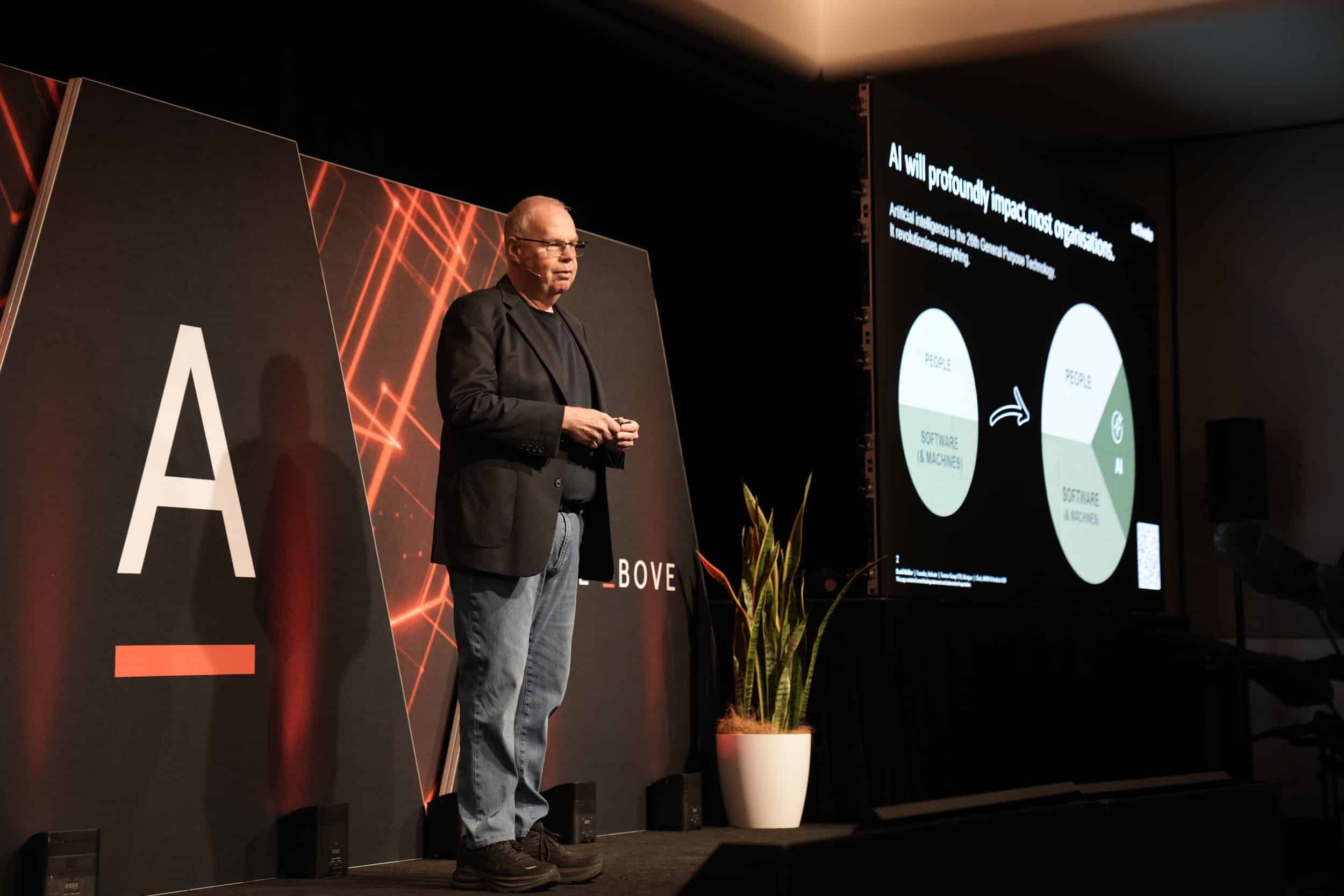


 Published Jun 23, 2026 in
Expert Presentations
Data & AI Strategy
Contributors
David Walker
Published Jun 23, 2026 in
Expert Presentations
Data & AI Strategy
Contributors
David Walker
AI is being asked to help government deliver leaner services, stronger productivity, and better citizen outcomes, yet many agencies are still trying to scale it through structures built for slower change.
The constraint is increasingly organisational, with leadership alignment, governance, funding models, workforce capability, and process redesign determining whether AI moves beyond experimentation.
At Government Edge, David Walker, former Group Chief Technology Officer at Westpac and DBS and Chair of the AI Council at UNSW, shared lessons from banking transformation and what they mean for responsible AI adoption across the public sector.
He explained why organisational readiness has become the biggest barrier to AI value and outlined the capabilities agencies need to turn AI ambition into measurable productivity gains.
Key takeaways:
- AI adoption depends more on organisational readiness than on technology maturity.
- Nimble organisations capture value faster by combining speed, reinvention and alignment.
- Leadership ownership, cultural change and enterprise-wide capability building are essential to scale AI successfully.
AI adoption is an organisational challenge
Most barriers to AI adoption sit within organisational structures, leadership, governance and processes rather than in the technology.
Organisations often invest heavily in AI tools but fail to realise value because they are not equipped to absorb change.
Without alignment across leadership, funding, governance and operating models, AI initiatives stall or remain experimental.
Nimble organisations unlock AI value faster and at scale
David identifies that fewer than 1% of organisations are truly ready to scale AI, and those that succeed build “nimble” operating models that can absorb change quickly.
Nimble organisations achieve faster adoption and significantly higher economic value.
He pointed to DBS as an example.
Long before AI became a board level priority, the bank invested in becoming a more adaptive organisation, embedding innovation, continuous learning, process redesign, executive ownership, and flexible technology foundations.
When generative AI emerged, those capabilities allowed the organisation to move faster than its peers and capture significant economic value.
They combine speed of change with the ability to reinvent processes, allowing them to capture productivity and cost benefits earlier than peers.
Value emerges when organisations redesign processes, decision making, and service delivery around new capabilities.
Leadership, culture and capability drive transformation
Successful organisations embed eight capabilities, including strong executive ownership, citizen focus, organisation-wide innovation, continuous learning, adaptive governance and flexible technology foundations.
AI cannot sit within a single team.
It requires coordinated effort across leadership, strategy, operations, technology and people functions.
For agencies pursuing productivity gains, workforce efficiency, and better citizen outcomes, AI adoption should be treated as an enterprise transformation agenda rather than a technology initiative.
Organisations that strengthen their ability to absorb change will be better positioned to realise value as AI capabilities continue to evolve.
 David Walker
(former) Group Chief Technology officer at Westpac & DBS and Chair of the AI Council at UNSW
David Walker
(former) Group Chief Technology officer at Westpac & DBS and Chair of the AI Council at UNSW
David Walker was appointed Westpac Group’s Chief Technology Officer in August 2019. He led Westpac through its technology transformation – simplifying and merging the bank, building 4th gen cloud-native applications, establishing and operating evergreen platforms, leading Westpac’s AI technology, and building a culture of passionate and forward-thinking tech and emerging talent.
David began his technology career in 1987 as a software engineer, focusing on coding complex systems. After a decade of evolving his software engineering craft, David founded a data science consulting. Over the following decade, it became the number one expert data insights company in Australia and Southeast Asia.
For the last 15 years, David has held executive roles in large, complex organisations across the APAC region. Prior to joining Westpac, David was part of the leadership team of Singaporean bank, DBS. In his ten years there, David helped transform DBS from a traditional bricks and mortar bank with little brand presence or recognition outside Singapore, to being recognised as the ‘Best Bank in the World’ and the ‘Best Digital Bank in the World’ by leading global financial publication Euromoney.
Less Join the ADAPT
 Insider Community
Get the latest A/NZ market research and insights on the core trends impacting leaders.
Join the ADAPT Insider Community
Get the latest A/NZ market research and insights on the core trends impacting leaders.