















How real estate firms turn multimodal data into explainable AI insight according to Domain’s Chief Data Officer
In this Data & AI Edge session, Pooyan Asgari, Chief Data Officer at Domain Group, explores how agentic AI, multimodal intelligence, and emerging governance expectations are reshaping enterprise data strategy.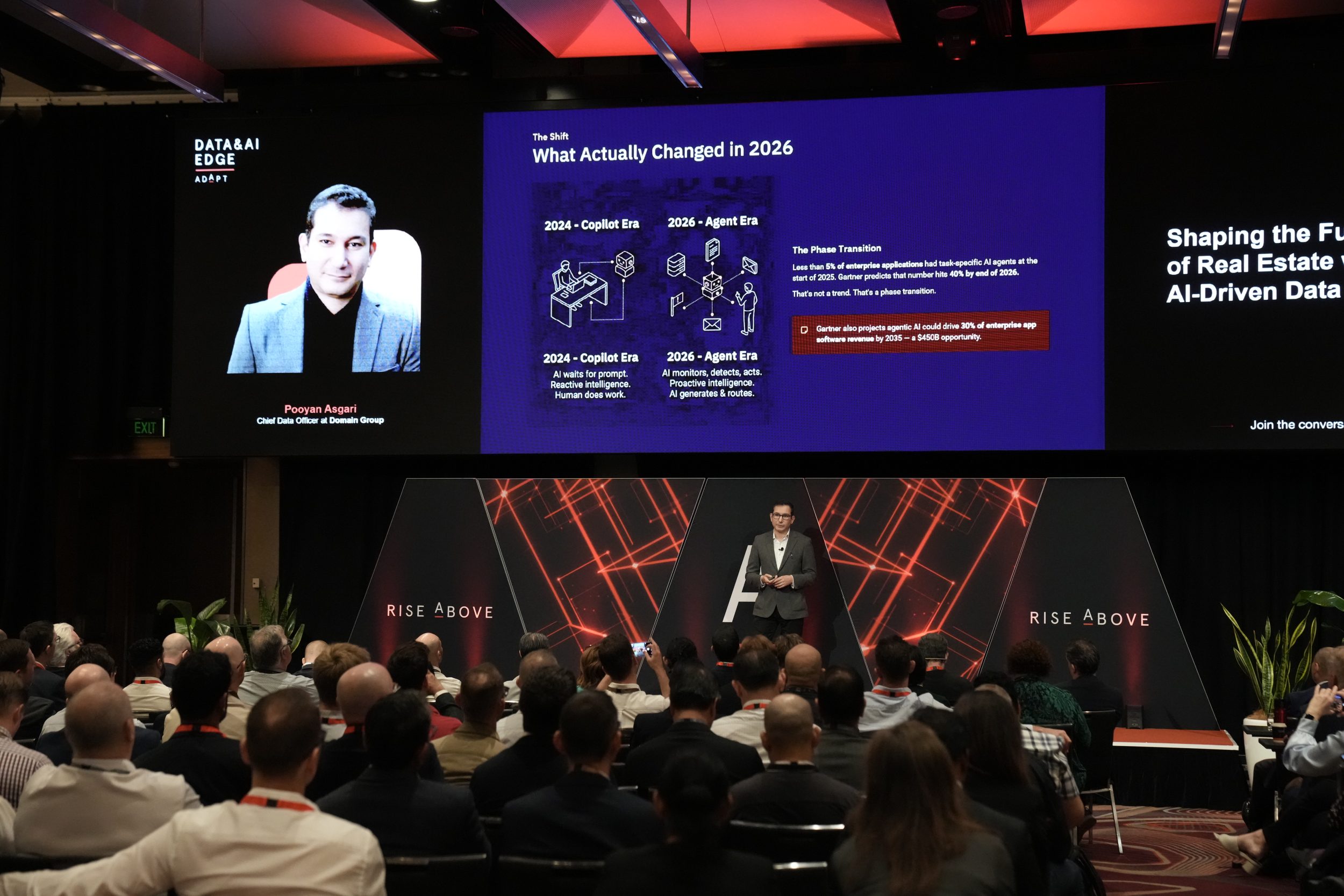


 Published Apr 9, 2026 in
Expert Presentations
Data & AI Strategy
Contributors
Pooyan Asgari
Published Apr 9, 2026 in
Expert Presentations
Data & AI Strategy
Contributors
Pooyan Asgari
Real estate AI is becoming more powerful because it can now interpret far more than structured records alone.
Images, spatial context, and other non textual signals are starting to influence how organisations understand property value, market change, and future risk.
At the 5th Data & AI Edge, Pooyan Asgari used Domain’s property valuation challenge to show how that shift is creating new opportunities, while also raising the bar on data readiness, explainability, and governance.
Key takeaways:
- Multimodal AI creates more value when organisations can extract usable signals from non textual data such as imagery, spatial context, and site level change.
- Agentic AI only becomes practical when data maturity has moved from data available to data usable, with governance, lineage, and enough confidence to support production use.
- High consequence AI decisions will stall unless organisations can explain how the output was produced and show that governance is built into the operating model.
Multimodal AI is changing what real estate data can reveal
Real estate data stops being limited to transactions, listings, and structured records once AI can interpret imagery and change over time.
That opens a different class of insight, especially in markets where future value depends on what is happening around a property, not only what is already recorded against it.
Pooyan makes that concrete through Domain’s use of aerial imagery.
What used to function mainly as visual context can now surface signals such as knockdown rebuilds, construction progress, landscaping change, solar installation, pool additions, and broader neighbourhood development.
In his example, multimodal processing combines those image based signals with other property data to generate new valuation insight without Domain having to add a new source of data.
Agentic AI raises the bar on readiness
Agentic AI increases the amount of monitoring, inference, and decision support organisations can automate.
That also exposes whether the underlying data estate is actually ready for it.
Pooyan frames readiness as a maturity problem. Organisations need to move from data available to data usable before agentic AI can work in production.
That means cataloguing, lineage, governance, and enough trust in the data to support more advanced intelligence.
He also argues that access to multimodal data will often come through partnerships rather than internal build, because the time pressure is too high for many organisations to create every required data asset themselves.
Explainability is becoming a production requirement
The next constraint on AI deployment is not model capability.
It is whether the organisation can explain how a high impact output was formed.
Pooyan ties that directly to the Australian context.
He points to the direction of local privacy and AI governance, where users are increasingly able to ask how an AI driven conclusion was reached.
For Domain, that matters immediately because property valuations and risk related insights can affect lending decisions and financial outcomes for individuals.
If the organisation cannot show lineage and explain how the system arrived at the output, the use case should not reach production.
That is why he treats governance as operational rather than documentary, with different thresholds for low risk, supervised, and high consequence decisions.
Multimodal AI can surface new property signals, but production value depends on usable data, deliberate partnerships, and governance strong enough to explain the output.
 Pooyan Asgari
Chief Data Officer at Domain Group
Pooyan Asgari
Chief Data Officer at Domain Group
Pooyan oversees Domain’s data, analytics, business intelligence, and AI strategies. Pooyan’s team is dedicated to providing seamless access to data and analytics across the business and supports teams to solve their complex problems with the help of data. His team also actively provides cutting edge AI and BI solutions to internal and external stakeholders. Before joining Domain in 2015, Pooyan was Director of Analytics Products for HLA Global, working with a number of high-profile healthcare organisations such as Cancer Council of Australia and centre of disease control (CDC) in the United States to provide cutting edge AI solutions for the medical sector.
 Join the ADAPT
 Insider Community
Get the latest A/NZ market research and insights on the core trends impacting leaders.
Join the ADAPT Insider Community
Get the latest A/NZ market research and insights on the core trends impacting leaders.