

















The Cloud Repatriation Paradox: Why Workloads Are Coming Home
In this Community Intelligence Report, ADAPT dissects why cloud repatriation is accelerating across Australia, and how capability gaps are turning hybrid infrastructure into a growing execution challenge.


 Published Jun 23, 2026 in
Articles
Cloud & Infrastructure
Contributors
Pooja Singh
Published Jun 23, 2026 in
Articles
Cloud & Infrastructure
Contributors
Pooja Singh
Australian cloud and infrastructure leaders are caught in an impossible equation: boards want faster AI acceleration, CFOs want tighter cost control, and cloud repatriation promises greater control while often creating new operational complexity.
This report reveals why hybrid infrastructure decisions are becoming capability bets, and why the next 12 months will separate organisations with execution discipline from those building environments they cannot manage well.
Three forces are colliding
AI demand is increasing infrastructure requirements just as finance teams scrutinise cloud spend more aggressively.
At the same time, organisations are bringing workloads back from public cloud in search of cost predictability, security, and data sovereignty.
Repatriation can look like control on paper, but without the skills, governance, and operating model to support it, hybrid infrastructure becomes harder to run than the cloud environment it replaced.
Two voices frame the strategic reality.
Matt Boon, Research Director at ADAPT, argues that organisations continue to treat cloud, data, and AI as separate conversations when they should be aligned around business outcomes and capability development.
Delan Naidu, a cloud infrastructure consultant working across government, healthcare, and utilities, highlights the execution challenge.
Greater control often comes with greater responsibility, requiring organisations to develop capabilities that many have never needed to build internally before.
Their message is clear: infrastructure strategy is becoming a capability decision, not a technology decision.
What you’ll learn in this report
- Why cloud repatriation is gaining momentum across Australian organisations.
- How AI investment is reshaping cloud cost and infrastructure decisions.
- Where hybrid infrastructure creates hidden capability and governance risks.
- What separates disciplined infrastructure strategies from expensive complexity.
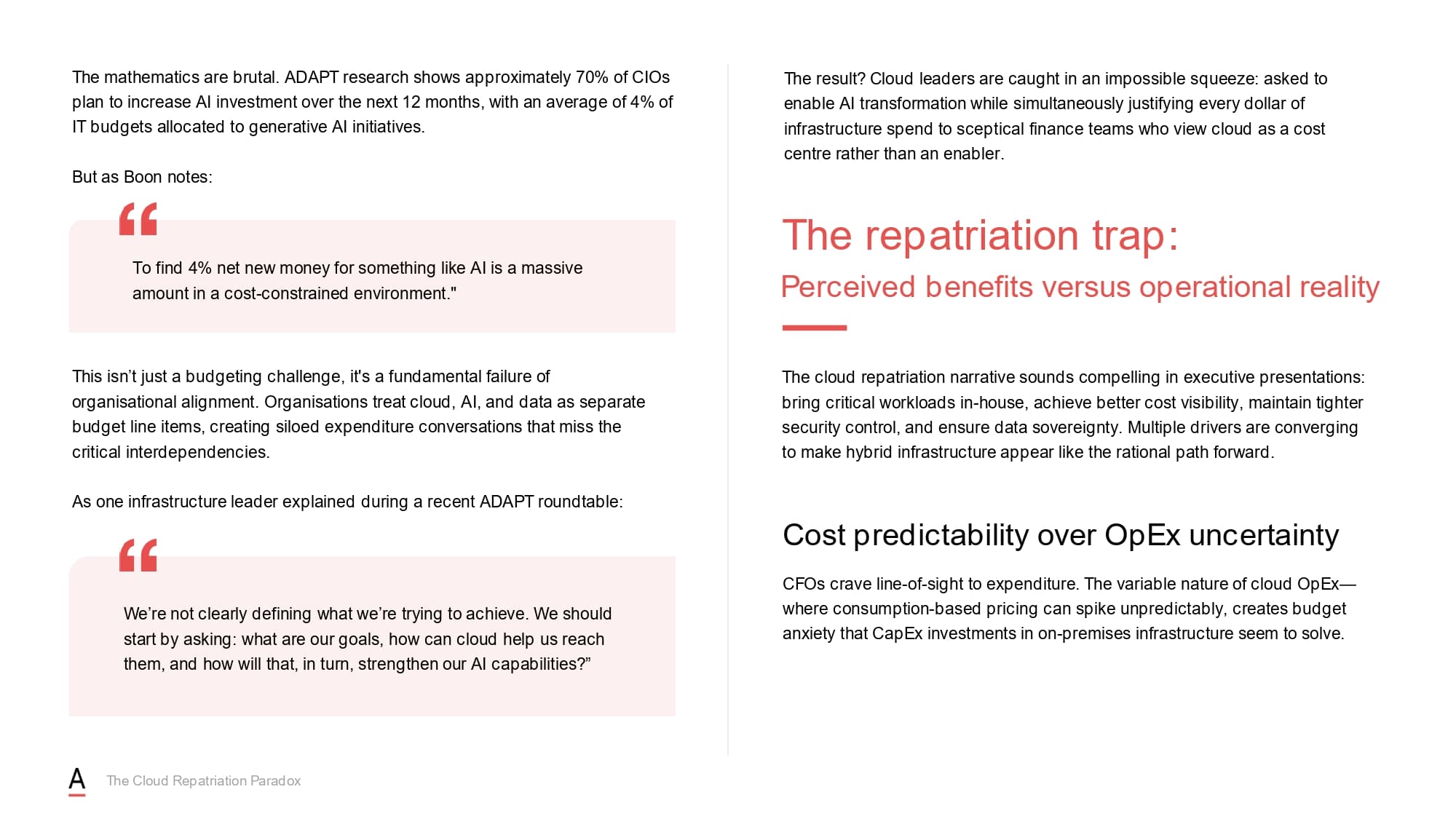
Australian cloud and infrastructure leaders are caught in an impossible equation: boards want faster AI acceleration, CFOs want tighter cost control, and cloud repatriation promises greater control while often creating new operational complexity.
This report reveals why hybrid infrastructure decisions are becoming capability bets, and why the next 12 months will separate organisations with execution discipline from those building environments they cannot manage well.
Three forces are colliding
AI demand is increasing infrastructure requirements just as finance teams scrutinise cloud spend more aggressively.
At the same time, organisations are bringing workloads back from public cloud in search of cost predictability, security, and data sovereignty.
Repatriation can look like control on paper, but without the skills, governance, and operating model to support it, hybrid infrastructure becomes harder to run than the cloud environment it replaced.
Two voices frame the strategic reality.
Matt Boon, Research Director at ADAPT, argues that organisations continue to treat cloud, data, and AI as separate conversations when they should be aligned around business outcomes and capability development.
Delan Naidu, a cloud infrastructure consultant working across government, healthcare, and utilities, highlights the execution challenge.
Greater control often comes with greater responsibility, requiring organisations to develop capabilities that many have never needed to build internally before.
Their message is clear: infrastructure strategy is becoming a capability decision, not a technology decision.
What you’ll learn in this report
- Why cloud repatriation is gaining momentum across Australian organisations.
- How AI investment is reshaping cloud cost and infrastructure decisions.
- Where hybrid infrastructure creates hidden capability and governance risks.
- What separates disciplined infrastructure strategies from expensive complexity.