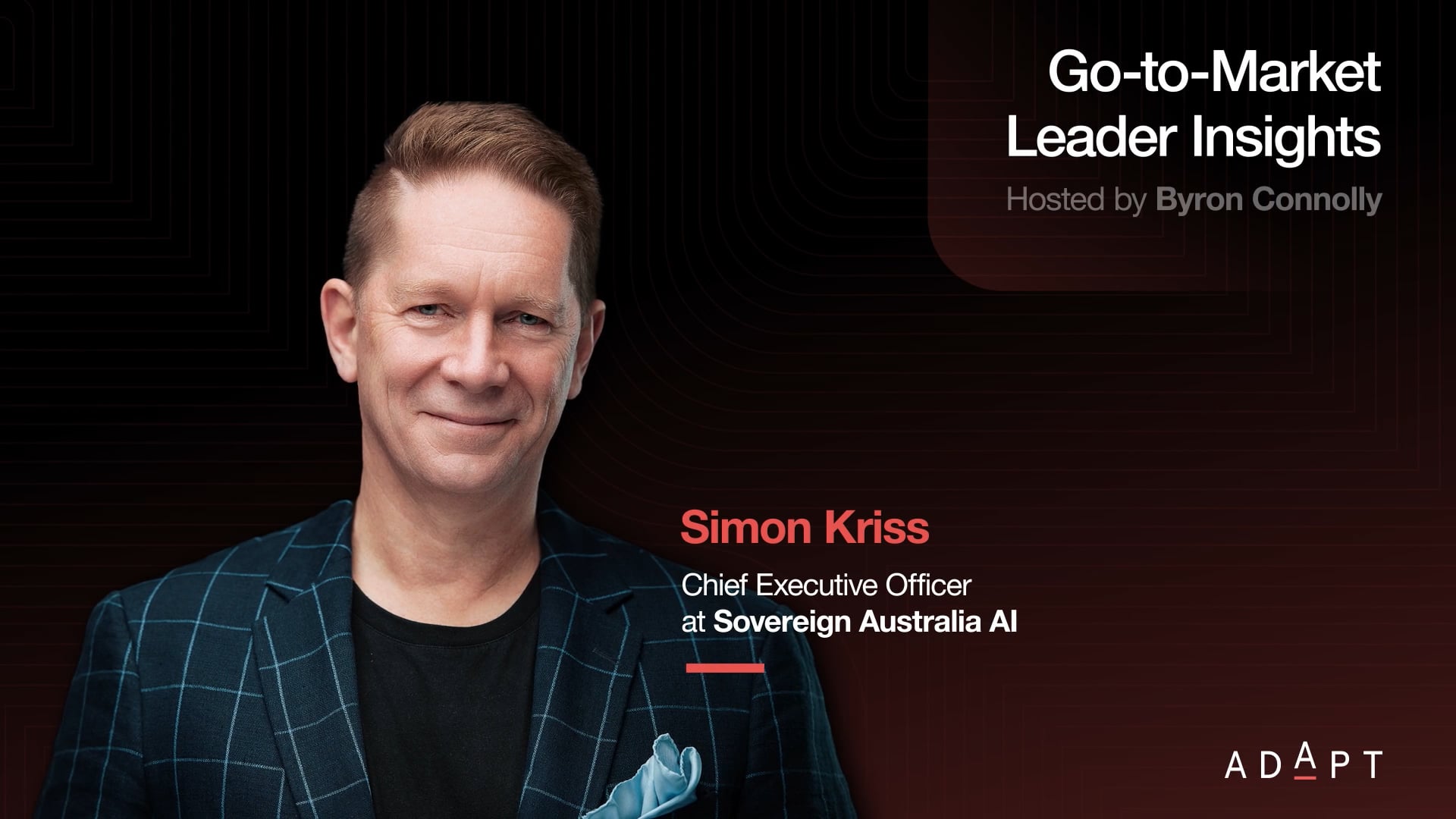








Sovereign Australia AI CEO Simon Kriss challenges AI job loss fears and calls for sovereign models in an interview with ADAPT’s Head of Programs & Value Engagement Byron Connolly.

Simon evokes a uniquely Australian slang term to describe the ongoing discussion about AI-induced job losses.

“I think the conversation is a bit of a ‘furphy,’” he tells ADAPT.

“We’ve [heard] time and time again [about] things that were going to decimate the workforce. The internet was going to decimate the workforce; nobody had thought of SEO (search engine optimisation) or SEM (search engine marketing) before the internet came along.

“The computer was going to [eliminate] typing pools and put all those people on the streets. That never happened.”

Simon looks back hundreds and even thousands of years, likening the AI revolution to the invention of electricity, the steam engine and horse-drawn ploughs.

“As far back as we can look, there used to be 100 farmers…hoeing fields by hand. Then we found out that a horse could pull a plough, so now we only needed 10 people in the field, but we now had foundries making ploughs and farriers shoeing horses.

“Then we invented a tractor…we only needed one person in the field, but we needed diesel mechanics, and people to make tyres.”

Simon is adamant the same pattern is occurring with AI as new jobs emerge in developed economies like Australia. AI will, however, ‘target and take out’ low value, high volume repetitive transactional roles such as medical transcription, simple contact centre services and bookkeeping; roles that have largely been offshored.

“So, if job losses are going to be felt, they’ll be felt in places like the Philippines, India and South Africa. Those traditional outsourcing locations will probably feel the pain.

“When they do, they’ll feel it even more because those economies can’t just drop $300 million to retrain their population to become AI-aware. They’re deciding whether to build a new hospital or put up three new 5G towers”, he says.

Simon predicts that young people entering the workforce today will take on jobs such as data curators, output checking and writing training pairs for reinforcement learning.

“We’re going to move from ‘being doers to being checkers.’”

His perspective stands in stark contrast to the position held by UK barrister, Iona Levine, who told ADAPT in November that the AI revolution is starting to look like another version of The Hunger Games with jobs disappearing across the knowledge economy.

Levine, who has helped build financial infrastructure in emerging global markets, argues that the middle class – doctors, lawyers and artists paying higher taxes, will be decimated. She believes that as automation accelerates, the dividends earned from these innovations should be shared across society.


A stronger case for sovereign AI

Large scale LLMs have recently come under fire for generating torrents of misinformation and disinformation. Grok spread misinformation about the Bondi shooting and the free AI assistant turned off its image generator following uproar over sexualised AI imagery.

Simon agrees this strengthens the case for Australia to create its own sovereign AI capabilities with domain-specific tools like the NSW government’s EduChat and MiAI Law, a new LLM created for the legal sector.

He says that while EduChat, is a great initiative, it’s still built on OpenAI technology and not tailored to Australian vernacular or culture.

“We [Australia] make up maybe 1% of the data [fed into] OpenAI’s [products] and we need models that are more Australian -aware.”

Simon notes that Australians “tend to tell you what things they aren’t rather than what they are.”

“A health setting is a great example. Mrs. Jones walks in, the doctor asks, ‘How are you today?’ She answers, ‘I’m not too bad.’ [She] doesn’t mean ‘not too bad’, [she] means, ‘I am really sick.’ [In contrast] Americans tend to be quite forthright. So, some of those subtleties will help make AI models so much better for Australians”, he says.

The bigger concern, he argues, is that people don’t know how models such as Anthropic’s Claude, OpenAI’s ChatGPT and Mistral AI were built or what data they were trained on.

“We don’t know all of the biases they have; we don’t know whether the data was sourced ethically. In fact, we’re pretty sure it wasn’t and that’s not good for Australia.

“Australia needs models where we can go right down to the base prompt and ask, ‘How was this model built?’”


Concern over health data sharing

OpenAI earlier this month launched ChatGPT Health, an unregulated AI assistant that provides health advice and is claimed to support clinicians in making diagnoses.

Simon says he “cannot think of one reason why anybody would or should want to” share their medical records with ChatGPT.

While he acknowledges OpenAI is far ahead of its competitors in gen AI, it remains an American company, and it is subject to the US CLOUD Act. This legislation compels any US company to share, when requested, the contents of any server they own or lease worldwide.

“If providers like ChatGPT [Open AI], Microsoft, Google and Amazon are asked, they’re not allowed to tell clients their data is being accessed.

“We are essentially giving up our medical records to a company where the US government could look at whatever it likes. How can we be assured that Open AI isn’t using that data to continue to train their models?

“They’re [also] not subject to the same copyright and privacy laws we have here in Australia. Our laws are far more stringent [than those] in the US. I have a real issue with generative AI being used to do any kind of medical diagnoses or anything like that. It’s a probabilistic engine and medicine is deterministic. It has its uses and I don’t think that’s one of them.”


Stop and step back on AI

Australian CIOs tell ADAPT their number one initiative for FY26-27 is to pilot and adopt generative AI solutions.

However, on the agentic AI front, 37% of CIOs surveyed by ADAPT say they are seeing no measurable return on their investments, and a further 46% report limited or unclear early returns.

Simon advises organisations struggling to move AI projects from PoCs to production to ‘stop and step back.’

He says many companies want to deploy AI solutions because their boards, CEOs or CIOs feel left behind if they don’t.

He argues that organisations need to question whether generative AI is the right solution for a particular problem.

“Why can’t it be traditional AI? Why can’t it be machine learning? Maybe you just need some old-school process automation. Figure out your use case and build your C-suite’s AI literacy.”

Simon recalls speaking to a CEO who wanted to use ChatGPT to calculate which routes his organisation’s trucks should take.

“I [said], ‘Hang on, that’s not what the tool does.’ It’s a probability text tool and you’re asking it to do a mathematical, algorithmic calculation. You don’t need ChatGPT for that. There are other tools that can do that.”

Contributors
Simon Kriss Chief AI Officer at simonkriss.ai
Simon is one of the world’s most influential AI thought leaders. HE is both an advisor and a hands-on Chief AI Officer.... More

Simon is one of the world’s most influential AI thought leaders. HE is both an advisor and a hands-on Chief AI Officer. Simon’s work spans business and government across Australia and the globe, focused on ethical AI adoption.

Simon presents on AI to audiences around the world, including recently speaking at the UN in Geneva. As the author of The AI Empowered Customer Experience and host of the AI in 5 podcast, he makes AI accessible and exciting.

Less
Byron Connolly Head of Programs & Value Engagement at ADAPT
Byron Connolly is a highly experienced technology and business journalist, editor, corporate writer, and event producer, and ADAPT’s Head of Programs and... More

Byron Connolly is a highly experienced technology and business journalist, editor, corporate writer, and event producer, and ADAPT’s Head of Programs and Value Engagement.

Prior to joining Adapt, he was the editor-in-chief at CIO Australia and associate editor at CSO Australia. He also created and led the well-known CIO50 awards program in Australia and The CIO Show podcast.

As the Head of Programs, Byron creates valuable insights for ADAPT’s community of senior technology and business professionals, helping them reach their organisational and professional goals. With over 25 years of experience, he has a passion for uncovering stories about the careers and personal philosophies of Australia’s top technology and digital executives.

When he is not working, Byron enjoys hot yoga, swimming, running, and spending time with his family.

Less
data skills security