












Lenovo’s Joe Ciardi and Paul Kristensen on Building AI Estates That Follow the Outcome
In this interview, Lenovo’s Joe Ciardi and Paul Kristensen discuss placing AI workloads around outcomes, cost and resilience.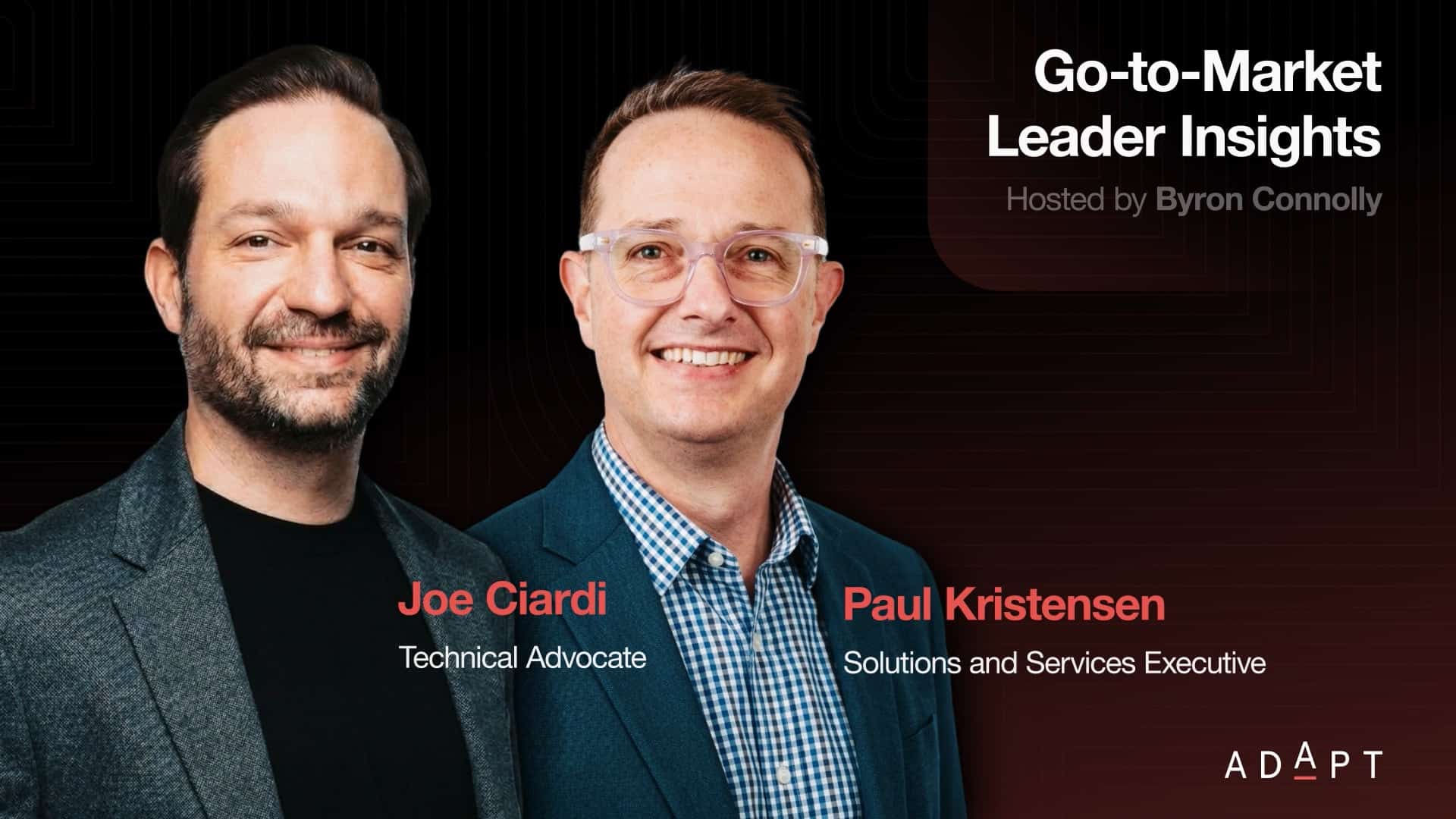


 Published Nov 2, 2026 in
Peer Insights
Cloud & Infrastructure
Contributors
Byron Connolly
Joe Ciardi
Paul Kristensen
AI infrastructure decisions should start with the business outcome, not the platform.
That was the message from Lenovo’s Joe Ciardi and Paul Kristensen, who say Australian organisations need to spread AI workloads across endpoints, private environments and public cloud, and be ready to move them as requirements change.
Inference does not switch off. As organisations move models into production, AI becomes a permanent, compounding load, often on estates that were never designed for it.
Ciardi, a technical advocate at Lenovo Australia, and Kristensen, a solutions and services executive, recently co-hosted ADAPT roundtables in Sydney with CIOs and senior technology executives working through exactly that shift.
Endpoint AI is not coming, it’s already here
Ciardi says one misconception keeps surfacing in his conversations with customers: that AI on the device is something to prepare for.
“The truth is that we couldn’t be further from that, it’s already here. We’re already seeing a series of tools that are quite mature: collaboration, security and productivity tools and more [are] already making good use of the local AI accelerators that have been in these modern systems for more than a few years”, says Ciardi.
Ciardi says these tools often go unnoticed because they are frictionless, transparent and effective.
But the next shift is bigger. Ciardi describes a typical employee who has moved from mainframes to PCs, then from local apps to almost entirely cloud-based ones.
That same employee will now move from cloud AI tools to agentic AI, which he likens to ‘running an AI teammate.’
He says that this changes the design brief for IT execs.
“While I am vetting new solutions and designing new services to roll out to my employees, I need to be asking: which parts of this solution should I put locally on the edge or the endpoint? The hardware is mature. We need to design for it and include it in our tech stack”, he says.
Ciardi argues that local accelerators such as deskside workstations and on-premise GPU clusters are critical in this conversation.
They turn unpredictable cloud API costs into more stable, fixed infrastructure investments, while also addressing data and privacy concerns and improving the speed and resilience of solutions organisations are building.
“Cloud AI will still be important. It will be a hybrid model. Cloud or data centre [infrastructure] is the place where we’ll be able to retain our large language models. We’ll have access to our frontier language models and most of our data will still sit in one of those two places as well.
“That’s where we’ll be able to carry out deeper, ongoing reasoning on our data over time. That hybrid approach is the next thing that I am encouraging customers to be ready for. The magic ends up being [about] doing the right work, [with] the right workload, in the right place, at the right time, for an optimal outcome”, he says.
Start with the problem, and expect to move
The on-premise, hybrid and cloud debate still dominates strategy conversations and, for most organisations, the answer is a mix.
Ciardi says there is no ‘one-size-fits-all’ approach to deciding where each workload should run.
“What I commonly see is great urgency coming from leadership. We need to do more with AI, whatever that means.
“There is absolutely a recognition among leaders that they need to adopt and build a culture around AI. But they don’t exactly know what problems they are solving. They don’t have outcomes in mind that they are looking to drive with these tools. That is a common mistake.
”Organisations need to be clear about the problem first. That makes it much easier to understand which parts of their tech stack need to go where.”
The decision depends on the requirements, including data sensitivity, privacy and sovereignty obligations, cost, response times and the resilience required.
“Probably nothing is permanent in this space. We saw a massive shift to the cloud more than 10 years ago. We’re now seeing the repatriation of many services and storage. We saw modern AI services launch cloud-only, and now edge and endpoint solutions make more sense as part of the tech stack.”
What breaks when the pilot grows up
Meanwhile, Paul Kristensen spends his days with clients asking the same question: how do we move from proof of concept (PoC) to production at scale? The first problem, he says, is that a pilot rarely tests anything.
“The pilot was easy, everything worked well, but that was with five, six, or 10 users,” he says.
“Suddenly, when an organisation moves to 100, 500 or 1,000 users, the business processes established through the POC get tested. Shadow IT starts to emerge. Staff are amazingly creative.”
That creativity exposes security, compliance and data-access gaps, he says.
“We need to be 100 per cent sure that we haven’t allowed sensitive data to become accessible. And when we use multiple agents, how do we make sure they don’t start accessing data that is not appropriate?”
The second problem is how the project was set up.
During discovery, Kristensen’s team is strict about identifying who owns the project, who signs it off and what return on investment looks like, whether that means hours returned to staff or a monetary return.
Projects led only by IT, without business buy-in and C-level sponsorship, tend not to make it past the pilot, he says.
When it comes to what breaks first, Kristensen points to process over technology or people.
He says organisations don’t put enough effort in what happens when clever people start testing a system at scale or who takes over “if a server goes down or the wrong answer is coming in.”
Planning for hardware that keeps evolving
AI reinvents itself every few months, which makes estate planning difficult.
Expectations also rise quickly around how many GPUs an organisation needs, what type it needs, and how quickly staff expect answers.
One option is to overbuild from the start, but Kristensen says that can be expensive because everything has an end of life.
Lenovo’s answer is what it calls TruScale, which gives organisations a choice of CapEx or OpEx models, backed by full lifecycle management.
“When hardware reaches the end of its life, how do we make sure it’s easy to transition to the next GPUs, the next CPUs and NPUs?” he asks.
That includes planning how equipment is repurposed as the estate evolves, which is where lifecycle thinking meets sustainability.
Lessons from the World Cup
Lenovo’s role in the FIFA World Cup, across three host countries with near-zero downtime, offers a large-scale test case.
Ciardi says the company deployed 600 staff working around the clock in the lead-up to and throughout the tournament.
He draws three lessons that Australian organisations can apply.
The first is integration. The deployment spanned Motorola phones, ThinkPad and ThinkCentre PCs, edge infrastructure, purpose-built AI solutions, people and services.
“All of that has to come together and operate seamlessly as one whole environment. This is the same way most businesses across Australia, SMB or above, will have to operate. When it works, you have great outcomes. When it doesn’t, you have a lot of friction”, he says.
The second is what Ciardi calls the democratisation of capability, which he sees as AI’s real value, more than automation.
Lenovo built FIFA AI Pro, an analytics platform that ingested millions of data points from every game and analysed more than 2000 football metrics.
All 48 teams received free and equal access.
“That level of technical analysis predominantly favoured only the richer nations. What FIFA AI Pro did for the smaller nations was give them a capability they previously would not have had access to”, he says.
He points to Cabo Verde, a nation of fewer than half a million people appearing at its first World Cup, whose players were largely part-time.
The team drew with eventual champions Spain and pushed runners-up Argentina to extra time.
“I can’t say it’s responsible outright, but it certainly would not have hurt”, Ciardi says.
The third lesson is reliability. Ciardi says that even the smartest, most complex and expensive AI solutions in the world are virtually worthless if organisations can’t rely on them while the work is happening.
Sustainability belongs in discovery, not the annual report
For many organisations, sustainability still sits on a reporting line.
Kristensen says it should shape the architecture, and that the push starts at C-level, with execs weighing best practice, local requirements and how they want the business to be seen.
At the endpoint, the calculation is simplest.
“You can now offset a notebook or a phone for the entirety of the power it uses over the life of that product”, he says.
Lenovo is working with organisations in the Northern Territory where land, water and gas are available, on new data centers built ‘behind the meter’, sourcing their own solar, gas turbines and pre-approved water storage.
Modularity matters too. Containerised, modular facilities can be shipped, removed, optimised and reinstalled as the technology evolves.
“When we carry out discovery, we will definitely have that top of mind: outcome first, then placement, then an estate built to change”, Kristensen says.
 Byron Connolly
Head of Programs & Value Engagement at ADAPT
Byron is a highly experienced technology and business journalist, editor, corporate writer, and event producer.
Prior to joining ADAPT, he was the editor-in-chief at CIO Australia and associate editor at CSO Australia. He also created and led the well-known CIO50 awards program in Australia and The CIO Show podcast.
Byron creates valuable insights for our community of senior technology and business professionals that help them reach their organisational and professional goals. He has a passion for uncovering stories about the careers and personal philosophies of Australia’s top technology and digital executives.
When he is not working, Byron enjoys hot yoga, swimming, running and spending time with his family. He completed the North Face 100km ultra marathon in the NSW Blue Mountains in 2012 and 2013.
Less Joe Ciardi
Technical Advocate at Lenovo
Joe Ciardi is a Technical Advocate with Lenovo, specialising in AI PCs, modern workplace technologies, and device strategy. With more than 20 years of experience in the PC industry, he works with customers and partners across Australia and New Zealand to help organisations adopt emerging technologies and improve employee experience, productivity, and business outcomes.
Joe regularly presents at customer events, partner forums, and executive discussions, sharing practical insights on AI readiness, device lifecycle management, workplace transformation, and the future of end-user computing.
Less Paul Kristensen
Solutions and Services Executive at Lenovo
Paul has deep experience helping organisations turn AI, modern workplace, cloud, hybrid, and private cloud investments into measurable business outcomes across the public sector, financial services, large enterprise, and education.
He focuses on full‑cycle enterprise sales — from deep discovery and unpacking complex pain points, to shaping solution architecture, building rapid AI prototypes, and driving predictable close plans. Paul’s approach blends commercial discipline with technical fluency, enabling him to align executive priorities with solutions that deliver real impact.
Less Join the ADAPT
Insider Community
Get the latest A/NZ market research and insights on the core trends impacting leaders.
Join the ADAPT Insider Community
Get the latest A/NZ market research and insights on the core trends impacting leaders.