














Industrialising AI requires operating model change before it delivers enterprise value
In this Data & AI Edge panel, data and AI leaders from ADHA, Kmart Group, and OpenAI examine how organisations can move beyond pilots and build the foundations for scalable, responsible AI.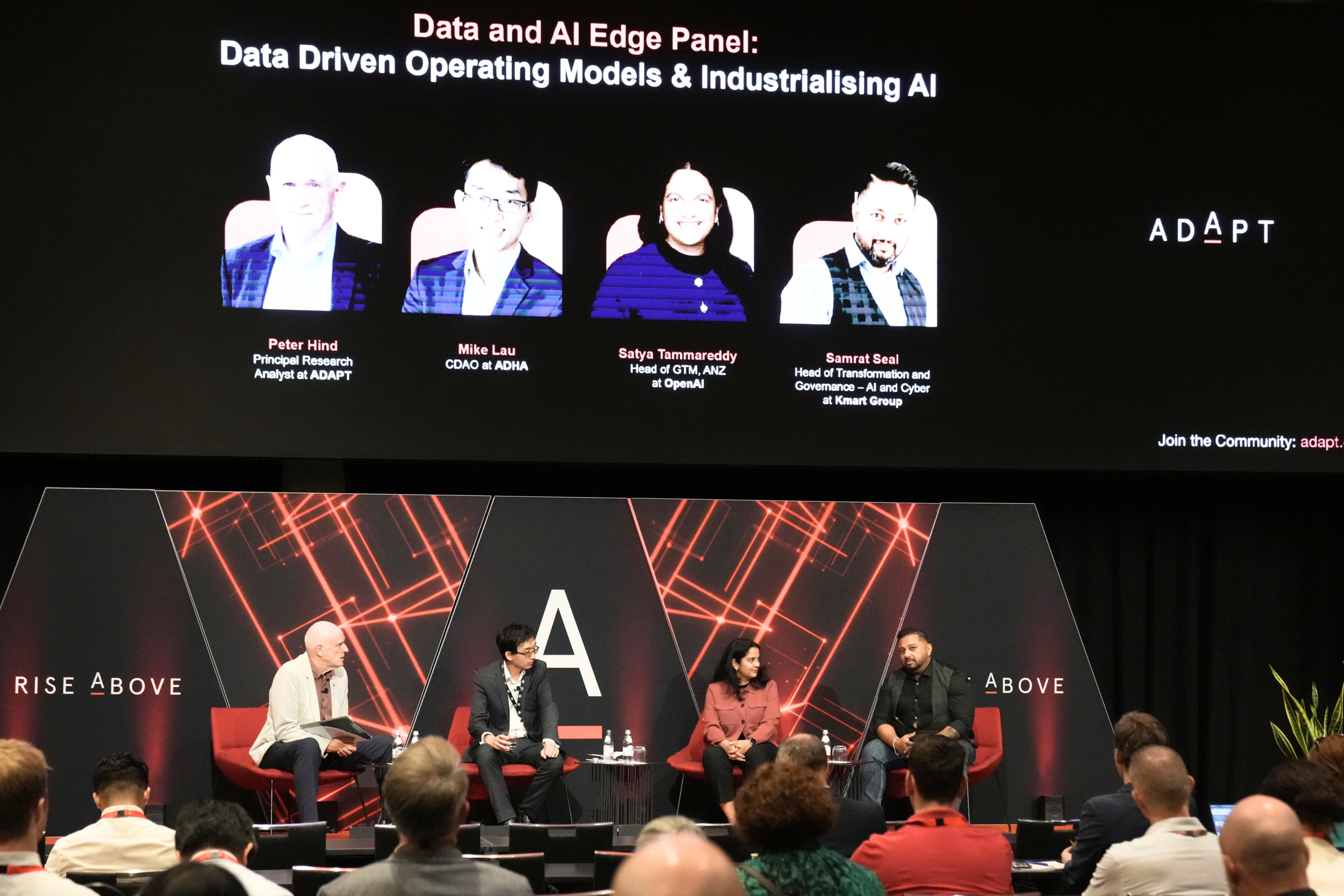


 Published Apr 8, 2026 in
Expert Presentations
Data & AI Strategy
Contributors
Satya Tammarredy
Mike Lau
Samrat Seal
Peter Hind
Published Apr 8, 2026 in
Expert Presentations
Data & AI Strategy
Contributors
Satya Tammarredy
Mike Lau
Samrat Seal
Peter Hind
Enterprise AI breaks down when pilots, governance, and workforce capability are treated as separate problems.
The real challenge is building an operating model that can bring them together and turn scattered progress into repeatable execution.
At the Data & AI Edge 5th Data & AI Edge, Mike Lau, Chief Data and Analytics Officer at the Australian Digital Health Agency, Samrat Seal, Head of Transformation and Governance, AI and Cyber at Kmart Group, and Satya Tammareddy, Head of GTM, ANZ at OpenAI, came together to examine what that shift demands from governance, capability, and organisational design.
Key takeaways:
- AI value comes from operating‑model change, not tools alone. People, process and governance must evolve together.
- Foundations enable scale. Strong data governance and shared platforms prevent fragmentation and unlock industrialisation.
- ROI is multidimensional. Adoption, impact and trust are as critical as financial returns when measuring AI success.
Data‑driven operating models are about people, process and feedback loops
The panellists agreed that a data‑driven operating model is not about autonomous decision‑making alone, but about how organisations consistently generate value through feedback loops connecting data, technology, people and processes.
As Mike emphasises, AI enables far more meaningful use of data, but technology alone never delivers value without human judgement to interpret context, manage bias and apply insights responsibly.
This view was echoed by Samrat, who highlighted the need for strong foundations in data governance before AI can scale, and by Satya, who reinforced that AI literacy and practical capability across the workforce are essential to turning advanced tools into real‑world outcomes, particularly where personalisation and societal impact are involved.
Industrialising AI requires foundations, not fragmented innovation
Retail and public sector experiences highlight the risks of fragmented, project‑based AI efforts: some use cases succeed, but scalability, portability and trust quickly break down.
Industrialising AI means getting the basics right first (data quality, lineage, ownership and governance), before scaling.
Frameworks that align AI investment to core business processes, supported by unified platforms and shared standards, allow organisations to move from months‑long experiments to repeatable capability delivered in weeks, not quarters.
Redefining ROI: adoption, impact and trust
The panel challenges narrow financial definitions of ROI.
Value from AI shows up through adoption (workforce capability and mindset shift), impact (productivity, speed to market, new capabilities), and trust (security, explainability, bias and reliability).
From an executive perspective, ROI is strongest when AI aligns to organisational mission, improving outcomes that matter to customers and citizens while enabling work that was previously impossible.
AI literacy, leadership endorsement and portfolio‑level thinking are what turn experimentation into sustained value.
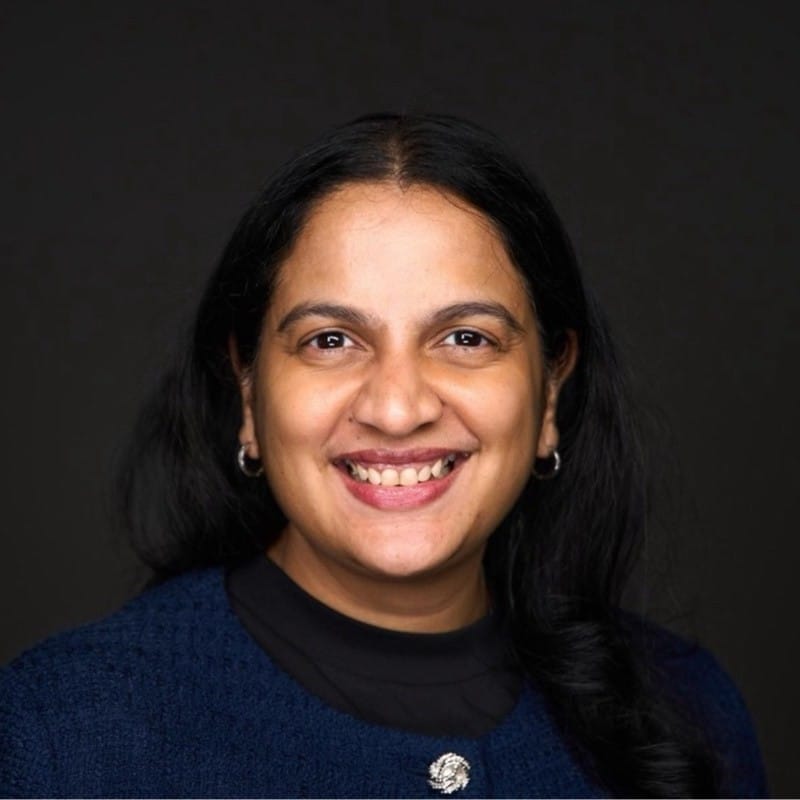 Satya Tammarredy
Head of GTM, ANZ at OpenAI
Satya Tammarredy
Head of GTM, ANZ at OpenAI
Currently at OpenAI, based in Sydney, leading go to market for Australia & New Zealand. Have experience scaling teams and GTM in high growth technology companies across APAC, having lived in Sydney, Singapore and Bangalore. I was the first hire for Dropbox in APAC and fifth employee for Stripe in Singapore. Prior to this, I was an investor at Morgan Stanley and an equity analyst at UBS, and have founded a travel tech startup.
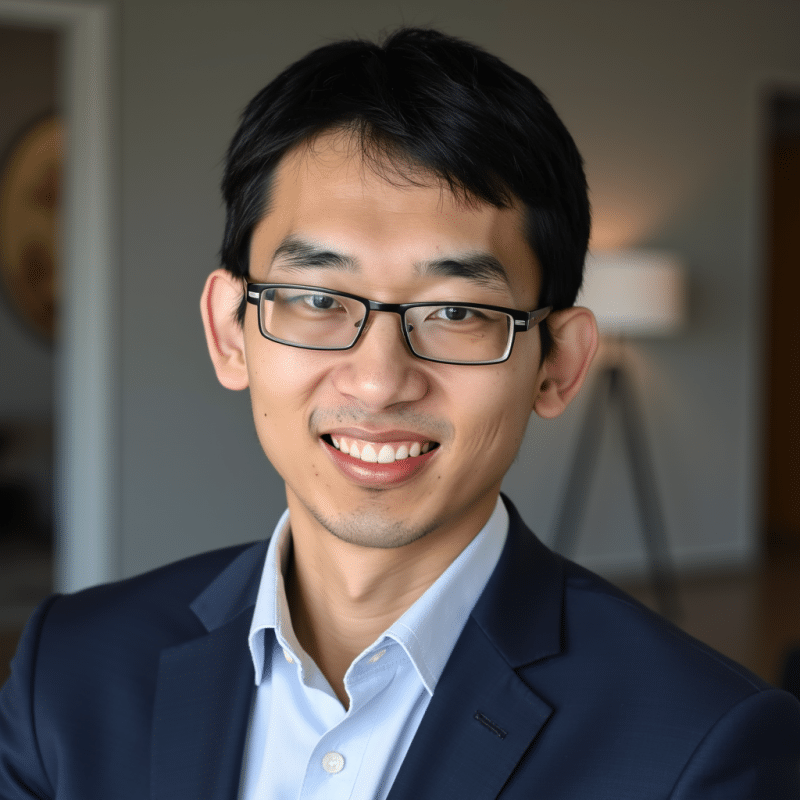 Mike Lau
CDAO at ADHA
Mike Lau
CDAO at ADHA
Mike is the Chief Data & Analytics Officer at the Australian Digital Health Agency who is driving the agency’s data strategy, analytics infrastructure and research program to ensure everyone’s data is trusted, secure and used safely to improve patient accessibility, outcomes and experience.
Digital health has become a vital part of a modern, accessible healthcare system designed to meet the needs of all Australians. While Mike has been fortunate through his career to have worked on initiatives generating opportunities for people to realise their potential across various sectors, Mike recognises that without good health, people are unable to take on these opportunities.
Previously Mike was a senior executive with a portfolio delivering various research, digital and data initiatives for the NSW Department of Education’s Centre for Education Statistics and Evaluation. Having seen the impact education and engagement have on both individuals and businesses alike, Mike brings a passion for helping learners, young and not so young, transition to a world through lifelong learning which is getting more and more complex with issues such as Industry 4.0 and the future of work.
Prior to joining the public sector, Mike worked for 10 years in the Australian Big 4 Banks in senior executive roles leading business lines undergoing major customer experience transformations in product innovation, omnichannel service delivery, organisational design, agile transformation, digitisation and data science strategy. His roles have encompassed leading end-to-end game changers, from the strategy, manufacture and service, of market-fit solutions that represent the voice of the customer.
A keen advocate in maximising the potential, well-being and activating leadership from every individual, Mike is also a SAFe Practice Consultant, Prosci Change Professional and IECL Accredited Coach.
Less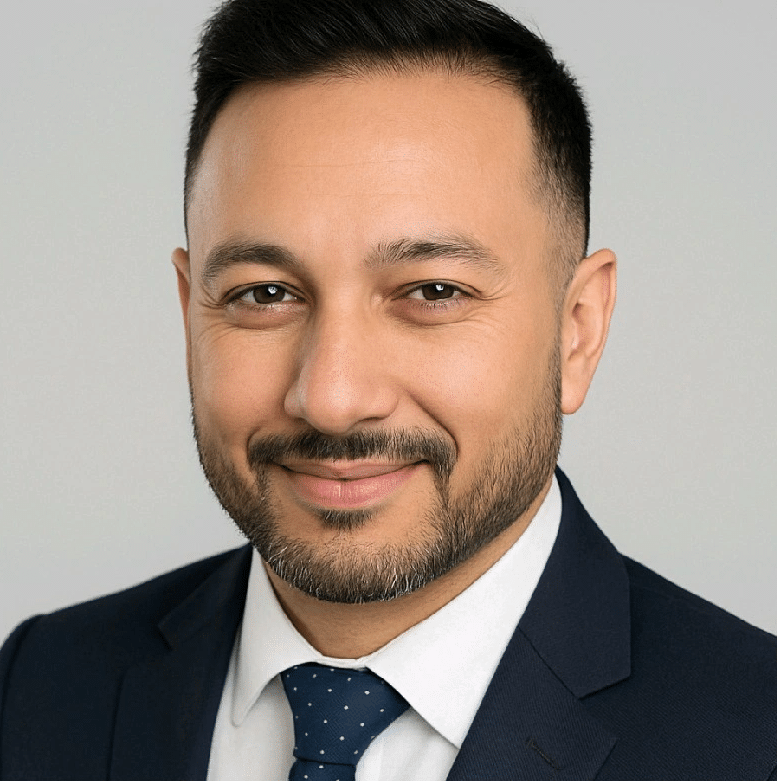 Samrat Seal
Head of Transformation and Governance at Kmart Group
Samrat Seal
Head of Transformation and Governance at Kmart Group
A technology strategy thought leader with a legacy of shaping and delivering high-stakes digital transformations, Samrat is known for leading from the front—where innovation, security, and business value converge. With a sharp strategic lens and deep domain expertise, he has successfully built and managed complex portfolios across cross-section of business, while delivering enterprise-wide transformation initiatives, with end-to-end P&L ownership and NorthStar commercial acumen.
Samrat brings an unique combination of strategic clarity, technical depth, and business-first mindset to every engagement—driving change at scale, mitigating risk, and unlocking long-term value for stakeholders. He is adept at navigating ambiguity and aligning technology investments with business outcomes, while ensuring agility, regulatory compliance, and secure-by-design principles remain at the core of delivery.
A proven people leader, Samrat has built and led high-performing, cross-functional teams across geographies—fostering collaboration, ownership, and continuous innovation. His leadership approach empowers talent, nurtures future leaders, and builds a culture of excellence, accountability, and resilience.
With a strong foundation across cybersecurity, AI, cloud computing, API ecosystems, and over-arching digital transformation, Samrat is committed to advancing enterprise capabilities through secure, scalable, and future-ready platforms. He is passionate about shaping the next frontier of technology, translating vision into execution, and delivering measurable business impact in an ever-evolving digital landscape.
Less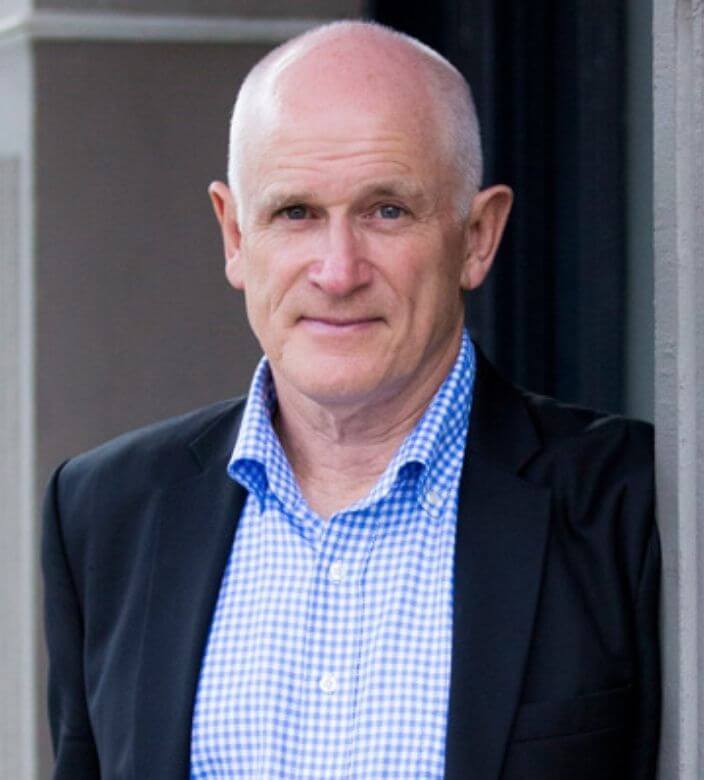 Peter Hind
Principal Research Analyst at ADAPT
Peter Hind
Principal Research Analyst at ADAPT
Peter Hind has spent the last 25 years as an analyst and commentator on the ICT industry.
His primary areas of interest are the potential of technology to transform the way organisations operate, the change management obstacles executives encounter in realising this potential, as well as the tactics and techniques leaders have deployed to overcome these difficulties.
Peter now takes on multiple roles within ADAPT including the moderation of private events and roundtables, interviewing business executives about the strategies they are pursuing and assisting with the structuring of delegate surveys.
He also interrogates and analyses ADAPT’s treasure trove of end-user and C-suite data.
Less Join the ADAPT
 Insider Community
Get the latest A/NZ market research and insights on the core trends impacting leaders.
Join the ADAPT Insider Community
Get the latest A/NZ market research and insights on the core trends impacting leaders.