














How will AI and quantum computing work together?
In this interview, Claudine Ogilvie, former CIO at Jetstar and CEO HivePix & ADAPT Advisor, explores the intersection of AI and quantum computing.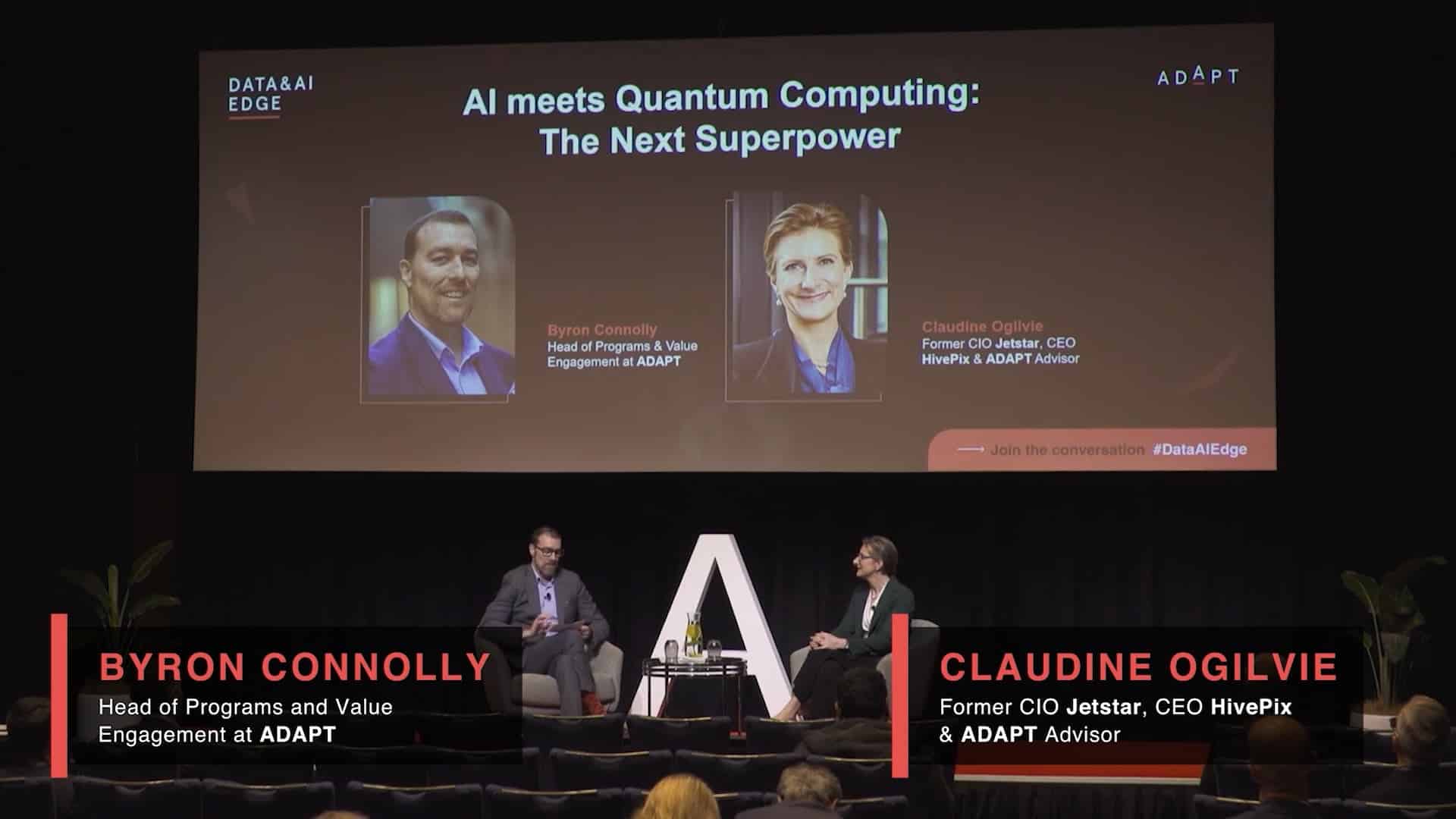


 Published Aug 15, 2024 in
Expert Presentations
Data & AI Strategy
Contributors
Claudine Ogilvie
Byron Connolly
Published Aug 15, 2024 in
Expert Presentations
Data & AI Strategy
Contributors
Claudine Ogilvie
Byron Connolly
In April, US-based PsiQuantum announced it would build the world’s first utility-scale fault tolerant quantum computer in Brisbane thanks to a $940 million investment from the Australian and Queensland governments.
Former US Department of Defense official, Michèle Flournoy, who also serves on PsiQuantum’s advisory board, told the Australian Financial Review last week that the combined power of quantum and AI technologies will be the equivalent of this century’s nuclear bomb.
It’s certainly a critical time in the development of quantum machines, particularly in this AI era.
So, what is a quantum computer?
Put simply, a quantum computer is based on the principles of quantum mechanics. Unlike traditional computers, which use bits that are either 0 or 1, these machines use qubits, which can be in a state of 0 or 1 simultaneously. This is called ‘superposition’ and it enables quantum computers to process vast amounts of information concurrently to solve problems much faster than computers being used today.
These qubits can be ‘entangled’ which means that the state of one qubit is related to the state of another, regardless of the distance between both qubits. This allows quantum machines to complete complex calculations more efficiently.
Claudine Ogilvie, CEO at data company, HivePix, sat down with ADAPT at Data Edge in Sydney to explain the current quantum landscape. Ogilvie says these machines will provide the computational boost that is required for AI, which is being held back by the limitations of classical computing.
What’s holding back commercial availability?
Ogilive, who is also a former CIO, says that as it stands at the moment, there are key challenges that are holding back the development of quantum machines.
They are ‘noisy’ and produce a lot of errors because qubits can be easily disturbed. Decoherence – the process by which a quantum machine’s information is altered by the system’s interaction with its environment – is also an issue.
Right now, quantum machines are quite small, but they are being tested for what could be argued as potentially inconsequential edge use cases in areas like financial services to help optimise financial portfolios and deliver the best returns.
One of the biggest hurdles standing in the way of the widespread commercialisation of quantum machines is keeping them cool as they process trillions of operations per second, she says.
Ogilvie believes that it may be five years before these quantum scaling challenges are sorted.
“The infrastructure that they [quantum computers] need is extremely expensive and there’s an enormous amount of cryogenic infrastructure required to do it. You’re going to need cryogenic infrastructure the size of two skyscrapers and the hardware needs to be perfect at the molecular level. So, it’s not very practical or pragmatic,” says Ogilvie.
Modelling changes to the Earth’s climate and discovering new drugs are clearly two key areas where quantum computers are going to provide the best value – areas that require the crunching of massive amounts of data.
“You can imagine the millions, if not billions of inputs that are required to start accurately modelling data [for climate modelling],” she says.
Currently, vaccines and medications can take years to develop and commercialise, but quantum machines will help speed up that process significantly, she adds.
Quantum in the AI era
Ogilvie says that in this quantum and AI era, organisations need to prepare for two scenarios.
The first is that quantum computers, coupled with AI capabilities, can be very powerful and as these machines get larger, they will crunch data that feeds machine learning algorithms in ways that we have never seen before.
“Large language models (LLMs) feeding AI today are getting bigger and bigger and more and more unwieldly. Quantum computing is going to help us wield that data significantly better and in a more controlled and precise way.”
She says that AI will help manage the energy required to feed LLMs and quantum computers are going to start crunching larger volumes of data to solve more complex problems. Both will feed into each other in an environment where classical and quantum machines will co-exist.
“I think you’re going to see that breakthrough moment within, give or take, the next five years.”
The second scenario or burning issue is the impact of quantum advancements on cyber security. Quantum machines in the future will undoubtedly be able to break through existing cyber security protocols and hackers are certainly ready for the next quantum wave to hit.
“This could be an area where chief data officers may need to collaborate with their CISOs because once a quantum computer gets big enough, it will be able to crack Shor’s algorithm and that underpins all our cyber security protocols,” says Ogilvie.
“It [the algorithm] protects our data.”
As a result, organisations need to be aware of how their data is logged and classified in ways that they know where it is stored and protected.
“That’s something that you can start now,” she says.
 Claudine Ogilvie
Former CIO at Jetstar & APAC Tech Executive at Compass Group
Claudine Ogilvie
Former CIO at Jetstar & APAC Tech Executive at Compass Group
Claudine is an accomplished entrepreneur, CEO, and board director with 20 years of leadership across strategy, innovation, and emerging technologies. She brings deep expertise in data, AI, quantum computing, and cyber governance, with a track record spanning aviation, finance, insurance, and consulting. Known for blending commercial acumen with visionary thinking, Claudine helps organisations navigate complex technology landscapes with confidence.
- Managing Director at O&O Consulting and CEO of HivePix.
- Board Director at Cuscal, Scyne Advisory, and formerly Youi Insurance.
- Former CIO at Jetstar Group and Lead technology, data businesses and innovation
at Compass Group APAC. - Past leader of Consumer and Industrial Markets at KPMG.
- Recognised in Australia’s Top CIO50 (2016).
- Holds qualifications from MIT (Quantum Computing), GAICD, UTS, and ESC Reims.
- Active adviser and coach to leaders in innovation, diversity, and ESG.
 Byron Connolly
Head of Programs & Value Engagement at ADAPT
Byron Connolly
Head of Programs & Value Engagement at ADAPT
Byron is a highly experienced technology and business journalist, editor, corporate writer, and event producer.
Prior to joining ADAPT, he was the editor-in-chief at CIO Australia and associate editor at CSO Australia. He also created and led the well-known CIO50 awards program in Australia and The CIO Show podcast.
Byron creates valuable insights for our community of senior technology and business professionals that help them reach their organisational and professional goals. He has a passion for uncovering stories about the careers and personal philosophies of Australia’s top technology and digital executives.
When he is not working, Byron enjoys hot yoga, swimming, running and spending time with his family. He completed the North Face 100km ultra marathon in the NSW Blue Mountains in 2012 and 2013.
Less Join the ADAPT
 Insider Community
Get the latest A/NZ market research and insights on the core trends impacting leaders.
Join the ADAPT Insider Community
Get the latest A/NZ market research and insights on the core trends impacting leaders.